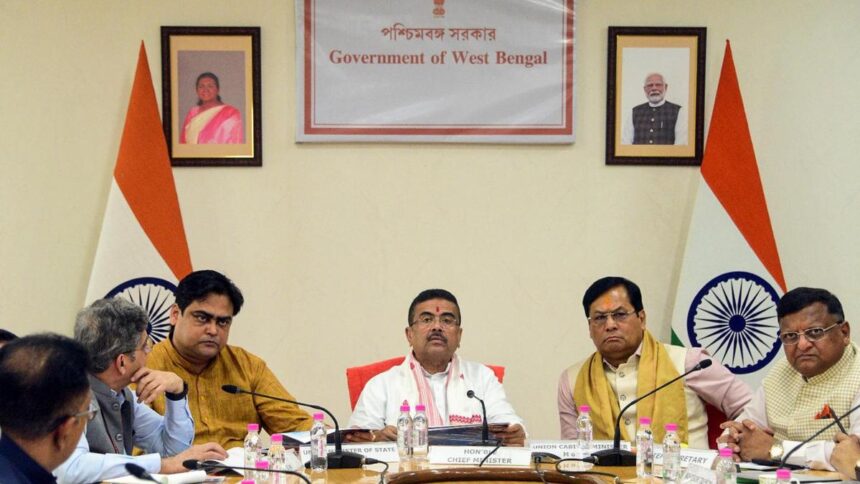






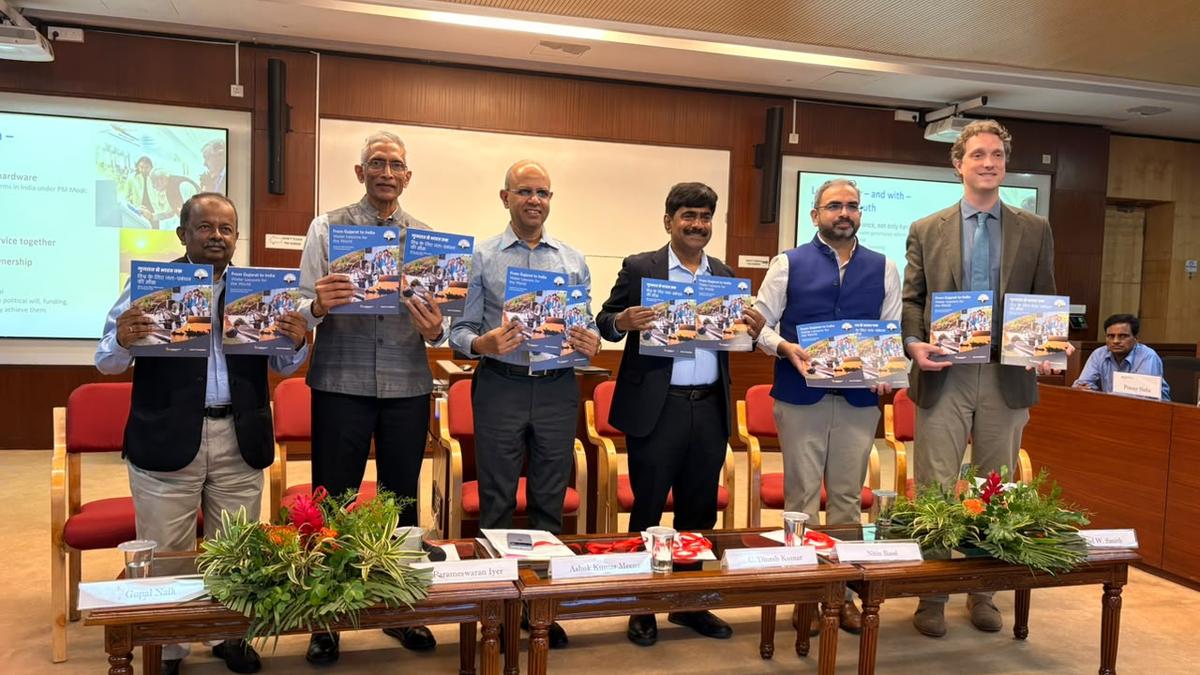


(L-R) Gopal Naik, Chairperson Jal Jeevan Mission, IIM Bengaluru; Parameswaran Iyer, Former Secretary and Ashok K Meena, Secretary, Department of Drinking Water and Sanitation, Ministry of Jal Shakti; U. Dinesh Kumar, Director-in-charge, IIM Bengaluru; Nitin Bassi, Fellow and Lead, Sustainable Water Programme, CEEW; Daniel W Smith, Assistant Professor, George Mason University, at the launch of the case study “From Gujarat to India: Water Lessons for the World.”
| Photo Credit: Special arrangement
Under the Jal Jeevan Mission, the government is using integrated water data, digital twins and Artificial Intelligence to enable localised water budgeting at the village level, said Ashok K. Meena, Secretary, Department of Drinking Water and Sanitation, Ministry of Jal Shakti.
He hoped that this would help improve infrastructure management and predict water supply and sustainability problems before they occur. Mr. Meena was speaking at the launch of From Gujarat to India: Water Lessons for the World, a case study documenting the evolution of water governance in Gujarat and India between 2001 and 2026, at IIM Bangalore.

Integrated platform
“What we have tried is to provide a decision-support system to people who are concerned about source sustainability. The decision-support system brings together data on rainfall, water, aquifers, runoff, and information from various departments. The entire data is mapped on a platform that is visually easy for local implementers to understand,” said Mr. Meena, adding that the platform will be made available to gram panchayats.
According to him, in the next level, this data will be made available for water-balance studies and water budgeting.
“Water budgeting will become a norm for local governance, helping local authorities assess the total amount of water coming into an area, how much is being used, whether the area is in deficit or surplus, and what the best use of the available water would be. Water budgeting will increasingly become possible with data coming together from various departments. So, there will be greater convergence of water-related data at the local government and State levels,” Mr. Meena explained.
Digital twin
The Jal Jeevan Mission also aims to make a digital twin of the water-supply infrastructure that is being created, mapping the entire chain from the source to households. This, Mr. Meena noted, would provide clear visibility for the operation and maintenance of water infrastructure, both at the local micro-utility level and the macro-utility level.

“Earlier, when we implemented these projects as engineering solutions, we divided them into contractual packages where one contractor would do the pipeline work, another would construct tanks, another would develop the production well and so on. Now, we are combining everything from the source to the household into a single water-supply scheme across the country. This is being developed as Sujalam DPI, a digital public infrastructure for the entire country,” Mr. Meena said.
According to him, the data will be owned by the State governments but will be visible at the national level. He hoped that the use of AI and other new technologies will help the officials with predictive maintenance.
Improved coverage
The case study, co-authored by Nitin Bassi, Fellow and Lead, Sustainable Water Programme, CEEW, and Daniel W. Smith, Assistant Professor, George Mason University and launched at the event, showed that Union water-sector allocations increased from 0.8% of the total Union budget in 2001-02 to 2.2% in 2025-26. Across rural India, 464 million more people use safely managed drinking water today than in 2000, while the rural household tap coverage has increased from 17% in 2019 to over 80% in 2026, it showed.
Published – October 07, 2026 06:22 pm IST