



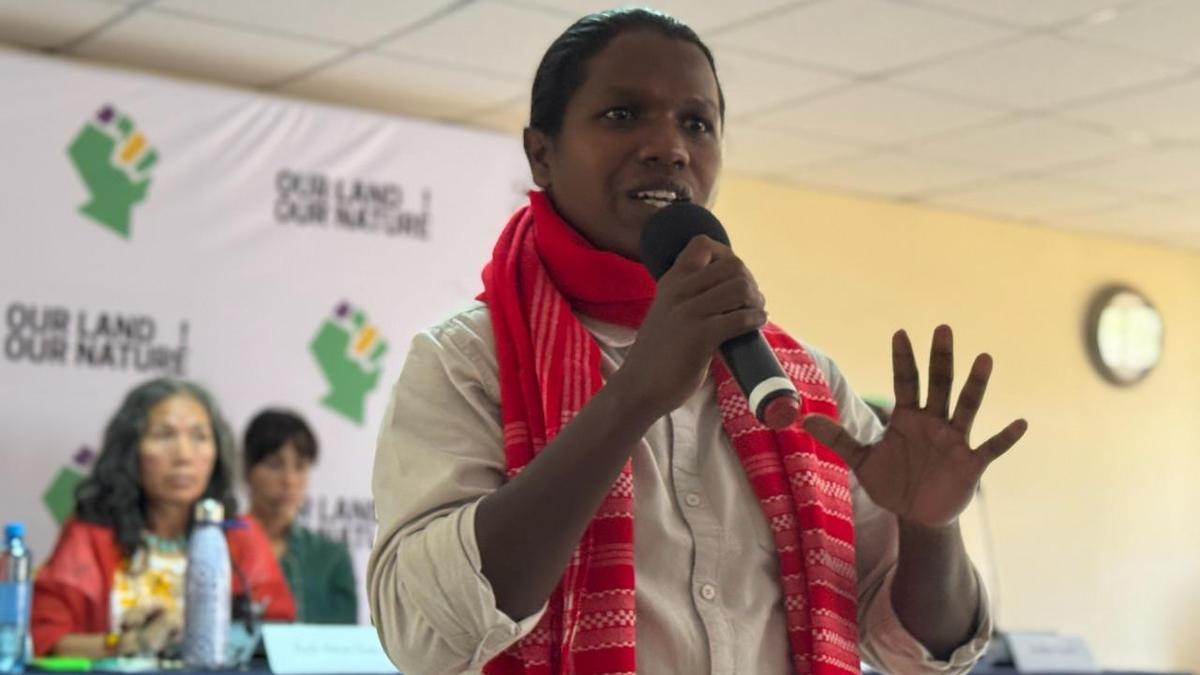

“In the name of conservation, the Adivasi community is being subjected to violence and false cases, and our homes are being destroyed. Big NGOs and companies, in the name of carbon credits and conservation, want to occupy our land and promote tourism and other commercial activities. This is the story of many communities like ours across the world,” said Shivu J.A.
Mr. Shivu, 31, from the Jenu Kuruba community in the Nagarahole forest between Kodagu and Mysuru districts in Karnataka, was among the indigenous representatives from 16 countries across Africa, Asia and the Americas who participated in “Our Land, Our Nature” in Nairobi, Kenya.
Other countries
The representatives included members of the Qom and Mbya Guarani communities from Argentina, Uchupiamona from Bolivia, Kua from Botswana, Bunong from Cambodia, Baka from Cameroon, Pasto from Colombia, Kichwa from Ecuador, Maasai from Tanzania, and Diné and Dakota from the United States.

The gathering was organised by Conservation Solutions Afrika and Survival International. According to the organisers, at least 3 million indigenous people are paying the price for conservation “with their land and with their lives”.
“At the same time, governments and conservation organisations are expanding protected areas, while carbon markets are creating new pressures on indigenous territories,” they added.
Nairobi declaration
On September 25, a ‘Nairobi Declaration’ was issued by the newly formed Indigenous Lands Alliance. It said, “True conservation is part of our traditional systems. We oppose conservation characterised by market systems, land grabbing, financialisation of nature, greenwashing by major polluters, and false nature-based solutions. We demand equality, consent, transparency, respect and dignity. We reject using our sacred relatives and spirits, such as the jaguar, the lion, the elephant, the whale and the buffalo, and their ecosystems as carbon sponges and biodiversity credits and offsets for corporate pollution.”
“We demand that our ancestral lands, including those grabbed for parks and wildlife sanctuaries, be returned. Conservation must be led by Indigenous Peoples, because we know better. We are against the commodification of our relationships with land, air, water and every living thing, against carbon trading and offsets, REDD+, biodiversity credits and offsets, and geoengineering. We are against colonial and fortress conservation. We are against extraction dressed up as protection,” it added.
Through crowd funding
Mr. Shivu shared details of their journey to the global gathering over the phone from Nairobi. “The organisers have known us for decades because of our fight against several such attempts to evict us from our ancestral lands, whether by declaring them a tiger reserve or a protected area. Due to the false cases foisted on us, it is even difficult to get a passport. Through crowdfunding and the organisers’ support, we managed to reach Kenya on September 21 because of the significance of the event,” he said.
He spoke about how their community had endured “historical injustice” since British rule, which, he said, had continued long after Independence. “All these attempts at ‘conservation’ are aimed at commercialising forests through NGOs and big companies, while giving no say to forest dwellers, who have a 15,000-year history here,” he said.
Pointing to what he described as the irony of similar approaches towards indigenous people across India, he said: “Even in the Andaman and Nicobar Islands, tribes want to be left alone, but they are not being allowed that. Are all the problems caused by climate change because of Adivasis, forests and animals? And will they be solved by declaring eco-sensitive areas and tiger reserves?” he asked.
Thimma J.K., 56, a leader of the community, said the event provided an opportunity to interact with similar communities from across the world and realise that they all faced comparable challenges. “The lack of consultation is common everywhere. NGOs’ interference has to be stopped. For us, the forests are our thayi naadu (motherland) and the animals our manetana devaru (family deities). We are conserving the forests, so why is there a third person involved? This is not the government’s land either,” he said.
Published – September 25, 2026 08:07 pm IST