

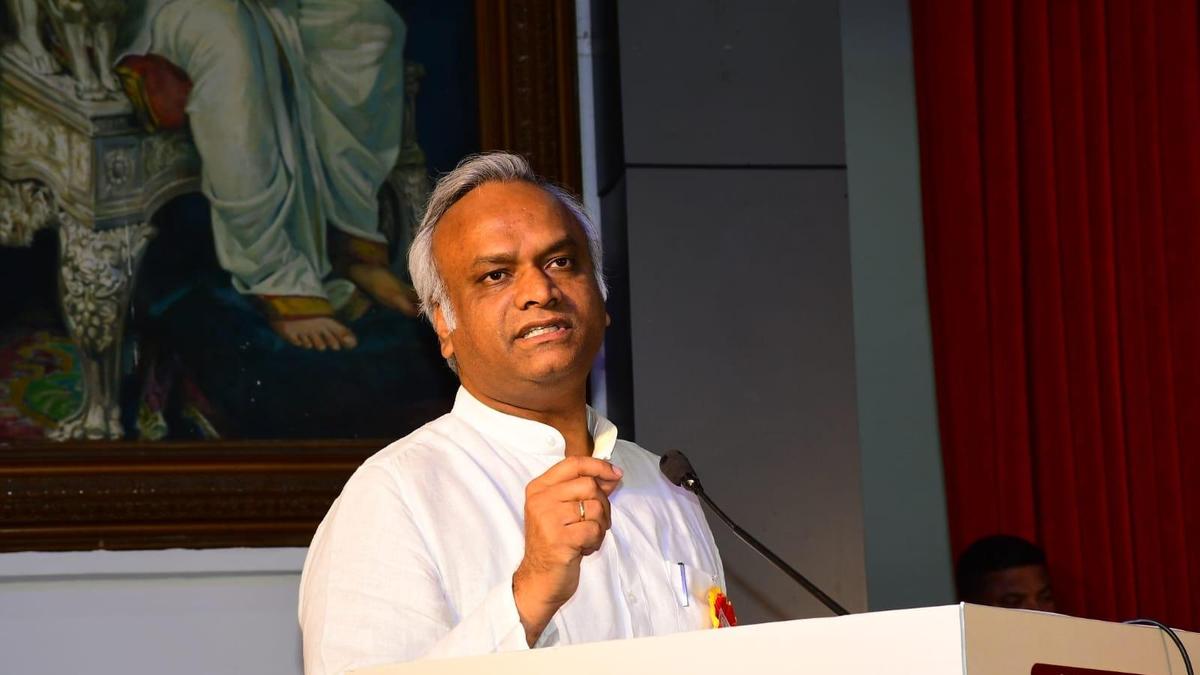

The Karnataka government plans to establish a dedicated single-window interface to coordinate international partnerships and ensure that engagements continue after visiting delegations leave Bengaluru, stated Priyank Kharge, Minister for IT/BT and Home.
“I do not want us to measure success by the number of delegations that have come, by the number of MoUs we have signed, or by the number of letters of intent,” he said.
The key change would be in how the government measures success, he said, while addressing a large audience of global collaboration partners and international trade mission representatives at a Global Innovation Alliance (GIA) meet held here on Tuesday, ahead of Karnataka’s annual tech exposition, the Bengaluru Tech Summit.
Defined partnership cycle
Mr. Kharge said the next phase of GIA would include adoption of a defined partnership lifecycle, beginning with identifying the right partners and aligning priorities, followed by formalisation, execution, measurement and the scaling of successful programmes.
“Instead of counting the number of MoUs and delegations, the government would track how many Karnataka start-ups entered new markets, how many technologies were jointly developed, how many collaborative research programmes were launched, how many pilots were converted into businesses, and the investments into jobs,” he said.
He said a global collaboration approach was already being applied in areas such as urban mobility, where the State was seeking international expertise to address Bengaluru’s mobility challenges through infrastructure, mass rapid transit, metro systems, and last-mile connectivity. Companies from the Netherlands and Singapore, along with startups from Karnataka’s ecosystem, are among those working with the State on such initiatives.
The Minister also observed that the nature of economic competition and collaboration has changed. Technologies such as artificial intelligence, quantum computing, semiconductors, biotechnology, climate technology and space technology were increasingly being developed through networks spanning universities, startups, researchers, investors, corporations and governments, he pointed out.
“The question for States like Karnataka is no longer simply about how we attract investments. The bigger question is how we become part of global networks where the next generation of technology companies and jobs are being created,” he said.
Mr. Kharge said Karnataka was also seeking to reposition itself from being a destination for technology investments to becoming a global innovation partner, with the State government shifting the focus of its international engagement from signing memoranda of understanding (MoUs) to measurable outcomes such as joint technology development, startup expansion, research partnerships and job creation.
Focus on ‘deep-tech decade’
According to the Minister, the State has committed over ₹600 crore towards next-generation innovation. It has over 80,000 startups and over 1,100 global capability centres, while accounting for more than 40% of India’s IT and services exports and a similar share of the country’s engineering research and development talent.
Nearly half of India’s entire AI talent is concentrated in Karnataka, and Bengaluru’s technology startups attracted $4.4 billion in funding during the first nine months of 2026, accounting for about 43% of India’s technology investment during the period. Around 58% of India’s AI startup funding was also flowing into the Bengaluru-Karnataka ecosystem, he added.
The State was simultaneously building capabilities in emerging sectors, he further said, adding that its quantum mission envisages creating a $20-billion quantum economy by 2035, while plans include a dedicated quantum city and a quantum venture capital fund. In space technology, the State was targeting a 50% share of India’s space market and 5% of the global market, Mr. Kharge said.
Traffic, techies
Mr. Kharge conceded that the Outer Ring Road (ORR) area was under traffic snarls because of the high concentration of tech workers there. “ORR is a technology corridor, spread across roughly 8.5-9 km, employs around 800,000 knowledge workers and accounts for up to 18% of India’s over $300 billion IT exports. Therefore, there is a lot of traffic there,’’ the Minister said.
Published – October 06, 2026 11:10 pm IST