





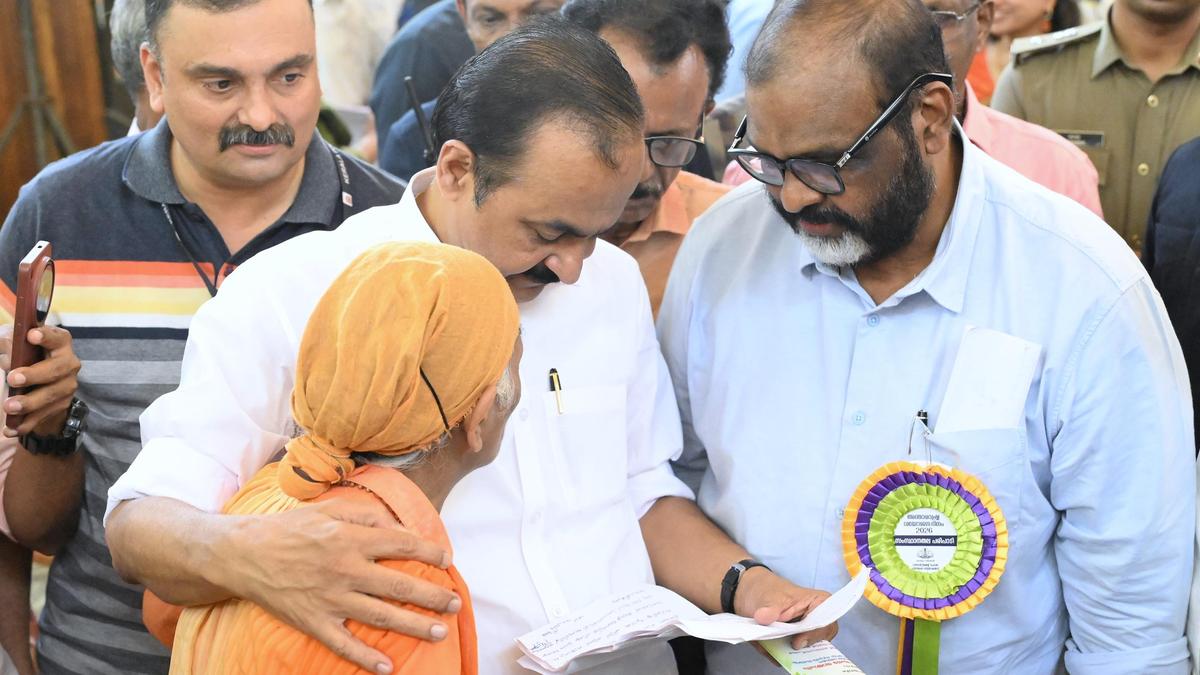


Keralam Chief Minister V.D. Satheesan and Minister for Transport C.P. John addressing the grievances of an elderly woman during an event marking International Day of Older Persons in Thiruvananthapuram on Thursday.
| Photo Credit: NIRMAL HARINDRAN
Keralam has unveiled a ‘Comprehensive Elderly Care Action Plan’ that envisages 12 levels of intervention by stakeholders, along with timelines, to address the needs of the State’s ageing population and strengthen geriatric care infrastructure.
Minister for Health K. Muraleedharan presented the action plan, which provides a framework for healthy ageing, functional ability, and social and mental well-being, to Chief Minister V.D. Satheesan on the occasion of International Day of Older Persons on Thursday.
The action plan identifies individuals, families, community volunteers, and neighbourhoods as main stakeholders, supported by the primary health system — ASHAs, family health centers, Janakeeya Arogya Kendram, local self-governments, and small private providers. The primary care system should be guided by the secondary system at community health centres and major government and non-government hospitals.
Ensuring adequate personalised care and resources, including nutrition, medicines and social-security measures, encouraging physical and cognitive activities, developing awareness of legal rights of the elderly, and utilising basic digital technology for daily living come under this category of interventions.
The neighbourhood/ward-level interventions include encouraging social engagement programmes for the elderly; building capacity of elderly persons for self-assessment and awareness of health risks/illnesses; developing awareness of financial fraud, safe banking practices, and making of wills; identifying volunteers willing to participate in elderly-care activities; and forming neighbourhood groups for physical and cognitive activity promotion.
The ward-level teams, in coordination with ASHAs, form the third level of intervention. They are tasked with annual health screening using SHAILI app, with vulnerable elderly living alone specifically flagged, and monthly home visit for all bed-bound elderly.
The other levels of intervention include Janakeeya Arogya Kendram teams that are coordinated by mid-level service providers; primary health care facilities; local self-governments department level; secondary care team/block level; major hospitals, including private hospitals; non-governmental organisation/community-based organisation; care homes and hospices; district-levels; and State-level.
The action plan is built on a four-category framework: bed-bound elderly, home-bound elderly, elderly with chronic illness, and active elderly, each with distinct care pathways tailored to their specific needs. By adopting this categorisation, the plan establishes a continuum of care and ensures that no elderly person is left behind.
Published – October 01, 2026 09:31 pm IST