



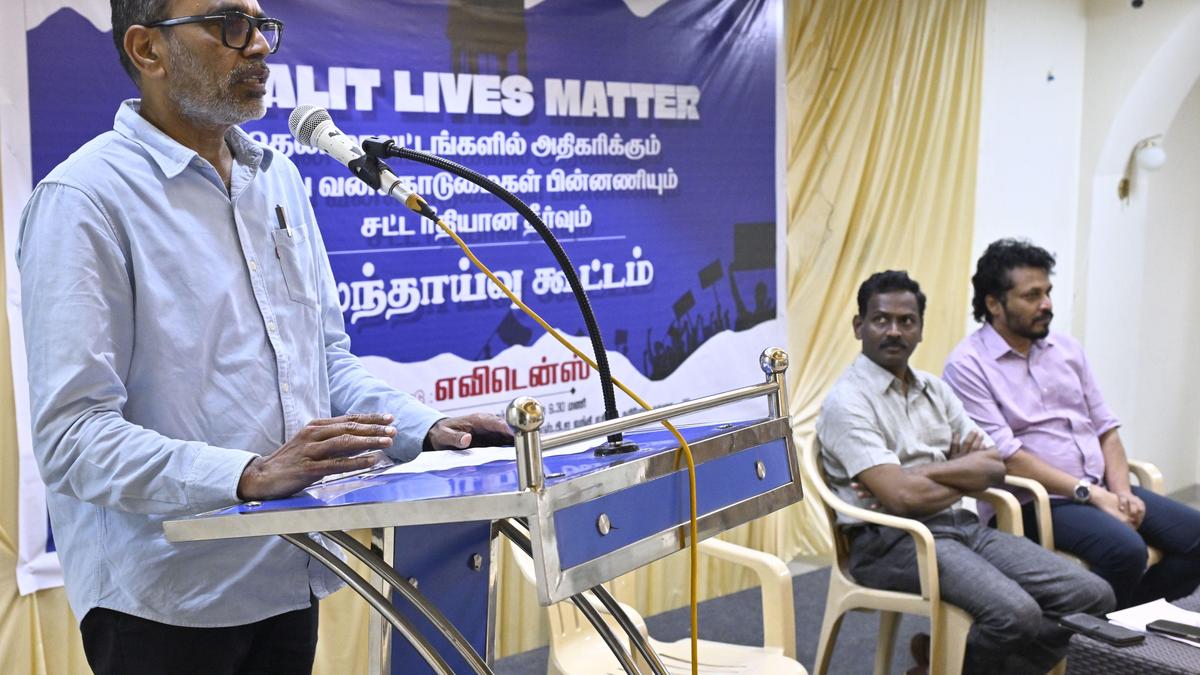

“Legal practitioners must develop a deep expertise in the Scheduled Caste and Scheduled Tribe (Prevention of Atrocities) Act, 1989, to represent victims with greater skill and efficiency,” said senior advocate Lajapathi Roy
Speaking at a conference titled ‘Increasing Caste Atrocities against SCs in Southern Tamil Nadu’—organised by the Madurai-based NGO ‘Evidence’ on Saturday, he urged advocates to master the specific sections and legal nuances of the Act.
He stressed that meticulous attention to detail was essential to secure higher conviction rates and close the technical loopholes that often allow the accused to evade justice.
Reflecting on landmark legal battles that remained etched in public memory, Mr. Roy noted, “From the 1992 Sennagarampatti case, involving the double murder of Ammavasi and Velu, to the Gokulraj murder case in 2015, each trial offers unique legal significance. These cases must be keenly studied and internalised by every advocate working in this field.”
“Section 8 of the SC/ST (Prevention of Atrocities) Act, which allows for the presumption of offenses, is one of the statute’s most critical components,” he stated. He further noted that while this provision was effectively utilised in the Kannagi-Murugesan case, the prosecution failed to apply it in the Gokulraj murder case.
Mr. Roy referred to one of the earliest cases registered under the Act in Madurai district, the 1992 Sennagarampatti double murder case, which occurred five years before the 1997 Melavalavu massacre, wherein six SC men, including a panchayat president, were hacked to death.
Such cases provide a vast repository of legal precedents and hard-earned lessons, highlighting the systemic patterns of caste violence and the critical need for meticulous investigative procedures to ensure that justice is not delayed or denied, he noted.
A. Kathir, executive director of Evidence, stated that according to National Crime Records Bureau (NCRB) data from 2021 to 2023, Madurai recorded the highest number of SC/ST atrocity cases with 144 filings. This was followed by Virudhunagar (137), Thanjavur (130), and Pudukkottai (93).
Updating these figures with recent trends, he noted that between May and August 2025, Theni surged to the top with 54 cases, while Madurai followed with 37, and Pudukkottai and Thanjavur shared the third spot with 35 cases each.
Mr. Kathir observed that while the rise in reported cases is a positive indicator of increased legal awareness among the victims, the abysmally low conviction rate remains deeply concerning.
Based on extensive field studies and interactions with survivors, he alleged that police stations—particularly in the Southern districts—remain under the undue influence of dominant-caste officials. “This institutional bias alone is enough to derail and delay the entire pursuit of justice,” he remarked.
Furthermore, he highlighted a disturbing trend over the last three years – the proliferation of caste associations on social media.
He warned that these platforms are being used to radicalise minors from dominant-caste Hindu communities, brainwashing them to uphold and enforce agendas of caste supremacy.
J. Balasubramaniam, writer and Assistant Professor at Madurai Kamaraj University, noted that unlike in Northern districts of Tamil Nadu, the Southern districts do not exhibit a landscape of total dominance or the complete subjugation of Scheduled Castes (SCs).
He attributed this regional distinction to the presence of economically resilient and well-educated SC communities within the Southern districts.
“While SC communities held significant political influence during the 1960s, the following decades saw a shift in strategy by dominant-caste groups,” he observed.
“Realising they could not easily surpass SCs in terms of educational attainment or land ownership, these groups sought refuge in political patronage and institutional clout to re-establish and strengthen their grip on the region,” he added.
“Even during the Kodiyankulam violence against SCs, the attacks by dominant-caste groups were specifically targeted. They did not just assault individuals but systematically destroyed high-value assets such as televisions, refrigerators, and VCD players—luxury items that, at the time, were often not even present in the homes of the attackers,” he stated.
This destruction, he noted, was a reaction to the visible economic upward mobility of the SC community.
Published – January 24, 2026 08:53 pm IST