





In an unprecedented move last Wednesday (September 23, 2026), Brazilian President Lula da Silva’s campaign asked the country’s Federal Supreme Court (STF) to “investigate the possible U.S. interference in the country’s electoral process”. Lula’s Workers’ Party (PT) also filed a case with the Superior Election Tribunal (TSE) against the far-right presidential candidate Flávio Bolsonaro, seeking a probe into alleged U.S. support for his campaign.
The petitions came the same day as 14 countries belonging to the Shield of the Americas, a group of right-wing Latin American governments assembled by U.S. President Donald Trump, signed a pact designating 24 drug-trafficking groups as “shared threats”. Brazil’s two criminal organisations, First Capital Command (PCC) and Red Command (CV), were among the groups mentioned in the deal. Mr. Lula immediately hit back at the decision. “Brazil does not underestimate the challenge posed by organized crime, but it does not intend to outsource the responsibility of protecting its citizens,” the Brazilian leader said in his speech at the United Nations.

In his UN speech, Mr. Lula minced no words about how the U.S. threat is being perceived in Brazil. “In Latin America and the Caribbean, geographical proximity to the world’s greatest military power is inescapable… But Brazil does not fit in anyone’s backyard,” Mr. Lula declared to loud applause. The Brazilian did not meet Mr. Trump in New York; instead, he engaged with New York Mayor Zohran Mamdani and Senator Bernie Sanders, in what was seen as a political message to Mr. Trump.

New York City Mayor Zohran Mamdani and Brazilian President Luiz Inacio Lula da Silva, speak to reporters after a meeting in New York, U.S., on September 21, 2026.
| Photo Credit:
Reuters
Brazil goes to the polls on October 4 in a tense election. Mr. Lula leads Mr. Flávio by five points in the first-round polls. If they meet again in the second round on October 25, polls show a close race, adding to fears of U.S. interference influencing the result. In recent months, the Trump administration has put enormous pressure on Brazil through tariffs, sanctions and by classifying PCC and CV as terrorist organisations.

Adding to the concerns is a confidential report sent recently by Brazil’s Intelligence Agency (Abin) to the President and TSE. The report raised the risk of U.S. interference to a “critical level”. The Abin assessment, reported widely by the Brazilian media, says the “reaffirmation of U.S. hegemony” in Latin America is a priority for Washington, particularly to counter China’s influence over strategic assets.
It is not just the Lula government, but independent analysts too see the threat of the U.S. throwing its massive weight behind Mr. Flávio. “On the eve of the election in Honduras, Trump went on social media and called on the Honduran people to vote for the right-wing candidate and he won,” said Caio Junqueira, an analyst. Though Mr. Flávio’s campaign has denied the accusations, his repeated meetings with Mr. Trump and interaction between U.S. officials and Brazilian right-wing influencers at the U.S. consulate in São Paulo have raised concerns here.
Another serious charge against Mr. Flávio — made by Renan Santos, a right-wing candidate, and reported to TSE by Mr. Lula’s party — is the alleged funding of his campaign through the U.S.-based RockBridge Network, an organisation created in 2019 by J.D. Vance, now U.S. Vice President,and Chris Buskirk, and funded by tech billionaire Peter Thiel. It was reported last week that a delegation linked to Mr. Thiel was in São Paulo just months before the official beginning of the election campaign. “It is an open secret that Mr. Thiel now lives in Argentina and he is working closely with the (Javier) Milei government. We are certain that he is using his money and tech power to influence the Brazilian election,” says a PT campaign official who does not want to be named as a case has already been filed with TSE. “We suspect the Big Tech, in alliance with Trump, is doing everything they can to support Flávio.”
These suspicions became stronger last week as Meta disabled advertisements for President Lula’s campaign just days before the first round. Mr. Lula’s advertising account was restored after his campaign filed an appeal, but the California-based firm has not yet explained the reason for the temporary block. The incident has reinforced the argument by Mr. Lula’s allies that U.S. companies are working in favour of their opponents.
But it is not just the Brazilian left that is complaining about the U.S. interference. Last week, a group of 31 Democratic members of the U.S. Congress sent a letter to the U.S. Secretary of State, Marco Rubio, criticising the Trump administration over “an apparent effort to interfere with, and potentially undermine” Brazil’s elections. The letter, also signed by Senator Sanders, pointed out the recent U.S. actions which “reflect a broader and deeply troubling pattern of interference by the Trump administration in recent electoral processes across Latin America” – from midterm elections in Argentina and presidential elections in Honduras and Colombia.
While Mr. Flávio has made it clear that, if elected as President, he would openly follow pro-Trump policies in Brazil, especially in the area of natural resources like critical minerals and rare earths. But some even on the right see that attitude as a big problem for Brazil’s sovereignty. “Donald Trump is seeking to take control of the Panama Canal, a free country, and now he wants to interfere in Brazil,” Renan Santos, of the Mission party, said in an interview last week, criticising Mr. Trump for his attempt to influence the result in favour of the far-right candidate.
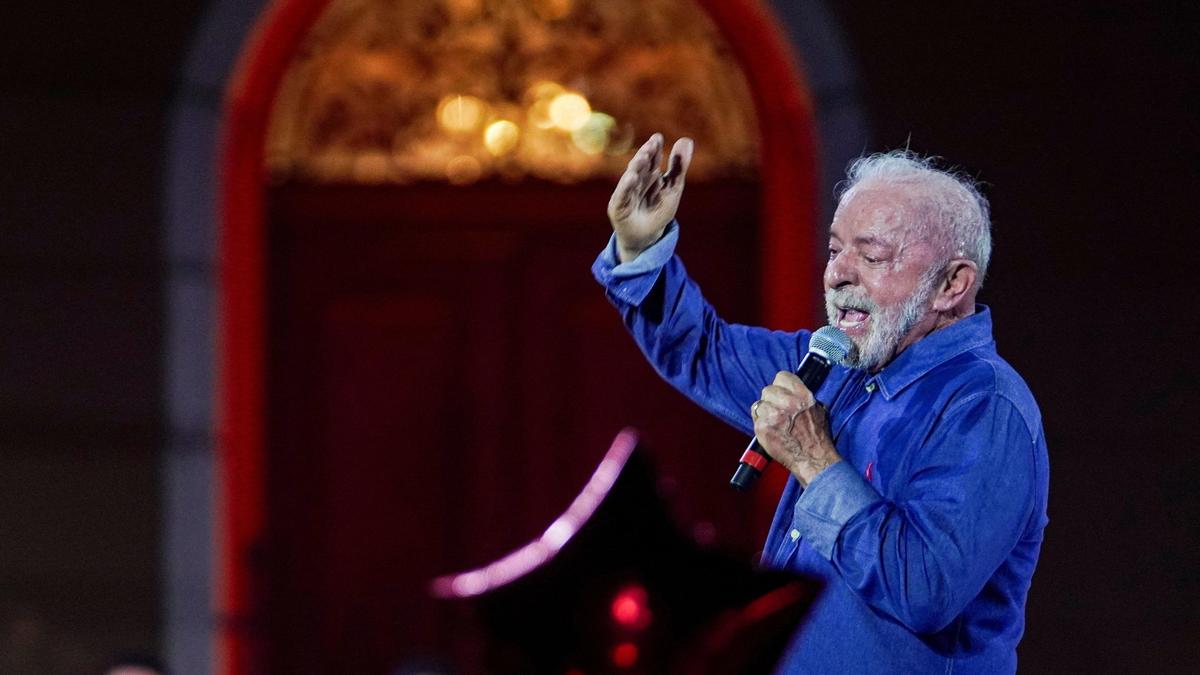
But Mr. Lula is taking no chances as he seeks a fourth term. After warning last week that any U.S. interference in election is “unacceptable”, he rolled out welfare and debt-relief measures and banned online betting, seeking to reinforce his social and economic agenda. Yet the U.S. remains central to his campaign message. At a rally in Recife on Saturday, Mr. Lula appealed to nationalist sentiment, telling a crowd of 80,000: “A vote for Bolsonaro is a vote for a man who wraps himself up in the American flag before going to bed every night.”
Mr. Lula is fighting this crucial election on both bread-and-butter issues and Brazil’s sovereignty.
Published – September 29, 2026 08:40 pm IST