







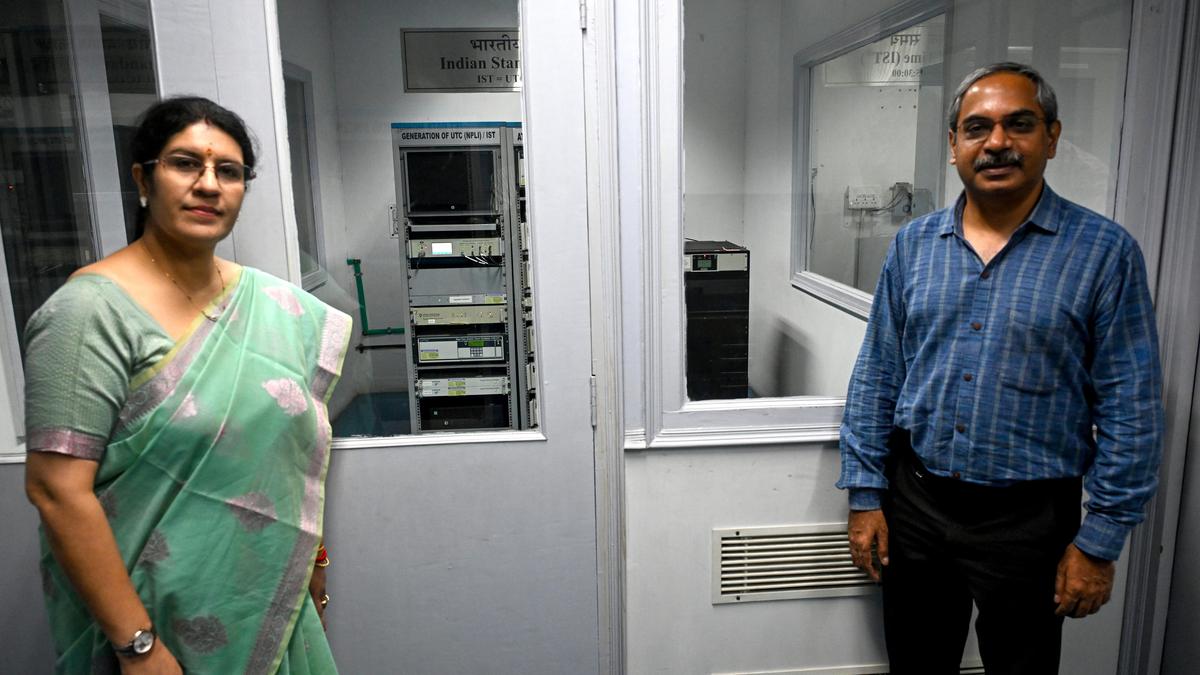

Indian Standard Time (IST) is created at the CSIR-National Physical Laboratory (NPL) in a room the size of an office cubicle, on a sprawling Delhi campus, not far from where the Green Revolution took root. Created, not in the Einsteinian way of space and gravity doing mysterious things, nor in the pejorative way about Indian time being stretchable. Time here emerges as a consensus of a parliament of clocks.
Parliament is not stretching the comparison. NPL’s foundation stone was laid in 1947 and its building opened in 1950, the year India brought its Constitution to effect. No other institution clocks itself so exactly to the nation’s origin. On 27 August, the Department of Consumer Affairs notified the Legal Metrology (Indian Standard Time) Rules, 2026, which make IST the only permissible time reference in the country for legal, administrative, commercial and official purposes, require that it be drawn from an authorised Indian source, and come into force in the last week of February 2027.

Inside, is a temperature-controlled squeeze of a room where eight clocks live. If Patek Philippes and Breguet’s are the aesthetic pinnacles of timekeeping, the clocks at NPL are an abomination. Two grey racks on wheels, with beige metal boxes on these shelves. The only concession to the idea of a clock is a row of red digits on each front panel, stepping forward once a second. Far from timepieces, they more resemble amplifiers in a recording studio.
Wristwatches, even those worth eight figures, may be paragons of workmanship but, by the standards of the NPL clocks, terrible timekeepers. They will run a few seconds fast or slow every day. Even a ₹2,000 quartz watch, incomparably plainer, will be off by 10-odd seconds, though only over a whole month. NPL’s system of atomic clocks would take something on the order of a few million years to lose one.
Worth the time
It is easy to forget that a second does not exist. Not in the existentialist, what-really-is-time sense, but in the more prosaic sense that a temperature reading is only the average bounce of molecules; a decibel, just a ratio of perceived sound to the quietest imaginable quiet. The ‘second’, that way, is a mathematical derivative and a unit of repetition. Take anything that appears to repeat regularly — heartbeats in a day, breaths during a jog, the cycle of day and night — divide its duration into equal parts, and the parts become units.
Eventually by the 17th Century in Europe — by compressing a millennia-spanning narrative involving Egyptians, Babylonians, and time-keeping — the day was cut into 24 perceptibly equal units called ‘hours’. Each hour was cut into 60, called ‘minutes’, and at some point someone reasonably decided that you could keep up this slicing-in-60s forever but would have to keep coming up with new words for it. The line was best drawn at ‘seconds.’
‘One Nation, One Time’ and how it works | Explained
Multiply that 24 and the 60 twice over and that is how 86,400 seconds made a ‘day’, the unimpeachable turn of night and light and the periodicity people most cared about. Nothing could seem more regular than that, until it emerged that it was not.
The Moon’s gravitational pull, ocean currents, the breathing atmosphere, and the churn of magma deep inside the planet all, incrementally, upset its rotational regularity. The Earth spins sometimes faster, sometimes slower, and global commerce eventually prevailed upon modernity to divorce the ‘second’ from the earth. Mercifully, by the early 20th Century, the then new science of quantum physics was at hand. Certain transitions, it turned out, between the energy states of atoms occur at frequencies far more regular, and far more reproducible, than a spinning planet.

The curious case of caesium
We know there may be several Earth-like planets in the universe, but have yet to chance upon one. In 1955, when British physicists Louis Essen and Jack Parry built the first practical caesium atomic clock at Britain’s National Physical Laboratory, it was as if humanity found a new ‘Earth’, a replacement for the demoted Earth, in an isotope of an element called caesium-133.
If elements were musical genres, the soft silvery-golden caesium would be punk. It melts at room temperature and reacts violently with water. Yet, in a vacuum it’s as unerring as a Shinkansen. Its atoms are relatively heavy and slow, easy to produce as a beam, and possess a ‘microwave transition’ — a switch between two internal states, triggered by radiation at one exact wavelength — whose frequency can be reproduced with extraordinary precision.
In 1967 the General Conference on Weights and Measures, the international body that decides how the world defines and measures things, ordained that ‘second’ was 9,192,631,770 cycles of the radiation corresponding to that transition — radiation, in other words, at a frequency of about 9.192 GHz.
An atomic clock does not count seconds by watching anything move. It keeps time by finding a frequency that nature supplies. Inside each beige box at NPL, common across all five of its caesium clocks, is a sealed metal tube under high vacuum. The clock needs two things: something to produce a signal at roughly the right frequency, and something to tell it when the signal is exactly right. The first is an ordinary quartz oscillator, of the sort in the ₹2,000 watch, whose steady hum the clock’s electronics multiply up into microwaves. The second is caesium.
Caesium atoms boil in a small oven, magnets sort them into the required state, and they fly its length through a chamber where the oscillator’s microwaves are humming at about 9.192 GHz. If the frequency is exactly right, some of the atoms flip to their other state, and a detector at the far end counts how many did. Too high or too low, and the count falls; the electronics read that shortfall and nudge the oscillator back. The atoms are a referee. They do not keep time, just judge the crystal that does.
The accuracy follows from the quality of the judge. An atom, by human standards, is perfection. Every caesium-133 atom in the universe answers at precisely the same frequencysince there were caesium atoms, and unaltered whether Delhi, Paris, or Tokyo.
Which is why an atomic clock looks less like a clock and more like laboratory experiment. It is not cheap and cannot be brandished. Miniature versions are entombed in the roughly 30 satellites of the U.S. Global Positioning System (GPS), which is where contemporary civilisation actually gets its precise time. On the ground they are bought by those whose work depends on infinitesimal precision — stock exchanges, banks, missile programmes, navigational tools, anything with a satellite application — at $30,000 to $60,000 apiece, which is still cheaper than a Richard Milles wristwatch.
Time is measured
The atom may be incorruptible, but the paraphernalia around it — vacuum tubes, magnets, racks, all the ungainly, aesthetic-sucking apparatus meant to isolate it from the forces that sully the Earth’s rotation — is not caesium-133. Life happens to caesium clocks too, and while they drift only a little, drift they do. Adding more clocks does not fix that. And so NPL governs time the way its birth twin, democratic India, has governed itself since 1952. It holds elections.
NPL runs five caesium clocks and three hydrogen maser clocks together and takes a weighted average, adjusting the weights as individual clocks misbehave. A maser, the sibling of the laser, takes the opposite approach to caesium. It lets excited hydrogen atoms stimulate further microwave emission in a resonant cavity, producing an exceptionally stable microwave note.It turns out the two have conveniently complementary defects.
Also read | A natural resonance frequency of cesium 133, please
Caesium holds its accuracy over months but is noisy minute to minute. A maser is exquisitely smooth over hours and sags over weeks. IST thus results as a hierarchical consensus of eight clocks. Because caesium alone defines the second, the five of them — not unlike a five-judge Constitution Bench — establish how far the ensemble has strayed from the 9,192,631,770 constitutional ticks, and the masers, like the elected Executive, dispense the resulting time while continuously rebalancing against that verdict.

NPL runs five caesium clocks and three hydrogen maser clocks together and takes a weighted average, adjusting the weights as individual clocks misbehave.
| Photo Credit:
Shashi Shekhar Kashyap
The result of all of this is a local realisation of Coordinated Universal Time (UTC) to which five and a half hours are added to make IST. UTC is computed by the Bureau International des Poids et Mesures at Sèvres, outside Paris. Like the caesium bench inside NPL, it judges.
Some 85 laboratories worldwide send in the readings of around 450 clocks; the BIPM weights them. Those that deviate the least pull more weight and from this is computed an ‘ensemble’ average called International Atomic Time. Leap seconds are then inserted — not for leap years, but to keep the atomic count in step with the stubbornly irregular Earth — and the result is UTC.
UTC is therefore never broadcast to anyone, because it does not exist in real time. It is published once a month, as backlog, in a document called Circular T, which tells each national laboratory how many billionths of a second they were off 30 days ago. Every timekeeper in the world is thus steering towards a target that will not be known for another month. “If our clocks fluctuate too badly or go away from the UTC, then we have to make large corrections, which means the clocks will take time to stabilise, come back to the stable zone. So, we need to steer it as close to the UTC, predicting it — that is the art,” Prof. Venugopal Achanta, Director of CSIR-NPL, says. NPL puts the systematic uncertainty of IST against UTC at about ±2.8 nanoseconds and like its equivalents globally, keeps that artful algorithm secret.
The transmission problem
All the fastidiousness in that room produces, in the end, an almost comically humble object: an electrical pulse, one every second, on the second. Pulse per second (PPS) is the currency of the entire trade.
“The problem now comes in the dissemination,” Achanta says, and this is where the achievement starts leaking away. The clocks in the room are good to about one part in a hundred trillion. What leaves the building over a satellite link is good only to a few billionths of a second — three or four orders of magnitude worse — because the pulse must climb to geostationary orbit and come back down, and the Earth is neither flat nor obliging, and every correction costs precision. Fibre does far better. On its own campus, NPL sent a time signal down an unused strand of Airtel’s fibre and back, a 40-kilometre round trip, and lost less than a billionth of a second.
BSNL then carried a signal 460 kilometres from Bengaluru to the National Stock Exchange in Chennai, through just two relay points along the way. The clock at the far end was off from the one at the start by 40 picoseconds — forty trillionths of a second. Distance turns out to matter less than the number of relay points, or ‘hops’ on the route, each one adding a little error. The 460 kilometres to Chennai crossed two. A 70-kilometre run to Faridabad crossed 16, and what arrived was, in Achanta’s words, “Poor.”

Fibre of that quality is being built for institutions that need exacting fidelity: exchanges, banks, telecom operators, power grids. For everybody else there is a ping. NPL runs about 20 network time servers behind an IP address; a computer sends a packet, gets a few kilobytes back, and sets itself. Thirty thousand such requests arrive every second, against a claimed capacity of 2 million. Exchanges and banks, who need microseconds rather than milliseconds, get a more careful protocol called Precision Time Protocol (PTP), which measures and subtracts the network’s own delay.
The irony about all this elaborate infrastructure, and the years of thought spent shaving the smallest slivers of a second, is that for most, it changes nothing. GPS has broadcast excellent time, free, to anyone with a receiver for four decades, and virtually every network in India — Airtel’s, Jio’s, Google’s data centres, the phone in your pocket — takes it from there. “At the user level there’s nothing much we have to do. If you take the mobile phone, we don’t sync it to any server because our Airtel or Jio or whatever the service provider is, is linking or syncing it to the setting of the time — their time; they’re taking it from GPS,” says Achanta.
Vocal for local
The government has nonetheless decided that this will no longer do. Time has been concretised and like the kilogram and metre, become an object for the State to define and inspect.
“The Akashvani (radio) news bulletins used to start with a beep, a time check — that was from NPL,” Achanta muses. “We evolved standards for everything except time. The process started in 2021, and now it finally has legal backing.” For the first time the rules make time — like weight and length — a legally enforceable standard.
The Department of Consumer Affairs has, for decades, sent inspectors to weigh the sweetshop’s scale and measure the tailor’s yardstick. Those inspectors will now be expected to audit whether a bank’s servers are traceable to NPL-ordained time. Convenience, plainly, is not the reason. There are three others, Achanta explains.
The first is that the free-GPS tap is foreign and can be turned off. GPS is a U.S. Air Force asset operated at Washington’s discretion, and a signal can be denied, jammed, or — more insidiously — falsified. “Nowadays it is very easy to spoof satellite signals. Even jamming is possible,” Achanta says. A receiver fed a signal one second late will place itself kilometres from where it stands. “We don’t know what Trump will say next second. He may say ‘Block all signals,” or “Pay me for using the satellite,” Achanta says.

Venu Gopal Achanta with Poonam Arora, Scientist G and Sumit Kumar Mishra, Scientist G, at NPL in New Delhi.
| Photo Credit:
Shashi Shekhar Kashyap
He alludes to a long-circulating claim to a denial of GPS to India during the Kargil War in 1999. While there is no official or declassified American document proving a targeted, intentional shutdown of GPS signals to India, what’s verifiable is that the U.S. military degraded the quality of GPS signals, compromising access globally, through a feature called Selective Availability, which introduced an error margin of about 100 meters.
The second reason is solving intricate legal disputes. “What happens if there is a contestation: Somebody says, ‘I made this transaction at such and such time,’ but the other person says, ‘No, you’re off by (this many time units) — you didn’t meet the deadline, your bid is invalid.’ Now who is going to judge this? Both are correct, because one is taken from some other country and this guy is taking it from IST.” Achanta says he was unaware whether disputes of such a nature actually exist, explaining that it is about being prepared. “We need to think ahead.”
The third is that redundancy must be built before it is needed. Five Regional Reference Standard Laboratories — at Ahmedabad, Bengaluru, Bhubaneswar, Faridabad, and Guwahati, all under the Ministry of Consumer Affairs — exist largely to shorten the distance between the pulse and its recipient. Each will eventually hold atomic clocks good enough to run unsupervised for days if everything upstream fails. And in Bengaluru, beside ISRO, NPL is assembling a full duplicate of the Delhi ensemble — the same caesium standards, the same masers; an identical parliament sitting in reserve.

India out there
India’s original fears about the Kargil imbroglio resulted in NavIC: seven satellites, approved in 2006, first launched in 2013, parked in geostationary and inclined geosynchronous orbits some 36,000 kilometres up so that they hang permanently over the subcontinent, covering it and 1,500 kilometres beyond. India’s own sky, India’s own time.
The sky, however, has since emptied. The rubidium atomic clocks aboard the first-generation Indian Regional Navigation Satellite System (IRNSS) came from a single European vendor. They began failing from 2016 — the same clocks failed on Europe’s Galileo — and IRNSS-1A lost all three clocks. This forced ISRO to replace it with a new one: IRNSS-1. By the beginning of 2026, only four satellites were providing NavIC’s positioning, navigation and timing (PNT) service: IRNSS-1B, IRNSS-1F, IRNSS-1, and NVS-01.
NVS-02, launched in January 2025, reached transfer orbit and stopped there because of a loose connector in a propulsion valve. Then on March 13, 2026, three days after IRNSS-1F completed its designed 10-year life, its clock stopped. That left three satellites transmitting navigation signals against a minimum of four.
NavIC is, for the moment, not a navigation system. The next in the series, NVS-03 was to have been launched at Sriharikota in September, but is now expected only in November. The crippling of NavIC undermines one of the requirements of the new rules, which is that time from NavIC is one of “authorised” sources of time for Indian users.
The rulesput responsibility on the end entity rather than its supplier, monitor deviation from IST, and hold auditable records proving traceability. It also bars any entity from recording a time reference other than IST, which, read literally, unsettles the near-universal historical practice of storing timestamps in UTC. Another rule permits the director of Legal Metrology to charge a subscription for the service. Rule 11 says non-compliance is “punishable,” without naming the section of law under which it has been framed.

In Mr. Achanta’s reading, however, it is the telecom operator that is at the heart of compliance: “It is the responsibility of our internet service provider to make sure that their time is synced to Indian Standard Time, so that all our PCs and mobiles are.” An inspector who wants to check a bank will be told the time comes from Airtel, and will go and check Airtel. “At the level of Airtel and Jio, all they have to do is just update this to NPL. It is a very simple thing for them.”
The telecom industry has expressed reservations as far as ease of compliance goes. One telecom industry source says, while declining to be identified, that there are a variety of architectures that telecom operators use, to make sure that the time across their networks is synchronised. “There are some challenges since there are multiple systems aligned in a different way,” the executive says, adding that telcos were in discussions with NPL. “There are also issues with latency and the timeframe under which this has to be implemented,” the source said. “The functionality of NaVIC is also a concern.”
Mr. Achanta says, “Russian is better, cheaper, faster.” The hydrogen masers that carry Indian Standard Time between caesium verdicts and the climate chamber around them are Russian, made by Vremya-CH in Nizhny Novgorod. They were bought because they are excellent and because they are cheap — cheaper still since the invasion of Ukraine pushed European laboratories towards American suppliers, driving American prices up and lead times out to five and seven years. NPL builds its own caesium fountain and is designing an optical clock, but the lasers, mirrors, and cavities inside them are all imported. “We in the country, unfortunately, are not making any of these things.”
(With inputs from Aroon Deep)