






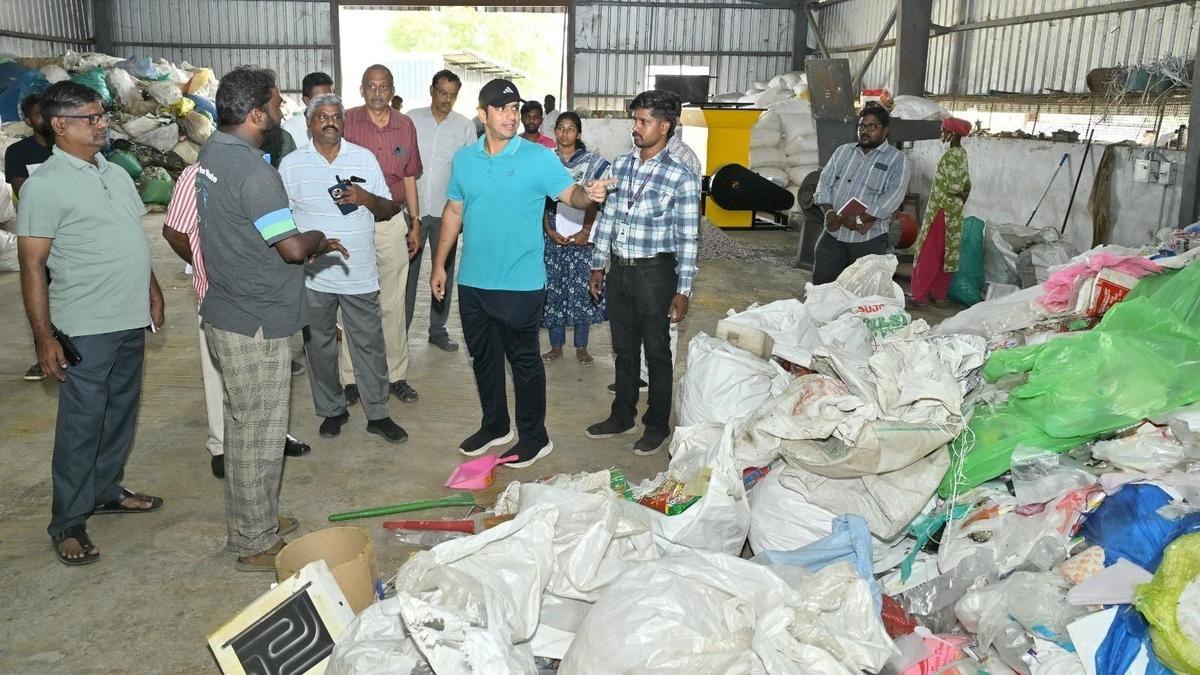


Coimbatore Corporation Commissioner Katta Ravi Teja inspecting the Micro Composting Centre in Ward 57 in Ondipudur.
Only 10 of the 36 micro composting centres (MCCs) in Coimbatore city are functional, the Central Pollution Control Board (CPCB) found during an inspection.
According to a CPCB inspection report, the 36 MCCs in Coimbatore have a combined design capacity of 47 tonnes per day (TPD). However, their operational/utilisation capacity was only 32.2–36 TPD.
Of the 36 MCCs, nine had been converted into Material Recovery Facilities (MRFs) or Dry Waste Centres (DWCs) and were functional. Seven MCCs had been adapted for other purposes, and 10 MCCs were either shut or non-functional.
The CPCB noted that most MCCs were located within or close to residential areas and educational institutions, leading to public opposition and under-utilisation of the facilities.
The inspection also found that around 5 TPD of compost was recovered from the MCCs, indicating a process efficiency of about 14.7%.
The city generates around 1,293 TPD of solid waste. Of this, 1,130–1,250 TPD is generated from households, markets, small commercial establishments, and bulk waste generators. The total processing capacity available for solid waste is 1,164 TPD, comprising 417 TPD for dry waste and 747 TPD for wet waste.
The wet waste processing infrastructure includes a 600-TPD windrow composting facility, a 100-TPD vermicomposting plant and the 47-TPD decentralised MCC network.
The CPCB said 80–100 TPD of waste generated by bulk waste generators was being processed at MCCs and MRFs, while 1,050–1,150 TPD of waste generated from households, markets and small commercial establishments was processed at integrated facilities at Vellalore and at MCCs and MRFs.
A senior Coimbatore Corporation official said the civic body was assessing the functioning of the MCCs, most of which were maintained by private companies. “We will address the complaints received about the facilities,” the official said.
The CPCB also recorded that seven MRFs were functional, with a combined design capacity of 35 TPD and an operational/utilisation capacity of 24–27 TPD. Along with the functional MCCs converted into MRFs/DWCs, 16 decentralised dry-waste facilities were functioning, with a combined design capacity of 77 TPD.
Published – September 30, 2026 06:59 pm IST