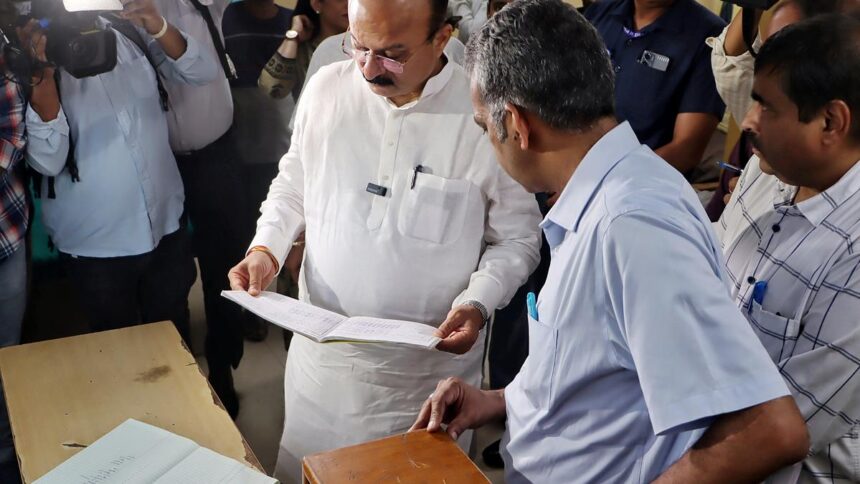









Sheikh Nawab inspecting wigs made for Durga idols.
| Photo Credit: Senjuti Sengupta
Maa Durga’s thick black, wavy hair always catches the eyes of spectators across pandals in West Bengal during the puja festival every year. However, not many are aware that these tresses are woven by Muslim artisans from Howrah’s Parbatipur village in the district’s Amta locality.
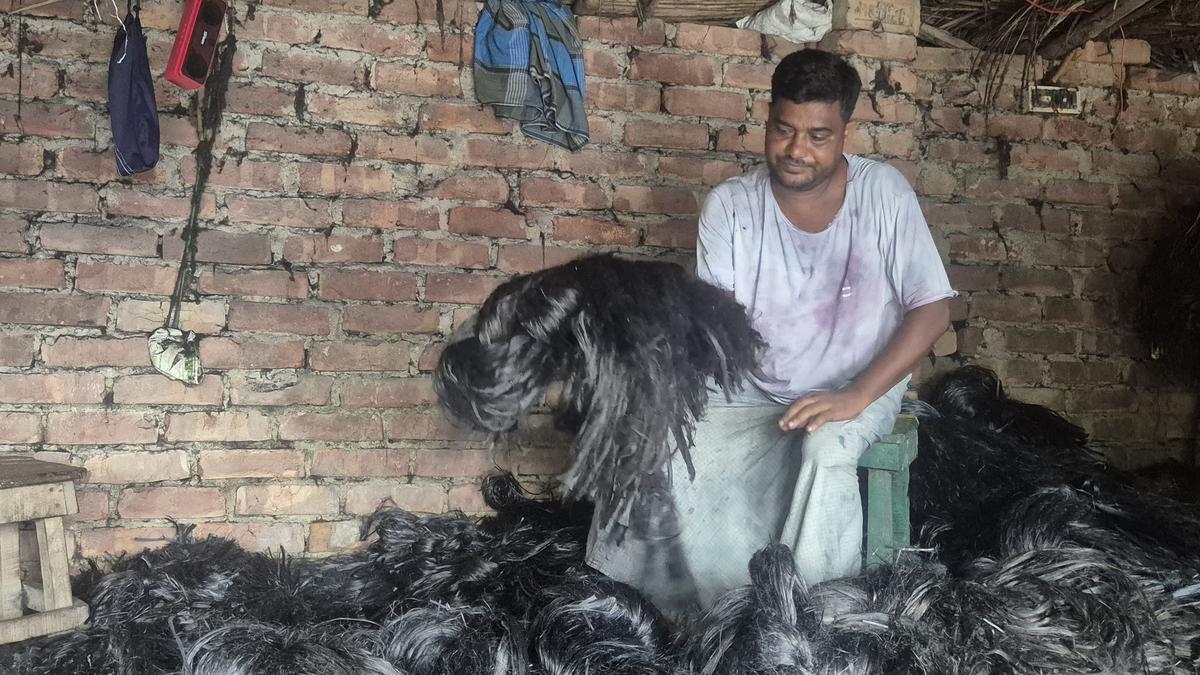
Pabataipur is 50 kilometres from Kolkata and is connected by the Baragachhia railway station. Sheikh Nawab (37) runs the largest wig business for the deity’s idols in the village. While he doesn’t remember which of his ancestors started this craft, he recalls learning it from his grandfather. “The crafting of wigs are done in two phases. We source the jute and dye it and then we hire several artisans to stitch them. Stitching takes the longest. We train the workers ourselves,” Mr. Nawab said.

Inside a small yard inside his house, the artisan has set up two thatched huts where the entire work is done. Two of his brothers boil black dye in a large charcoal pot to colour the white jute, which will be left to dry on a clothesline for the next few days. In another house on the same lane, five women stitch the freshly dyed jute on sewing machines.
Mr. Nawab displayed hundreds of packets of wigs he has stored in sacks. Each sack sells for around ₹9,000 to 10,000, mostly in Kumartuli, Bihar, Uttar Pradesh, Nepal, and Bangladesh.
Falling income
However, Prabatipur’s veteran artisans face many challenges, and all their efforts do not yield enough income.
In Frames | Kumartuli: where clay comes alive

Expert strokes: While some workshops retain the traditional shabeki style, others experiment with contemporary designs to meet specific commissions.

Work in progress: Ahead of Durga Puja, artisans perfect clay idols of Goddess Durga, Lord Ganesh and other deities at Kumartuli in Kolkata.

Basic coat: An artisan sprays paint on a clay idol at Kumartuli, where few women have broken barriers to enter the traditionally male-dominated craft.

Divine details: Idols cost between ₹50,000 and ₹3 lakh, depending on their size, with eco-friendly colours adding to the making charge.

Decked to impress: People crowd around to photograph an idol of Goddess Durga as it is readied for transport from Kumartuli.

Form to faith: Artisans breathe life into the clay idols that will soon grace puja pandals and move devotees

Moulded by time:For many artisan families, idol-making is a generations-old tradition, with Durga Puja believed to have been first celebrated in Krishnanagar, Nadia district, in 1606.

Festive flair: One of Kolkata’s most celebrated festivals, Durga Puja brings communities together in a celebration of faith while providing a livelihood for many.

Young fans: Visitors take selfies and pose for photographs beside unfinished idols of Goddess Durga at Kumartuli.
1/3
“Adverse monsoons and rising jute prices have hampered production over the last two to three years,” said Sheikh Injaman, another family member.
Mr. Injaman said the strain in relations between Bangladesh and India had also impacted trade. “We had great business relations with Hindu communities in Bangladesh. But that route is proving difficult due to the deteriorating political situation. We can barely pay the hundreds of labourers from nearby villages who work for us,” he said. A unit of jute now costs about ₹140 to 150, up from ₹90 two to three years ago.
Artisans say machine-based wig-making factories in Kolkata are tough competition for traditional handmade wigs. According to these craftsmen, artists from Kumartuli, Kolkata’s largest idol-making locality, source a good chunk of their wigs from three to five major factories instead of Parbatipur.

The changing socio-political landscape is another concern. “Earlier, we did not hesitate to approach idol makers, particularly those from the Hindu community. But now many of them hesitate to source wigs from us,” said Shona Bibi, a labourer who works for Mr. Injaman.
Published – October 11, 2026 10:09 pm IST