


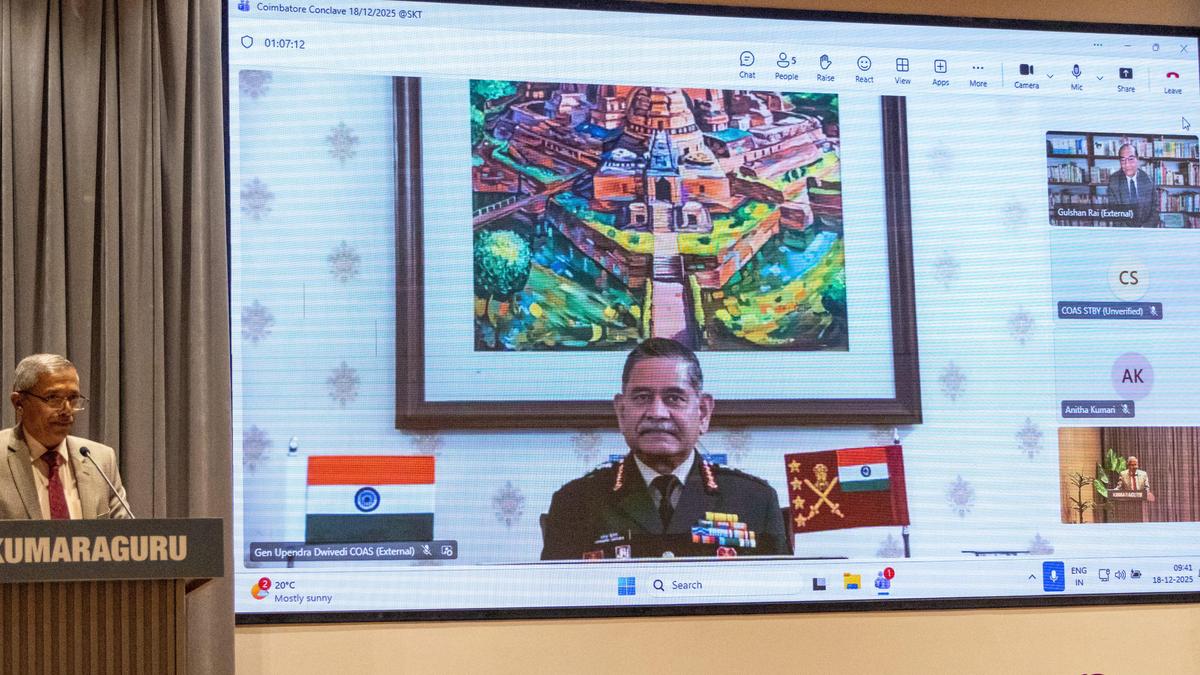

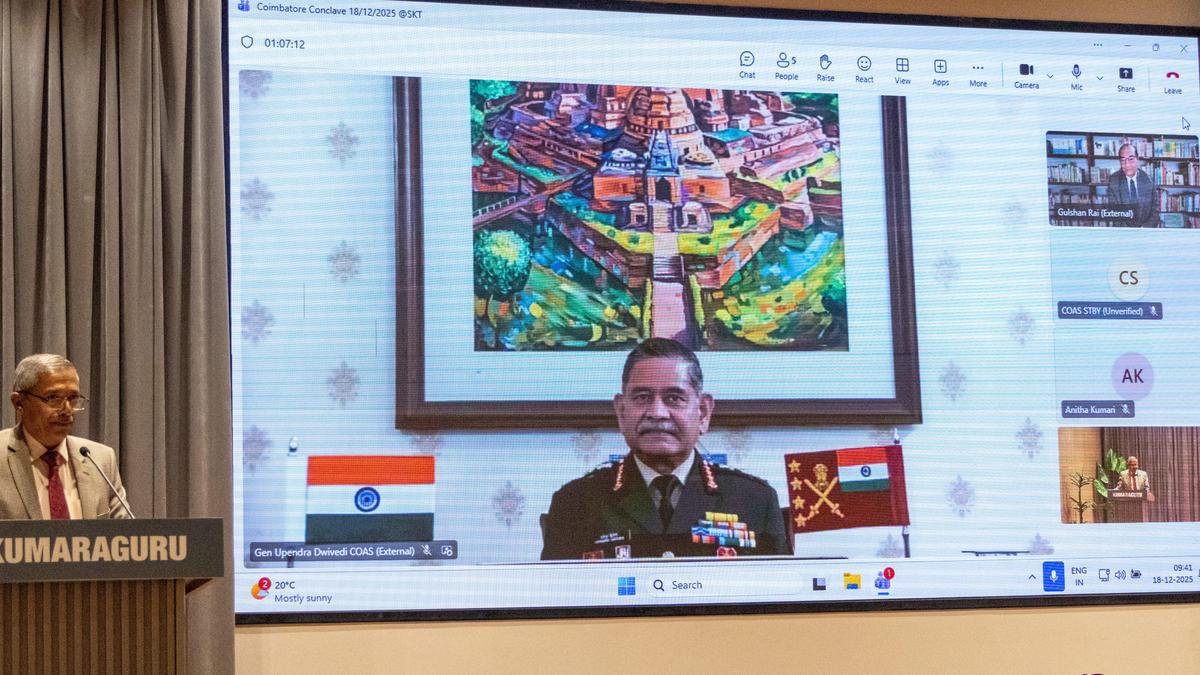
General Upendra Dwivedi, Chief of Army Staff, Indian Army, virtually addressing the inaugural session of ‘The Coimbatore Conclave 2025’ at Kumaraguru Institutions on Thursday.
| Photo Credit: Special Arrangement
India has moved beyond merely absorbing geopolitical turbulence to actively shaping outcomes, signalling a profound shift in the nation’s strategic doctrine, Chief of Army Staff General Upendra Dwivedi said in Coimbatore on Thursday.
The triad of 3Cs”—Competition, Contestation, and Conflict, has replaced the era of ‘long peace’, General Dwivedi observed, virtually inaugurating ‘The Coimbatore Conclave 2025’ hosted by Kumaraguru Institutions, conceptualised as a platform for diplomats, military strategists, economists, and policy thinkers to explore how India can transform global dynamics into strategic opportunities.
The conclave was organised by the members of RISET Foundation consisting of experts with diverse domain specialisation, formerly and currently associated with the government, industry and academia.
Outlining India’s evolving response to cross-border terrorism, the Army Chief said a new operational benchmark was created after the Pahalgam attack on April 22. The swiftness of the operation dismantled terrorist infrastructure deep within enemy territory. “India has demonstrated a doctrine that those who sponsor terrorism will face decisive consequences,” he affirmed.
Five key factors shaping the turbulent landscape constitute persistent terrorism that demands exemplary and resolute responses; the return of hard power signifying a shift from economic interdependence to military strength; militarisation of space and vulnerabilities in critical maritime routes like the Red Sea; economic paradox reflecting in instability that causes higher strategic risk-taking; and the dominance of military security paradox as the global defence spending has surged to $2.7 trillion.
Our world is now living through an air of constant conflicts with over 50 active conflicts and more than 100 protagonists blurring the very boundaries between peace and conflicts. Todays turbulence demand sharper anticipation, and the ability to turn it (turbulence) into strategic opportunity. India, he said, was converting global uncertainty into domestic capacity building, particularly through the “Aatmanirbhar Bharat” (Self-Reliant India) initiative.
India has converted global uncertainty into domestic capacity building, he said, stating that business exports will reach almost ₹30,000 crore this year, almost 50 times in 10 years.
General Dwivedi also launched the RISET website with the participation of Shankar Vanavarayar, president, Kumaraguru Institutions; Gulshan Rai, officiating president, Board of Trustees; RISET Foundation and Director General of the Foundation Lt. Gen. BS Raju (Retd.).
The three-day Conclave encompasses five themes: Emerging National Security Environment: Challenges and Opportunities; Evolving Global Geopolitics and India’s National Interests, Shaping the Discourse on Public Policy and Research in India; Increased Tariffs and Recent Regional Conflicts: What Next for Indian Industry; Media and India’s Public Communication Initiatives; and Technology and Innovation: Opportunities for Next-Gen in Defence and Fintech Domains.
The organisers have planned to arrive at policy recommendations for consideration of Central and State authorities.
Published – December 18, 2025 08:21 pm IST