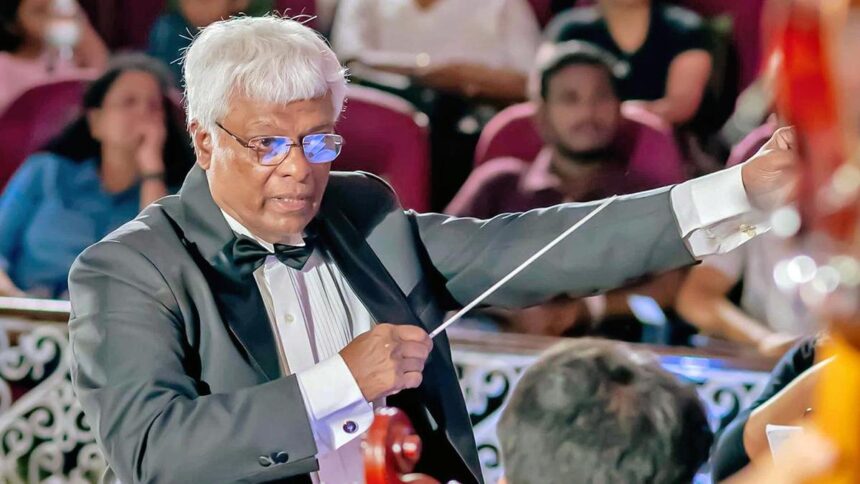



Anant Nag
| Photo Credit: Sreejith Ravikumar
“I would call it behaving, not acting,” veteran actor Anant Nag once said, pithily summing up his approach to the craft. With his skills forged on the Mumbai stage and not in a film school, reliance on what he called “behavioural” acting has stood Nag in good stead as he has easily moved between parallel and commercial cinema, exploring multiple genres from social drama to romance to comedy to horror.

The actor will, on September 22, receive the Dadasaheb Phalke Award for 2024, for his contribution to Indian cinema over five decades, at the 72nd National Film Awards ceremony in Gujarat. He was awarded Padma Bhushan last year. Nag is the second Kannada actor to win the Phalke after Dr. Rajkumar.
Born in 1948 in Uttara Kannada district in coastal Karnataka, Nag spent his childhood in a religious math and an ashram where his parents worked. Moving to Mumbai in his early teens for schooling was a culture shock, but he found his feet in Mumbai’s vibrant theatre world of the 1960s and 70s, acting in Konkani, Kannada and Hindi plays.

Nag’s transition to cinema came in 1973 with Sankalpa by P.V. Nanjaraje Urs in which he played a rationalist pitted against religious faith. A year later, he was introduced to Shyam Benegal with whom he worked in six films that remain milestones of Indian new wave cinema of the 1970s and early 80s, starting with Ankur, where he plays a complex-ridden son of a landlord. Nishant, Manthan, Bhumika, Kondura and Kalyug followed, offering him a range of roles with grey shades.
Commercial stint
Nag has often said his move to commercial cinema followed a realisation that a full-time career was hard in parallel cinema. Bayalu Daari (1977) was his first major commercial hit as a romantic lead, and a string of others followed such as Chandanada Gombe, Benkiya Bale and Naa Ninna Bidalare. He played the vulnerable middle-class protagonist in many of these based on popular novels, and his on-screen pairing with Lakshmi was a particular hit. Interestingly, Nag was popular in an era of superstars like Rajkumar, Vishnuvardhan and Ambarish, who had fan clubs that often competed with each other. Nag, despite his huge fan following, steered clear of this phenomenon, perhaps partly because he was never an “action hero”, and partly because he defied being cast in a mould.
An important phase of his acting career was his collaborations with his younger brother Shankar Nag, a maverick talent of Kannada film and theatre, who died in an accident in 1990. While films they did together such as Accident, Minchina Ota and Nodi Swami Navirode Heege continue to have a unique place in Kannada cinema, it was the series Malgudi Days based on R.K. Narayan’s works that won them national recognition in the early years of television. Nag has poignantly written about this association in the memoir, Nanna Thamma Shankara.
After a lean period in the late 1990s, Nag continued to act in 2000s, but mostly in supporting roles, in films like Mungaru Male. He came back to playing key roles again in films like Godhi Banna Sadharana Maikattu, with stellar performance as an Alzheimer’s patient, and Kavalu Daari where he plays a retired police inspector.
Nag is also one of the few Kannada actors to have successfully dabbled in politics. He was influenced by the JP Movement of the 1970s and was persuaded by the late Chief Minister, Ramakrishna Hegde, to join mainstream politics. He was nominated to the Karnataka Legislative Council in 1988 and was later elected to the Legislative Assembly. In 1996, he became Bangalore Development Minister in the J.H. Patel government. He quit politics, by his own admission, when it began to demand his full attention, away from cinema.
But Nag has never shied away from wearing his political views on his sleeve. He has been an unabashed admirer of Prime Minister Narendra Modi over the past few years and has endorsed Hindutva politics on many occasions, drawing criticism from liberal circles in Karnataka. When asked to comment on Phalke award, Nag said the congratulatory post on X from the Prime Minister “felt as good as getting two Phalke awards”.
Published – September 20, 2026 01:20 am IST