





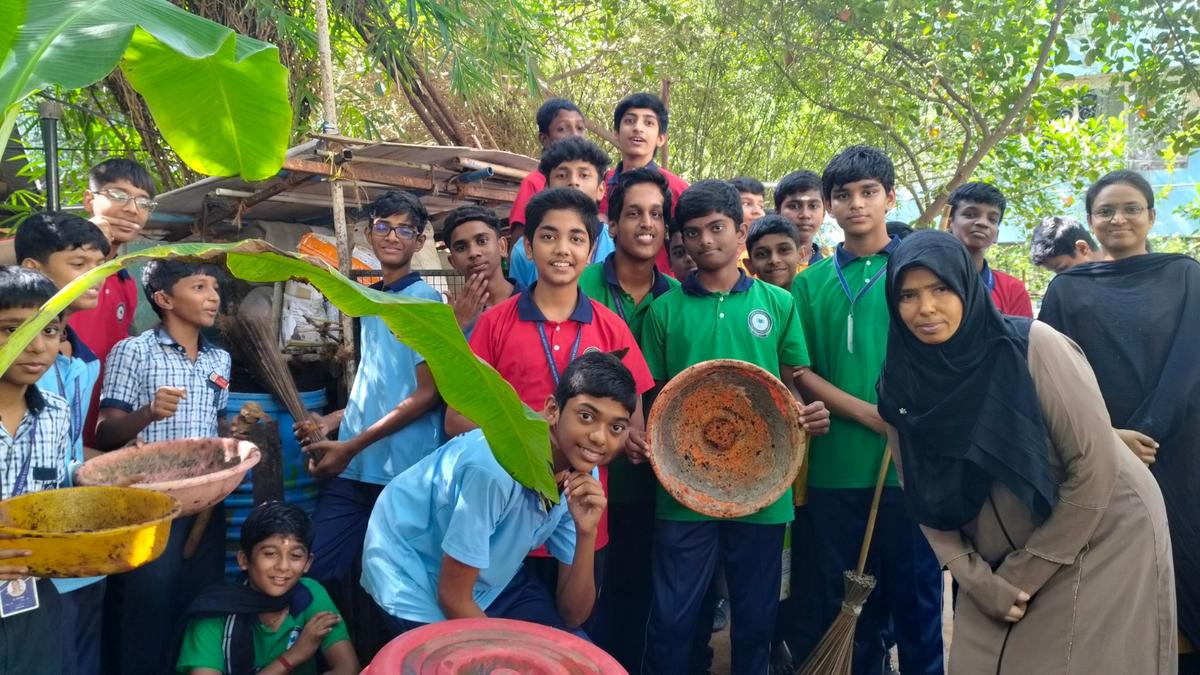


Shalika Banu (right) with students at the school campus.
Since the new academic year commenced this year at Fathima Central Senior Secondary School, Deepa B., a mother of two, has been following a practice diligently. She has all the vegetable peels from her kitchen dried at the terrace of her home, wraps them in a newspaper to be taken to the school every Saturday where she drops them in a vermicomposter.
Many parents at this school affiliated to Central Board of Secondary Education are nudged by the school management to bring their vegetable waste for composting on the school premises. And Saturday is set aside for this exercise. Currently, students of classes IX and XI follow the cycle for three months, after which it is the turn of students of classes V to VIII.
Some parents drop the waste mid-week as they do not want it to accumulate at home. And those like Deepa, who has children studying in classes VII and IX, dry it so that it is free of insects. “The quantity of wet waste that I send out is minimal, and seeing me my neighbour has also started sending it to the school’s composter,” says Deepa, appreciating the school for giving students a hands-on lesson in sustainability and science.
Fathima Central Senior Secondary School does not boast an expansive campus (it is less than an acre) but has taken a slew of initiatives to set an example for students and the community around that every small action makes a difference.

Children sowing the seeds in trays.
Shalika Banu, the vice-principal who has been driving such environment-friendly initiatives at the school, says the composting initiative has been running on the campus since 2015. Composting was earlier done in cement tanks but they discontinued the process three years ago to switch to the vermicomposting method. Even during the pandemic the school did not take a break as gardener Mani took care of it. Now, he is supported by Selvi. Currently, the campus has five vermicompost bins where dried cow dung and shredded coir are added to accelerate the process.
As regular supply of compost is ensured, the management went a step ahead to launch its own brand by the name “CONEURE” sold to the parents and the community around. Close to 25 kilos of nutrient-rich compost is generated once in three months.

The student-led audit team at the school visit classes to check if waste is disposed in the correct bins.
The school has a ‘Smart Water Irrigation System’, and 15-litre cans are used to grow vegetables such as tomatoes and chilli. As part of work education, students play a key role in maintaining the garden. Teachers have been promoting the growing of micro greens among the parent community for its nutritional benefits.
Shalika, who has been associated with the school for the last 19 years. “I had attended a teacher orientation workshop by R. Kishore Kumar of St John’s Schools who motivated me with his talk on who is a great teacher. I had shared that with my 2013 batch who were keen on starting something that benefits society and that set the ball rolling,” says Shalika, who recently won the Vidhya Seva Samman award 2026 for the ‘Best Teacher’.
Starting an eco-friendly team and the Green Clean Illuminators Club were the early initiatives taken at the school.

Engaging children in vermicomposting teaches them about nature, biology and sustainability.
“We made paper bags and distributed them to those waiting at the Nandanam signal. In another initiative, we gave away saplings that we received after a ‘plant growing competition’,” she recalls.
The award-winning teacher says in all these initiatives they ensure ‘no student is left behind’ as every project is linked to subjects such as Science, Mathematics, History and English and parents are happy to support the learning process.
Shalika is thankful for the support she received from both director Nigar Akthar and principal Naaz Parwar. “I would not have been able to cover so much ground without they giving me a free hand,” adds the teacher.
Published – September 19, 2026 08:50 pm IST