






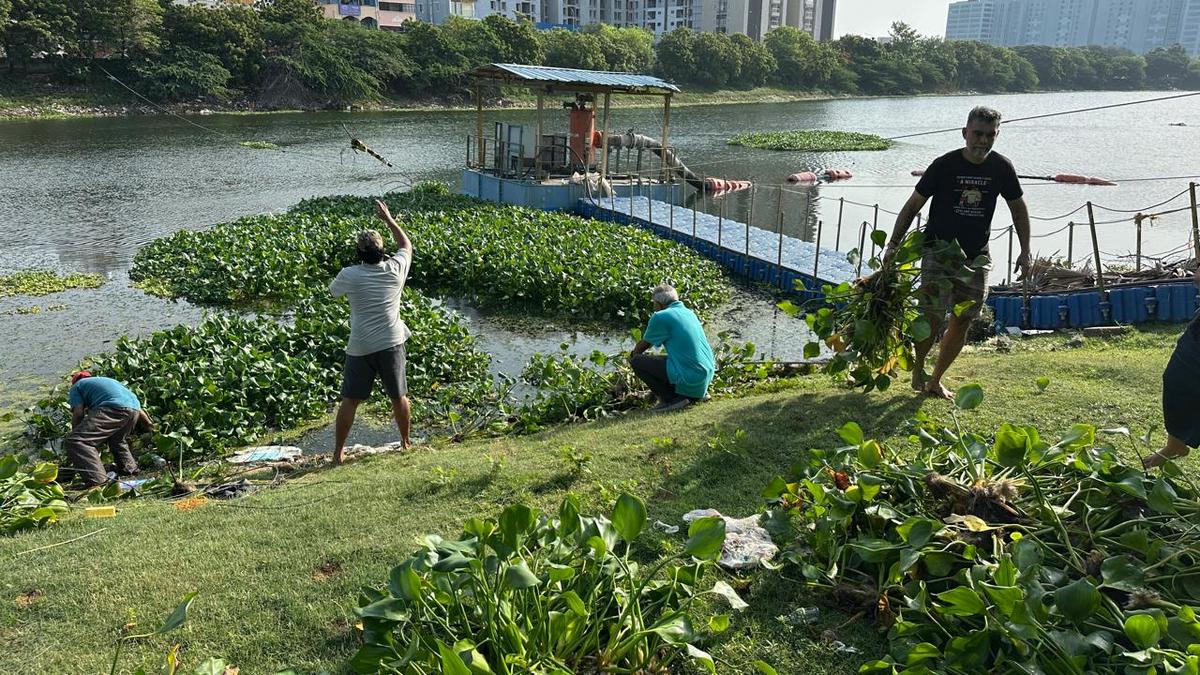


The association hoped the Corporation, PWD, and WRD would support the efforts to protect the lake.
| Photo Credit: SPECIAL ARRANGEMENT
Perungudi Lake, which had not seen water hyacinths for nearly a decade, has witnessed their rapid spread for the first time in recent months, raising concerns among members of the Perungudi Lake Area Neighbourhood Environment Transformation (PLANET) Association over the lake’s water quality and ecosystem.
PLANET members organised a lake-cleaning programme on Saturday to manually remove water hyacinth. The association hoped the exercise and wider public attention would prompt the Greater Chennai Corporation, Public Works Department (PWD), and Water Resources Department (WRD) to extend support for clearing the weed and protecting the lake.

Shaju John of PLANET said the invasive weed, which grows mainly in contaminated water, was restricting water movement, increasing stagnation and reducing oxygen levels in the lake.
| Photo Credit:
Special Arrangement
Shaju John of PLANET said the invasive weed, which grows mainly in contaminated water, was restricting water movement, increasing stagnation and reducing oxygen levels in the lake. Over 1,000 fish died during May and June this year, he said. The group has been manually removing the weed, though the lake’s depth makes it difficult for volunteers to enter the water. He said sewage from some households was being discharged through an old stormwater drain, while residents from nearby Kallukuttai and encroachments on the lake’s banks were also using the lake for washing, contributing to pollution.
Mr. John said lake was once a vibrant space after cleaning, and festivals and cleaning drives to protect the waterbody used to be held in 2016, 2017 and 2018, but were discontinued after the COVID-19 pandemic and the dispersal of the volunteer team.
PLANET member Prem Kumar said he had been observing the lake since 2015-16 and had never seen floating water hyacinth before. The lake was desilted around 2014 and had remained filled with water since the 2015 Chennai floods, unlike earlier years when it would dry up during summer. He suspected the growth could be linked to a government scheme introduced three to six months earlier under which treated sewage water was being stored in the lake.
Mr. John said the lake was deep, at about 30–40 ft, making manual removal difficult, so infrastructural backing for further cleaning process, regular removal of water hyacinth, prevention of further encroachments, protection of public walking paths, scientific lake restoration and active community participation.
Published – August 24, 2026 12:53 am IST