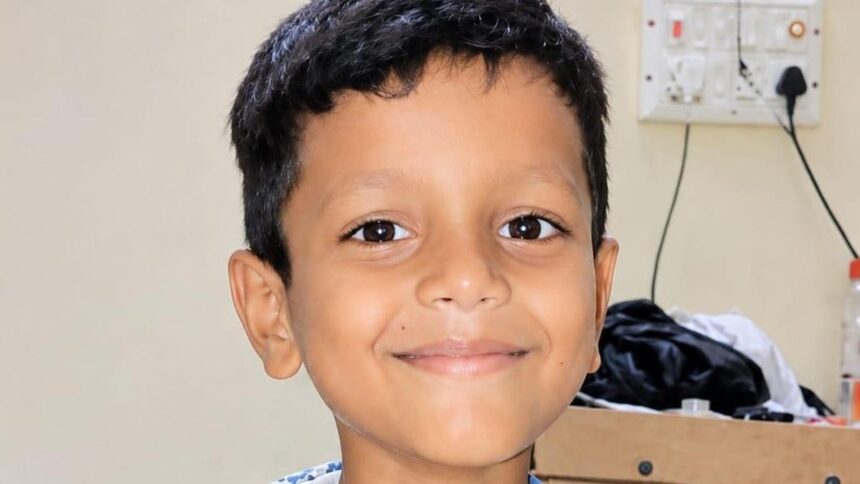




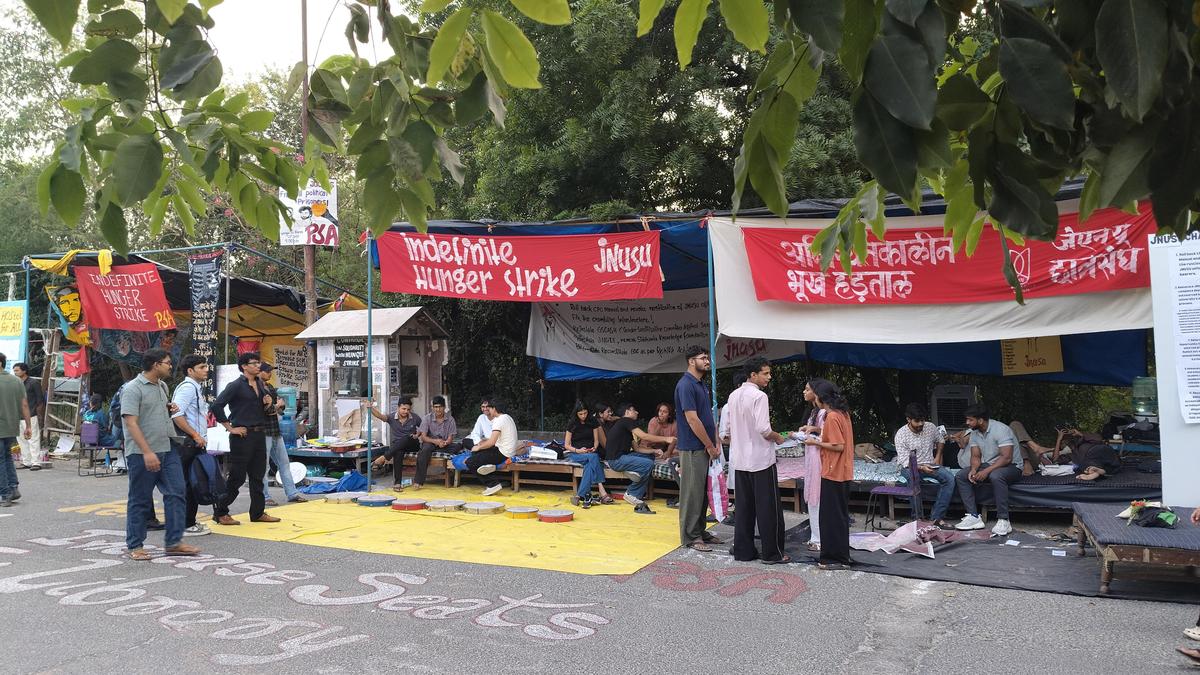


JNUSU president Aditi, who is staging a hunger strike on campus, said thousands are likely to visit Jantar Mantar.
| Photo Credit: Special Arrangement
With the October 10 protest looming, talk of the demonstration has been spreading across Jawaharlal Nehru University (JNU), where students are discussing how to reach the protest site amid restrictions on public transport. Some students said the curbs suggested that their protest was already gaining momentum.
Aditi, JNUSU president, who is currently on a hunger strike over various campus issues, said around 3,000 students had joined a protest from the campus on July 20, and they expected a similar turnout this time.
Danish Ali, JNUSU joint secretary, said, “Earlier, when we used to protest, it used to be just us. But now, there are hundreds of others. Students have been feeling motivated, at least first-year students.” Danish added that while JNU had earlier been villainised for its activism, the recent wave of protests had prompted people to rethink their perceptions.
Students were discussing ways to reach the protest site while ensuring their safety. They were being advised to leave in smaller groups to avoid detention.
At the hunger strike site on campus, talk of Saturday’s protest gathered pace through the evening. While some students said they would continue their hunger strike and remain on campus because “campus issues are important too”, others said they would travel to the protest site. They anticipated police vehicles and barricades at night.
Shubham Kumar, from the All India Students’ Federation (AISF), said, “We are expecting police vehicles outside campus and some barricades as well.”
On the public transport closures, he said, “They (government) need to realise that the more the restrictions, they are creating more buzz and making this a successful protest.”
Ujjwal Pandey, north zone coordinator of the Cockroach Janta Party, was discussing routes and plans with students. “We are still discussing the routes and timings. But this much is clear, wherever protesters are stopped, that will become a protest site too,” he said.
Three PhD scholars also discussed their travel plans, recalling that it had taken them around two hours to reach the protest site on July 20. One of them, Tasdique Mustafiz, said, “It took around two hours to reach last time. Because there were barricades outside and private vehicles were not allowed to enter and leave campus.”
Mustafiz said his mother’s name had been removed from the voter rolls. His family is based in Bihar, where he is originally from. His friend Mousam said, “I got a call from the BLO in Jharkhand saying that my name has been cut and I have to submit additional documents.”
The three scholars added that even their professors, who had lived in Delhi for years, had been receiving similar notices.
The students said dissent and the police brutality that comes with it is “not new for us”. However, they understood how difficult it was for common people to protest and said it was therefore important for them to raise the issue.
Published – October 10, 2026 01:34 am IST