




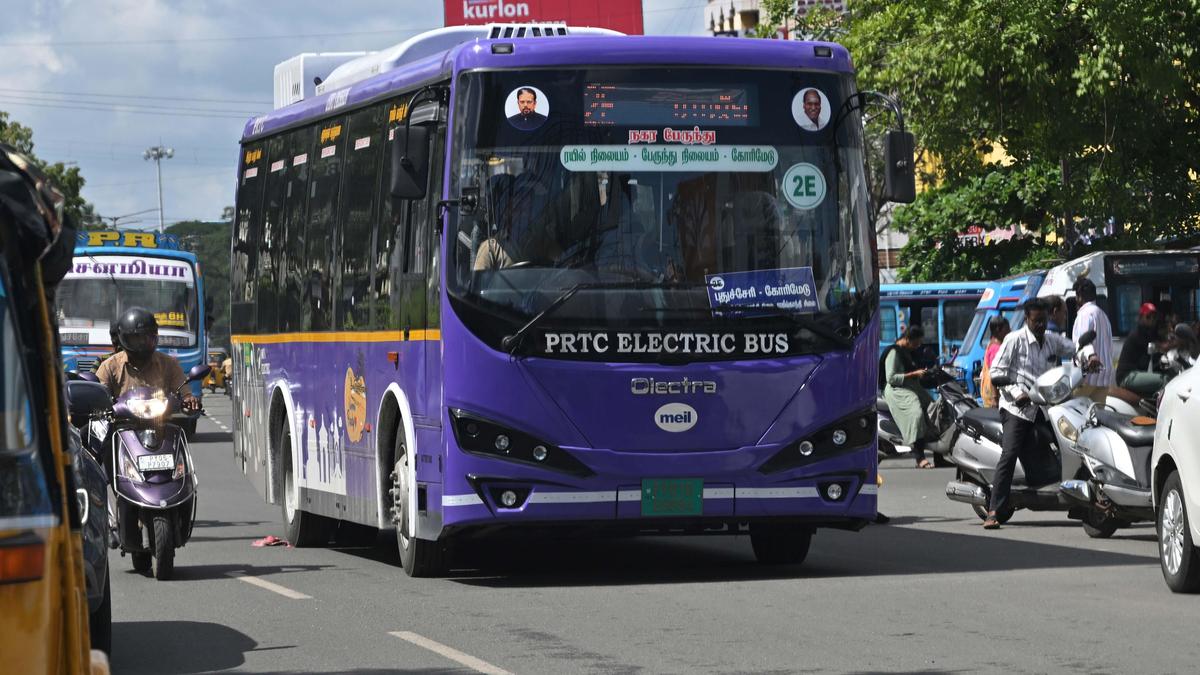

Puducherry is set to increase its fleet of electric buses with the U.T. government likely to grant the green signal for the supply and deployment of 75 electric buses under the PM-ebus Sewa scheme.
Official sources said the government had finalised the Operator, GreenCell Mobility for the supply and deployment of the buses. The PM-ebus Sewa scheme envisions the deployment of 10,000 electric buses across the country to strengthen public transport and promote e-mobility. With an estimated cost of ₹57,613 crore, the Centre will contribute ₹20,000 crore towards the programme.
“Electric vehicles (EVs) are transforming the way we travel by offering a cleaner, smarter, and more efficient alternative to traditional fuel-based transport. As far as Puducherry is concerned, Lt. Governor K. Kailashnathan is keen that the U.T. makes maximum utilisation under the scheme and pushes towards sustainable mobility, switching to electrification of its public transport system,” a senior official said.
“The file for approval of concessions agreement is under consideration of the Puducherry Government and once the concession agreement is signed with the Operator, the OEM will have to furnish bank guarantee and other procedural formalities,” the official added.
The Convergence Energy Services Limited (CESL), on behalf of Ministry of Housing and Urban Affairs (MoHUA), had aggregated the demand from cities shortlisted under the scheme.
States including Maharashtra, Haryana, Odisha, Gujarat, and Meghalaya and Union Territories of Chandigarh, Puducherry, and Jammu and Kashmir have been selected in the first phase. For 2024-25, CESL floated a tender for 4,588 electric buses under the scheme and Puducherry is eligible for 75 e-buses.
According to Transport Commissioner A.S. Sivakumar, “Puducherry plans to run 50 buses on intra-city routes (mofussil) and the remaining on Urban routes. Of the 75 AC buses, 50 will be 12-metres long and will be deployed on intra-city routes while the rest (9-metres long) will be deployed within urban areas.”
He added, “States or cities will be responsible for running the bus services under Gross Cost Contract (GCC) basis and making payments to the bus operators. The Central government will support these bus operations by providing subsidies to the extent specified in the scheme.”
Initially, the prototype will be supplied by GreenCell Mobility. Once the concession agreement is signed, they will start supplying the buses followed by the prototype. The prototype and a few more initial batch delivery buses can be charged at existing depot for electric buses on Maraimalai Adigal Salai or at NueGO’s own depot near Morattandi.
The private operator will be responsible for drivers and maintenance while the Puducherry Road Transport Corporation (PRTC) will be responsible for deploying conductors and paying the operator on a per-kilometre basis, he added.
Under the scheme, the government will provide ₹24 and ₹22 per km per bus deployed on inter-city routes and urban areas respectively to the administration and the remaining amount will be borne by the U.T.
Deployment of electric buses under the scheme is subject to completion of work related to associated infrastructure (behind-the-meter power and civil depot infrastructure). A sum of ₹8.15 crore has been sanctioned for behind-the-meter infrastructure.
A 3.5 acre site has been identified at the Truck terminal in Mettupalayam for the infrastructure. Cables will be laid from a sub-station in the vicinity and tenders have been floated for the infrastructure.
The construction of civil infrastructure for the bus depot is estimated at ₹12.75 crore. Tenders will be floated soon, and the amount is expected to be released soon, Mr. Sivakumar added.
For cities selected under the scheme, initiatives will focus on bus priority, infrastructure, multimodal interchange facilities, automated fare collection systems, and charging infrastructure.
A Payment Security Mechanism (PSM) will also be put in place by the Centre to protect e-bus suppliers and help in adoption of electric vehicles. PSM will ensure that e-bus suppliers are paid for their vehicles in the event of improper upkeep of vehicles, inefficiencies in fare collection, and poor health of State Transport Utilities.
As per the Union government, the scheme has been introduced to boost India’s electric mobility infrastructure. The scheme will support bus operations for 10 years.
Published – December 14, 2025 11:29 pm IST