






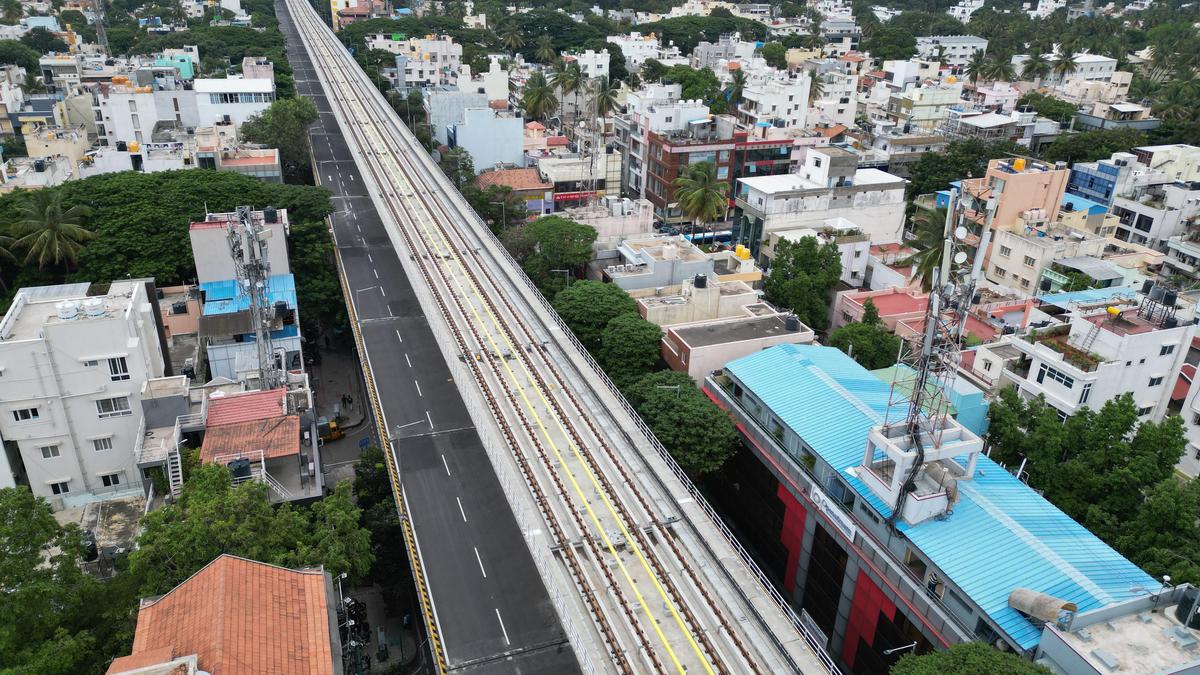


Nearly three residents’ associations have called for a protest to form a human chain near the proposed alignment on Sunday (October 11) to raise awareness among citizens about the impact of the elevated corridor.
| Photo Credit: FILE PHOTO
Adding to the continued resistance against Bengaluru Smart Infrastructure Limited’s (B-SMILE) elevated corridors project, residents of Jayanagar and surrounding areas are now opposing the proposed 18.5-km elevated corridor from Ragigudda Junction to Kanakapura Road in south Bengaluru, which will be tolled.
Nearly three residents’ associations have called for a protest to form a human chain near the proposed alignment on Sunday to raise awareness among citizens about the impact of the elevated corridor.
The opposition follows strong resistance from residents of Indiranagar, C.V. Raman Nagar, and HAL against the elevated corridor between Old Madras Road and Silk Board Junction. Separate groups in east Bengaluru have been opposing the project, with one of them conducting an independent, citizen-led survey of trees to assess the impact on green spaces.
In August, the B-SMILE floated tenders for the Ragigudda corridor, prompting residents to consult traffic and transport experts and review the Detailed Project Report (DPR).
Green spaces and land acquisition
Guruprasad D.N., one of the organisers, said a major concern was the need for the flyover. “There is already metro connectivity along the alignment currently planned by the B-SMILE. The actual requirement is to fix first- and last-mile connectivity,” he said.
The group also pointed out that the alignment passes through Rose Garden and Pipeline Road, both of which have extensive green spaces. Besides, the project also requires forest land near the NICE Road.
According to the official documents, the project requires 16,445 sq. m of government land, including corporation and forest land, as well as 13,481 sq. m of private land. Mr. Guruprasad said the private land requirement covers 24 properties.
The group also flagged that the elevated corridor would pass within a few feet of private properties, causing inconvenience to several households along the alignment.
Growth demands
B.S. Prahallad, Technical Director of B-SMILE, defended the project, citing the year-on-year traffic growth indicated in the DPR.
“We agree that it will be an inconvenience to local residents, be it during the acquisition or construction period, but a substantial number of commuters will gain from the corridor. These corridors are planned with the future in mind,” he said.
Public transport could help
The DPR states that the traffic capacity of most junctions along the proposed corridor has already exceeded their design capacity of 10,000 Passenger Car Units (PCUs) per hour, requiring immediate intervention to prevent bottlenecks.
The corridor primarily covers seven junctions — Rose Garden, Sarakki Junction, Konanakunte Cross 1 and 2, A2B Junction, 80 Feet Road Junction, and Turahalli Junction — where PCU growth is projected to be nearly 90% over 10 years.
For instance, the PCU count at Rose Garden in 2025 was 6,169, which is projected to rise to 11,599 by 2035. However, the DPR also offers two options to meet the growing demand, including policy changes, a modal shift, and the promotion of public transport.
Published – October 10, 2026 09:04 pm IST