



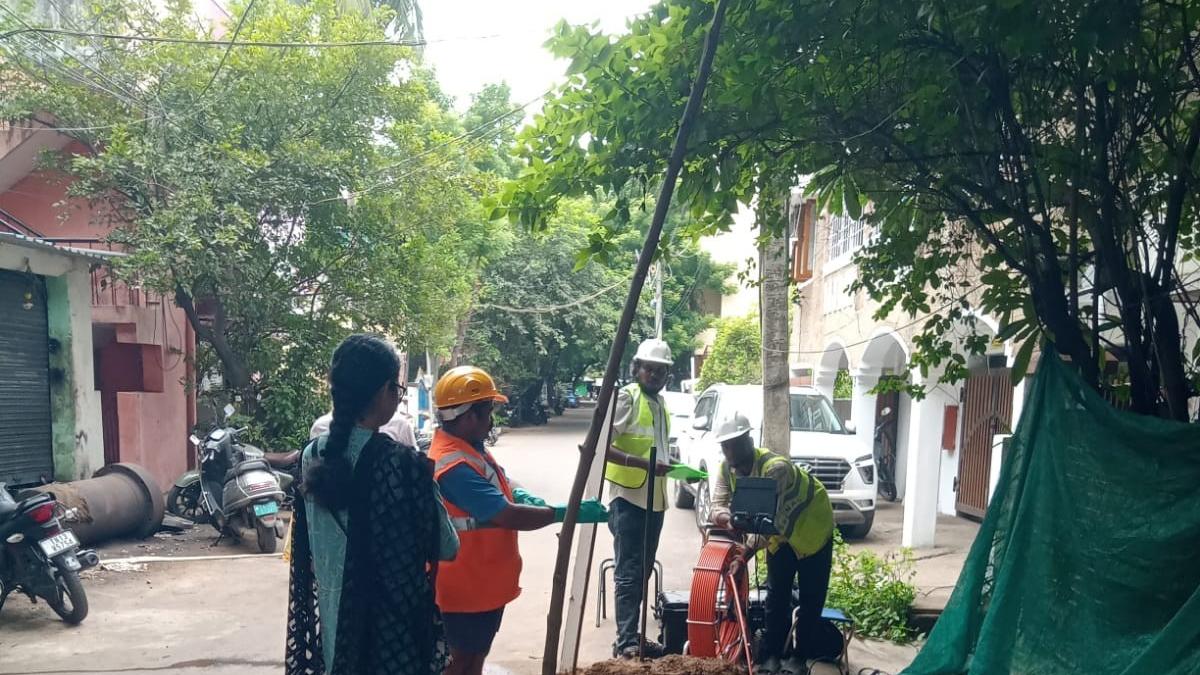


The cameras transmit video footage of leaks and blocks in pipelines as well as other structural damages.
| Photo Credit: Special Arrangement
Water pollution and leaks in ageing drinking water pipelines remain a concern in the city. To reduce water loss during distribution and detect leaks in the supply network, Chennai Metrowater has started using robotic equipment to assess the condition of the pipelines.
The conventional method of identifying the sources of leaks or water pollution involves digging multiple trial pits and making road cuts to understand the issue.
Officials of Metrowater said it was a time-consuming process, often resulting in disruption in water supply, more manpower and restoration costs. In some instances, identification of the issue and restoration could take up to 10 days as contamination ingress points were difficult to locate accurately.
It may be recalled that the water agency had deployed robots on a pilot basis in the city network to inspect the lines for damage in 2023.
Chennai Metrowater maintains a distribution network of nearly 6,200 km across the city. Defects in pipelines, including cracks, corrosion and sediment accumulation, pose major operational challenges. To fast-track the identification of complaints, the water agency has engaged Solinas Integrity Private Limited, an IIT-Madras-incubated startup, to provide robotic solutions across the city.
While the water agency receives complaints, including from zones 4, 5, 6 and 13, areas such as Mogappair and Ramapuram have been identified as vulnerable to frequent water pollution complaints.
With the robotic solution, a single pit, measuring 90 m to 100 m on each side, is dug to access the pipeline. Robotic micro cameras capture visual data from inside of the pipeline and transmit video footage of leaks, blocks and other structural damages. This enables officials to check defects and assess the pipeline’s condition within a day, officials said.
Water pollution
Residents of Mogappair said water pollution had been a frequent issue in areas, including Golden Colony, Valliammai Salai and Kavimani Salai. They said the network was inadequate for the mushrooming buildings, and urged the authorities to provide a permanent solution.
At present, the water agency has assigned the work on a hire basis, with payment depending on the type of robotic equipment and length of the pipeline inspected.
The rates range from ₹13 per metre to ₹53 per metre. While robocams are being used for small-diameter pipelines, two other types of robotic equipment are used to inspect pipelines of a diameter larger than 100 m.
The defect detection reports generated would enable Metrowater execute repair or replacement of the pipelines.
The ₹3.99-crore project would cover pipeline inspection for two years. The startup would be responsible for restoring the dug-up portions of the roads.
Published – September 30, 2026 05:00 am IST