




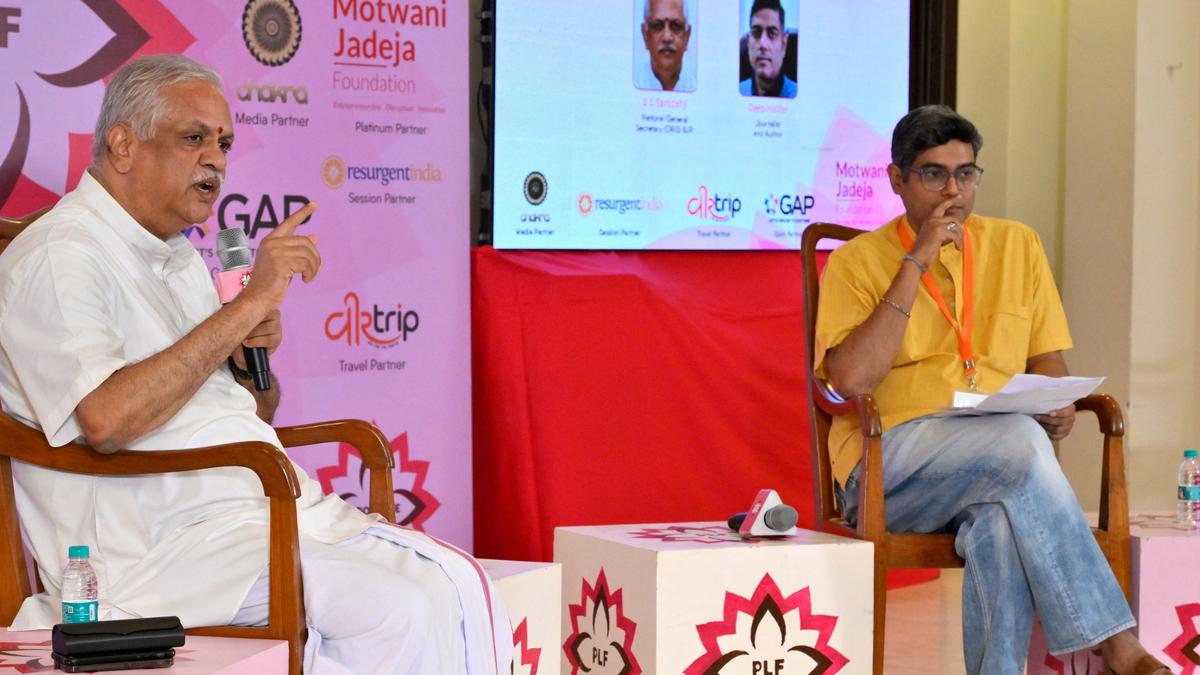


B.L. Santosh, National General Secretary of BJP, in conversation on ‘The RSS at 100’ at the Bharat Shakti Pondy Lit Fest 2026 held in Puducherry on Sunday.
| Photo Credit: S.S. Kumar
The Rashtriya Swayamsevak Sangh’s survival and expansion over a century is among its biggest achievements, said BJP national general secretary B.L. Santosh in Puducherry on Sunday.
Speaking at an interactrive session on “The RSS at 100” organised as part of the Bharat Shakti Pondy Lit Fest 2026, he defended the organisation’s ideological framework and described political engagement as a means of broader social transformation.
He said the RSS, founded in 1925, had emerged when Indian society was fragmented and disconnected from its civilisational legacy. According to him, the organisation sought to bring society together around cultural values and create conditions for what it considers positive traditions to flourish.
The BJP leader also disputed the characterisation of the RSS as right-wing or centre-right, saying those labels were drawn from Western political categories. He described the organisation as centrist in an Indian ideological context and said this should not be seen as a compromise between the political left and right.
Addressing criticism about Brahmin dominance, he said the composition of local RSS units was shaped by the social networks of those who first joined, rather than by a policy to keep out particular castes. He maintained that organisational leadership could emerge from any community. The RSS shakha system was founded for men but women take part in public and nation-building activities as equal partners, he said.
On questions concerning Muslims, Christians and communists, Mr. Santosh said the RSS did not treat entire communities as threats. He said it identified issues such as religious conversion, “jihadi mindset”, and intolerance as social problems.
He described himself as having been sent to politics on “deputation.”
Responding to criticism over the induction of leaders from rival political parties, including concerns about “Trinamoolification” in West Bengal and “Congressification” elsewhere, the BJP leader called such moves a “necessary evil” in pursuit of larger political objectives.
He said a legislative majority was required to implement key reforms and address urgent problems, particularly where a party did not have sufficient organic growth. He said the BJP had the capacity to assimilate newcomers.
According to him, the Gen Z should not be assessed solely through social-media trends or protest spaces. The RSS camps continued to attract young participants, he said and described the popularisation of ideas such as Hindu Rashtra and Akhand Bharat as an ongoing exercise.
On Nepal, he said the RSS was involved in non-political cultural and social initiatives aimed at preserving Hindu ethos and building connections among Hindu, tribal and Buddhist communities. He said the organisation had limited direct influence in Bangladesh but supported Hindus through diplomatic channels, international agencies and local contacts within the limits of international law.
Earlier in the day, he participated in various events held as part of Seva Sankalp Abhiyan, organised by BJP to mark 25 years of Prime Minister Narendra Modi’s public service. He had also called on Chief Minister and AINRC founder N. Rangasamy.
Published – September 27, 2026 11:18 pm IST