




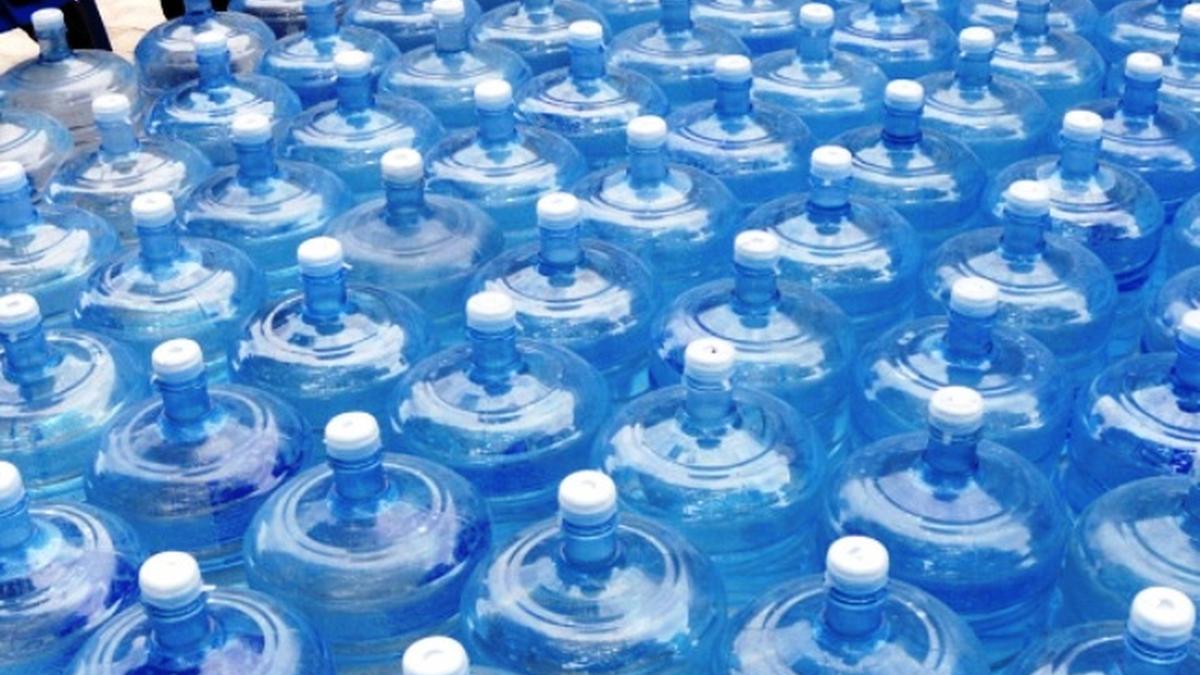

The Supreme Court on Thursday (December 18, 2025) declined to entertain a public interest litigation seeking directions to the Food Safety and Standards Authority of India (FSSAI) to revise its standards on permissible levels of antimony and Di(2-ethylhexyl) phthalate (DEHP) in packaged drinking water in line with international benchmarks.
A Bench comprising Chief Justice of India Surya Kant and Justice Joymalya Bagchi observed that the petition failed to reflect the “ground reality” of the country, where large sections of the population continue to grapple with acute shortages of drinking water, and characterised the plea as “luxury litigation”.
“Where is the drinking water in this country? People do not have drinking water. The quality of bottled water will come later on,” the Chief Justice said.
Appearing for the petitioner, senior advocate Anita Shenoy contended that India’s regulatory standards required urgent revision, as they permit significantly higher levels of antimony and DEHP than the thresholds considered safe by the World Health Organization and regulators in several other jurisdictions. Antimony, a metalloid, and DEHP, a synthetic chemical compound, are widely used in plastic products to improve durability, flexibility and overall functionality.
However, declining to entertain the plea, the Chief Justice noted that a substantial proportion of the population, particularly in rural areas, relied on groundwater for drinking purposes. “This is an urban-centric approach. People in rural areas drink groundwater, and nothing happens to them,” he said.
‘Ground realities’
Ms. Shenoy submitted that citizens were at the very least entitled to an assurance of clean and safe packaged drinking water, emphasising its direct implications for public health. Placing reliance on Section 18 of the Food Safety and Standards Act, 2006, she argued that statutory authorities were bound to comply with prescribed safety standards and that such obligations could not be diluted.
The Chief Justice, however, reiterated that the petitioner had overlooked the more fundamental concern of access to drinking water. “Water bottle should have this content, that content. These are all luxury litigations,” he observed, while also questioning whether regulatory standards followed in the United States or Europe could be realistically implemented in light of prevailing ground realities.
“Let us face the ground realities of the country. Nobody takes up the cause of the poor. All this is rich and urbanised phobia,” he added.
Ms. Shenoy clarified that the petition was confined to packaged drinking water and the transfer of substances from plastic into the water. “It is what travels from plastic into the water,” she said. The Bench, however, remained unconvinced.
Chief Justice Kant urged a broader appreciation of the country’s realities. Referring to Mahatma Gandhi’s travels across rural India after his return from South Africa, he said such journeys were undertaken to understand the plight of the people. “Tell the petitioner to travel to parts of India where people are still craving for drinking water and receive only a fixed quantity. Then he will understand what India is,” he said.
The plea, filed by architect Sarang Vaman Yadvadkar, said that the presence of antimony and DEHP beyond permissible limits posed serious risks to human health. “Both elements are found to have impacts on cardiovascular health, such as arrhythmias and bradycardia, as well as respiratory irritation and gastrointestinal distress. Chronic exposure has been linked to liver and kidney dysfunction, changes in blood sugar and cholesterol levels, and histopathological damage to multiple organs,” it said.
Citing scientific literature, Mr. Yadvadkar further contended that DEHP has been identified as a major contributor to cardiovascular disease, and claimed that India recorded the highest number of DEHP-related cardiovascular deaths, accounting for nearly one-third of the global toll.
The petition further pointed out that while the Bureau of Indian Standards lays down norms for drinking water bottles and the FSSAI prescribes standards for drinking water, the two regulatory frameworks have developed independently over time. “These standards have been modified over the course of years, and it is the submission of the Petitioner herein that the latest standards set by both the authorities are not only not in consonance with each other but also are substantially weaker or lower than the standards set by the World Health Organisation and in other countries,” it added.
Published – December 18, 2025 07:02 pm IST