



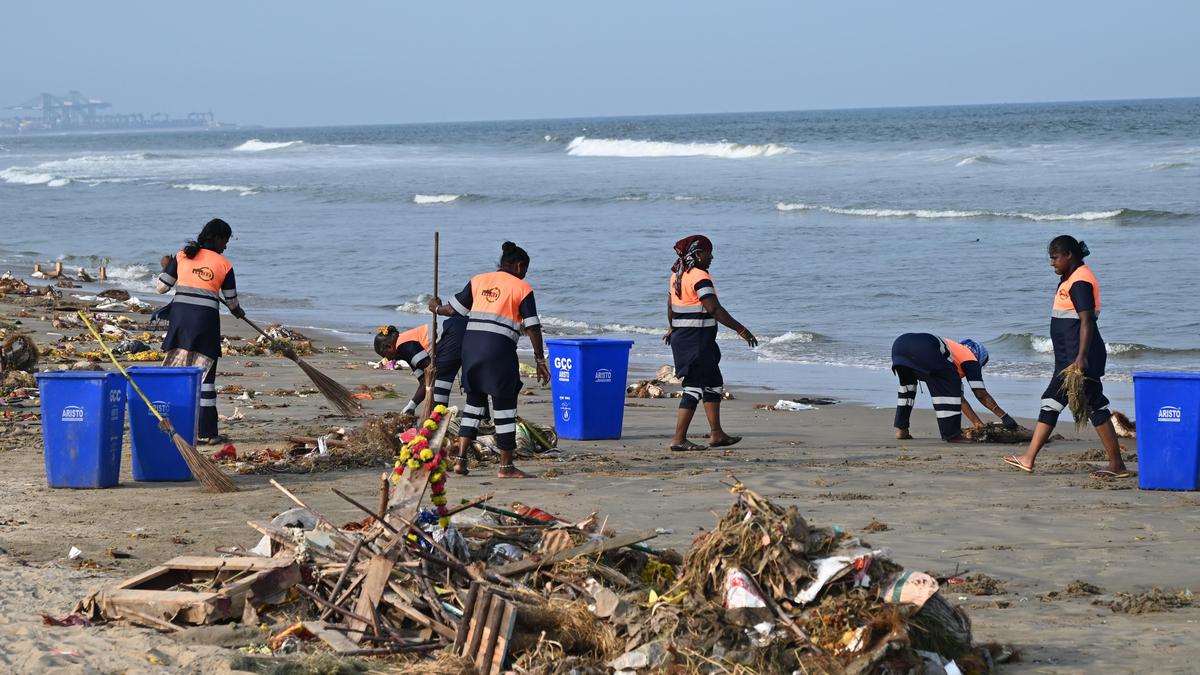


Corporation workers cleaning the Pattinapakkam beach after the idol immersion.
| Photo Credit: B. JOTHI RAMALINGAM
Scores of Vinayaka idols, which were worshipped over the past week, were found broken and washed ashore along the city’s beaches a day after the immersion on Sunday, leaving sanitation workers to clear tonnes of debris.
According to data from the Greater Chennai Corporation (GCC), 92.965 tonnes of waste were collected from the immersion sites between September 19 and September 20.
They included 9,413 idols, 61,690 kg of wooden pallets, 8,010 kg of flowers, 20,365 kg of dry waste, 1,550 kg of wet waste, and 1,350 kg of food waste.
Palavakkam accounted for the highest quantity of waste at 77.2 tonnes, including 57.1 tonnes of wooden pallets and 704 idols. At Srinivasapuram in Pattinapakkam, 4,879 idols were collected, the highest among the locations listed by the GCC.
Despite an advisory from the Tamil Nadu Pollution Control Board on eco-friendly idols, the city witnessed a huge amount of large idols made of Plaster of Paris (PoP).
A sanitation worker at Pattinapakkam, who did not wish to be named, said they had been redirected to beach-cleaning duties on Monday, and had been clearing the debris since morning.
“It is a bit sad to see the idol that was worshipped a week ago become trash,” the worker said.
M.S. Swaminathan Research Foundation scientist R. Ramasubramanian said the materials used in the idols and decorations could take days to dissolve. While the sea would disperse them over a wider area, immersion in smaller waterbodies could have a more concentrated impact, he said.
“Even in the sea, the immersion of idols made of PoP adds to existing pollution. The paint, which contains harmful chemicals such as lead and other heavy metals, can disturb the coastal ecosystem,” he said.
Marine biologist and trustee of Nizhal T.D. Babu said idols were traditionally made of clay, particularly as the festival coincided with the period before the monsoon, when lakes and rivers were desilted.
The clay from the desilting process was traditionally used by potters, he said, and returned to the periphery of the waterbodies to strengthen the bund and avoid water seepage during the monsoon.
However, the use of PoP and the trend of installing increasingly large idols for community celebrations had changed the practice over the past two decades, Mr. Babu further said.
“There must be a system in place; the government must bring out an SOP for the idols and the immersion process. There should be regulations at every stage, from the making of idols to community pandals,” he said.
Mr. Babu suggested a door-to-door collection of clay idols, which, he said, could reduce dumping, the need for large police deployments, and traffic congestion around immersion points. The dimensions and other specifications of community idols should also be declared in advance, he said.
“Vinayaka, who is believed to remove obstacles, should not be made an obstacle to environmental well-being,” he said.
Published – September 21, 2026 11:51 pm IST