






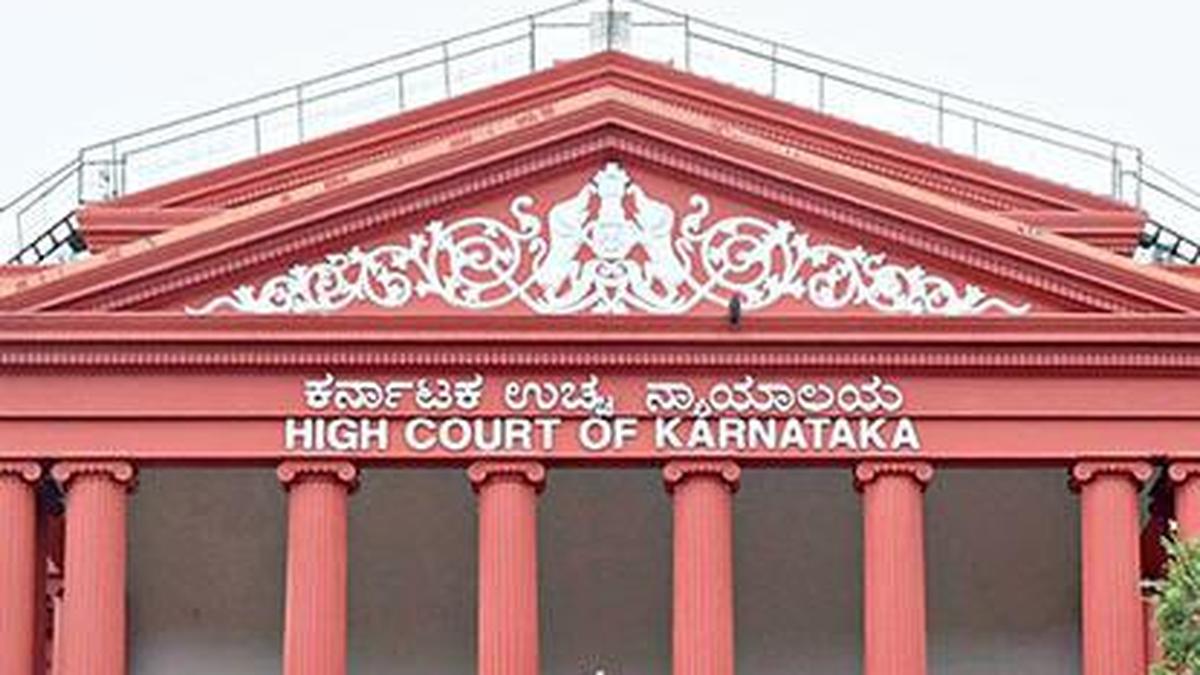


The High Court of Karnataka .
The State government also has the power, like the Central government, to invoke emergency clause under the Section 11 of the Electricity Act, 2003 to mandate all the power generating companies within the State to supply power exclusively to the State grid in ‘extraordinary circumstances’ like acute electricity shortage, said the High Court of Karnataka.
A Division Bench comprising Justice Anu Sivaraman and Justice Rajesh Rai.K delivered the verdict while allowing the appeals, filed by the State Load Dispatch Centre and the State government, against the March 11, 2024 verdict of a single Judge.
The single Judge had quashed the State government’s October 16, 2024 order asking all the power generators in Karnataka to operate and maintain the concerned generating stations to maximum exportable capacity and supply all the electricity generated to the State grid subject to certain conditions.
Single judge’s view
While allowing the petitions filed by NLS Sugars Ltd., Chamundeshwari Sugars Ltd., and Altilium Energie Private limited, the single Judge had said that only the Central government is the “appropriate government” under Section 11 of the Act for issuing direction under ‘extraordinary circumstances” to even those energy generating companies engaged in inter-state electricity transmission.
The State government, invoking Section 11 of the Act, had issued on October 16, 2023 a notification when Karnataka was reeling from a severe power crisis triggered by a failed monsoon and depleted hydel reservoirs, resulting in a deficient power supply of approximately 3,000 to 3,500 MW. The State had directed all power generators, including captive and co-generation plants, to operate at maximum capacity and supply their entire power to the State grid at a provisional tariff of ₹4.86 per unit.
Reserved
While reversing single Judge’s verdict, the Bench said: “In our view, the internal coherence of Section 11 of the Act is a bulwark interpretation in circumstances when the embedded generators operate within a State, although trades/sells power inter-state, the State Government is the appropriate government capable of both issuing directions and ensuring compensation through the State Electricity Regulatory Commission.”
Also, the Bench said that “ideally extraordinary circumstances, in context of Section 11 of the Act are archetypically regional and confer jurisdiction on the State government over generators physically located within the State during state specific crises.”
On the nature of power generation by the petitioner-sugar industries, the Bench said that though the regulatory framework permits captive generators and co-generation plants, like the ones operated by the petitioners, to sell surplus power through myriad mechanisms, however, this flexibility does not alter their fundamental character as embedded State generators primarily serve captive load.
Mere grant of No Objection Certificates (NOC) from the SLDC for scheduling power through open access and registered on power exchanges to sell surplus power does not transform captive generators like the petitioners into inter-State generating company under a composite scheme, the Bench said.
Published – December 22, 2025 08:02 pm IST