



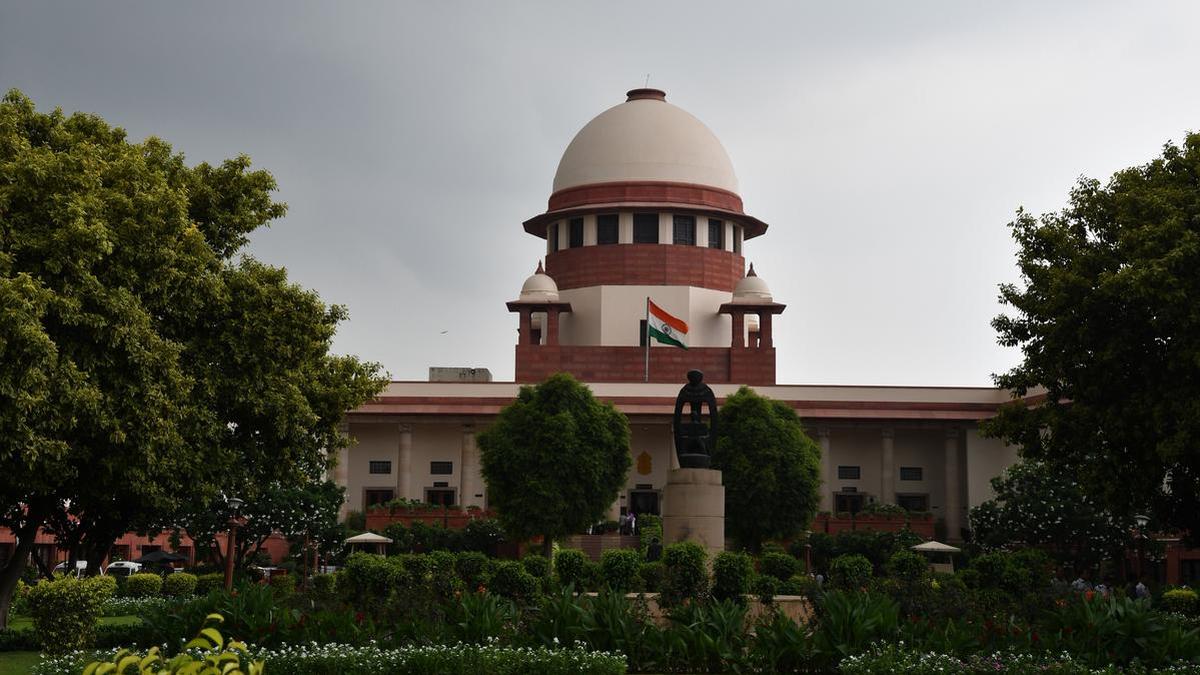


A general view of the Supreme Court in New Delhi.
| Photo Credit: The Hindu
The Supreme Court on Friday (October 9, 2026) dismissed the Andhra Pradesh government’s appeal against a High Court ruling that struck down its decision to restore 34% reservation for Backward Classes in local bodies. The court upheld the October 1 verdict that the State had failed to produce the empirical data necessary to justify breaching the 50% reservation ceiling.
Also read: Government taking steps to provide 34% quota for BCs in all local bodies, says A.P. Minister
Senior advocate Mukul Rohatgi contended before a Bench of Justices Dipankar Datta and Sheel Nagu that the State’s decision was supported by demographic data and other empirical material, but the High Court had erroneously concluded that it fell short of the requirements previously laid down by the top court for breaching the 50% reservation cap.
Court is unconvinced
The Bench, however, remained unconvinced, observing that figures drawn from a unified family survey were insufficient to justify the enhanced quota in the absence of a specific empirical assessment of backwardness and representation in local bodies.

“You show us how this data can be considered. This is a unified family survey. Under what law is this being made? Very reasonable approach by the High Court,” the Bench remarked while dismissing the plea.
In its appeal against the October 1 verdict, the State government sought to distinguish the 2026 exercise from the reservation framework struck down six years earlier, arguing that the quota had been determined afresh on the basis of a Statewide survey, verification by gram and ward sabhas, local-body-wise data and the findings of an independent dedicated commission.
Breaches 50% ceiling
According to the State, the survey pegged the Backward Classes population at 50.42% across Andhra Pradesh — 48.84% in rural areas and 54.35% in urban areas. It maintained, however, that the enhanced quota was not determined by population figures alone, but drew on a range of material gathered during the exercise.
In March 2020, the Andhra Pradesh High Court had struck down the then YSR Congress government’s decision to provide a 34% reservation for Backward Classes in local bodies after finding that it would take the combined quota for SCs, STs and Backward Classes to 59.85%, well beyond the 50% ceiling prescribed by the Supreme Court. The High Court had directed the State to bring the quota within the overall limit and undertake a detailed, data-backed exercise to establish backwardness.
In its 2021 ruling in Vikas Kishanrao Gawali v. State of Maharashtra, the top court had ruled that a contemporaneous and rigorous empirical inquiry into the nature and extent of backwardness in relation to local bodies was a prerequisite for such reservation.
The State government sought to restore the enhanced quota this year ahead of the local body elections. In August, it issued two government orders providing 34% reservation for Backward Classes in rural local bodies and 33.33% in urban local bodies.
On October 1, the High Court struck down the orders to the extent that they pushed the aggregate vertical reservation for SCs, STs and Backward Classes beyond 50%. A Division Bench of Chief Justice Lisa Gill and Justice Challa Gunaranjan rejected the State government’s reliance on the unified family survey as a sufficient basis for declaring reservation beyond 50%.
The High Court, however, did not foreclose the possibility of a higher quota for Backward Classes. It said the State could revisit the proposal after undertaking the empirical exercise mandated by the Supreme Court’s earlier rulings.
Published – October 09, 2026 11:02 pm IST