


Historical records of debates on the Justice Ismail Commission Report that took place in the Tamil Nadu Legislative Assembly as well as Legislative Council (since abolished) in 1978 reinforce that former Chief Minister and DMK president M.K. Stalin was indeed a political detenu under the Maintenance of Internal Security Act (MISA) during the Emergency.
The Commission headed by then Madras High Court judge M.M. Ismail was set up during the President’s Rule in May 1977. The Commission was mandated to conduct an inquiry into the incidents of beating and ill-treatment alleged to have taken place in the Central Prison, Madras, during February 1976 to February 1977.

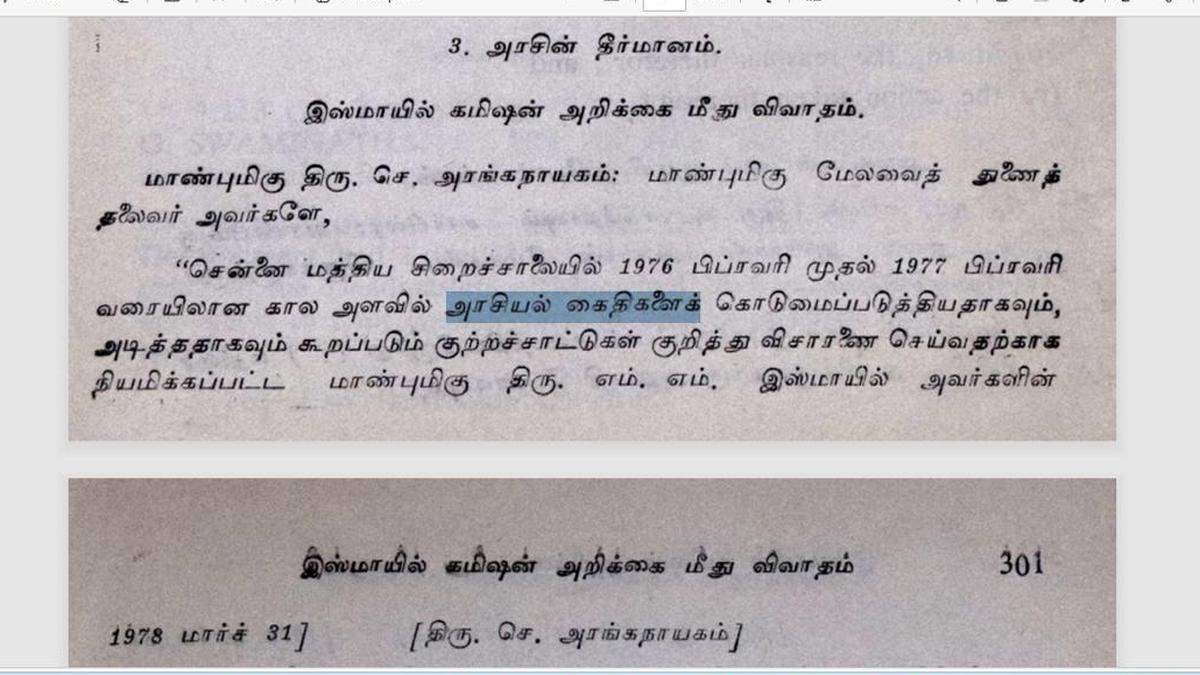
Records from the Tamil Nadu Legislative Assembly of speech made by M. Karunanidhi in 1978.
| Photo Credit:
Special Arrangement
As many as 88 prisoners were detained at the Madras Central Prison under the MISA. Prominent among them were Mr. Stalin, Dravidar Kazhagam leader K. Veeramani, former MLA Arcot N. Veerasamy (later Minister), DMK leader Murasoli Maran, and then MP Chittibabu.
The charge was that several detenus including Mr. Stalin, arrested soon after the dismissal of the M. Karunanidhi Government, were beaten up severely upon their arrival in the prison.

By the time the Commission submitted its report to the Government of Tamil Nadu in September 1977, the AIADMK headed by M.G. Ramachandran (MGR) had taken over the reins of power at the Fort St. George.
On March 31, 1978, a Government resolution was moved by Minister C. Aranganayagam on the floor of the Tamil Nadu Legislative Council to discuss about the Ismail Commission Report on the allegations of attack on the “political detenus”. Mr. Veerasamy spoke at length for more than an hour graphically describing the attack on the MISA detenus inside the prison.

Thereafter elaborate discussions on the report took place in the Legislative Assembly on April 6 and 7. On the second day, then Leader of Opposition and former Chief Minister M Karunanidhi spoke extensively on the arrest of the political party functionaries, following the dismissal of his government on January 31, 1976. The text of his speech, typed by the Assembly stenographers, ran to nearly 15 pages.
Karunanidhi recalled how family members of the MISA prisoners were denied an opportunity to meet them in Madras Central Jail even nearly four weeks after their detention. On February 26, 1976, he had shot off a telegram to Prime Minister Indira Gandhi, which read: “Interview for relatives of MISA detenus of DMK party in Tamil Nadu not yet granted for past 26 days in Madras prison. Reason we reliably understand the detenus are mercilessly beaten inside the prison. MPs, former MLAs and office bearers of DMK party are amongst such detenus so beaten. Request your immediate intervention preventing ill treatment and necessary action to get interview.”

The following day, he had written a letter to the President, explaining about the attack and poor prison conditions. “I do hope that your conscience will not accept the way in which the political prisoners have been treated worser than those who have been convicted for murder. I request you to save the jail birds from torture by the Madras Central Jail authorities,” he wrote.
A day later, Karunanidhi had telephoned Inspector General of Police F.V. Arul and gave him an ultimatum – he would go on a fast outside the jail if family members were not allowed to meet the prisoners by 1 p.m. the next day. It was after this that the authorities allowed them to meet the inmates.

Records from the Tamil Nadu Legislative Assembly of speech made by M. Karunanidhi in 1978.
| Photo Credit:
Special Arrangement
The DMK leader recalled his emotional meeting with his 23-year-old son Mr. Stalin with few words exchanged as the police were watching over the inmates.
Karunanidhi utilised the opportunity in the House to ensure the key extracts from the prison diary of the late Chittibabu, whose health condition had suffered a setback during the assault by prison staff, made its way into the Assembly records.

Referring to the discussion over the diary, Karunanidhi posed in the House: “Before his death, did Chittibabu write the diary anticipating such circumstance would befall him? Don’t we all know Chittibabu? Isn’t Chittibabu our close friend? Doesn’t the Finance Minister [Nanjil] Manoharan know, when we were together [DMK before the split], about how Chittibabu functioned efficiently as Mayor of Chennai and got fame? Didn’t he perform efficiently as an MP who was praised by Anna [C.N. Annadurai]? Are we doubting his diary?…. We need to ponder over this. At the time of penning his notes, Chittibabu could not have anticipated that the Ismail Commission would be constituted. He wouldn’t even have had an inkling that this diary would serve as an evidence. He had merely penned what happened…”
Referring to a demand by CPI(M) MLA Govindarasan to provide a compensation of Rs. 5 lakh to Chittibabu’s family, Karunanidhi said: “Even that is not required. It would be no exaggeration to say that if that great warrior’s diary makes its way to the records of this House, that would be the greatest honour for him.” Thereafter, Karunanidhi read out the key excerpts from the diary including how Surulirajan, a jail warder, had placed his boots on the face of Mr. Stalin, who had fallen on the ground inside the prison cell.

Records from the Tamil Nadu Legislative Assembly of speech made by M. Karunanidhi in 1978.
| Photo Credit:
Special Arrangement
[Other prominent MISA detenus in the country who had maintained a diary of what happened in the jail included the Gandhian leader Jayaprakash Narayan and actor Snehalatha Reddy, who like Chittibabu had died after being released from detention in Bangalore.]
A day earlier, in the Assembly, Durai Govindarajan, the Government Whip, cited the speech of another member, Jebamani (also a MISA detenu), to wonder if the latter was hinting at something deeper when he had said, “a son may face a situation where he would have to take the punishment for the mistakes committed by his father.”

Immediately, former Minister K. Anbazhagan (DMK) intervened, and said it was not proper for the Government Whip to make such statements with inner meaning. Jebamani responded saying he had not made that statement with any ulterior meaning. The Government Whip then said: “I only made a general statement and did not say that it was right to beat up Stalin there (in the cell).”
Not giving up, Anbazhagan contended Jebamani’s speech and Govindarajan’s statement appeared to convey that Mr. Stalin was imprisoned and beaten up because he was the son of the [former] Chief Minister.
Published – September 16, 2026 06:30 am IST