



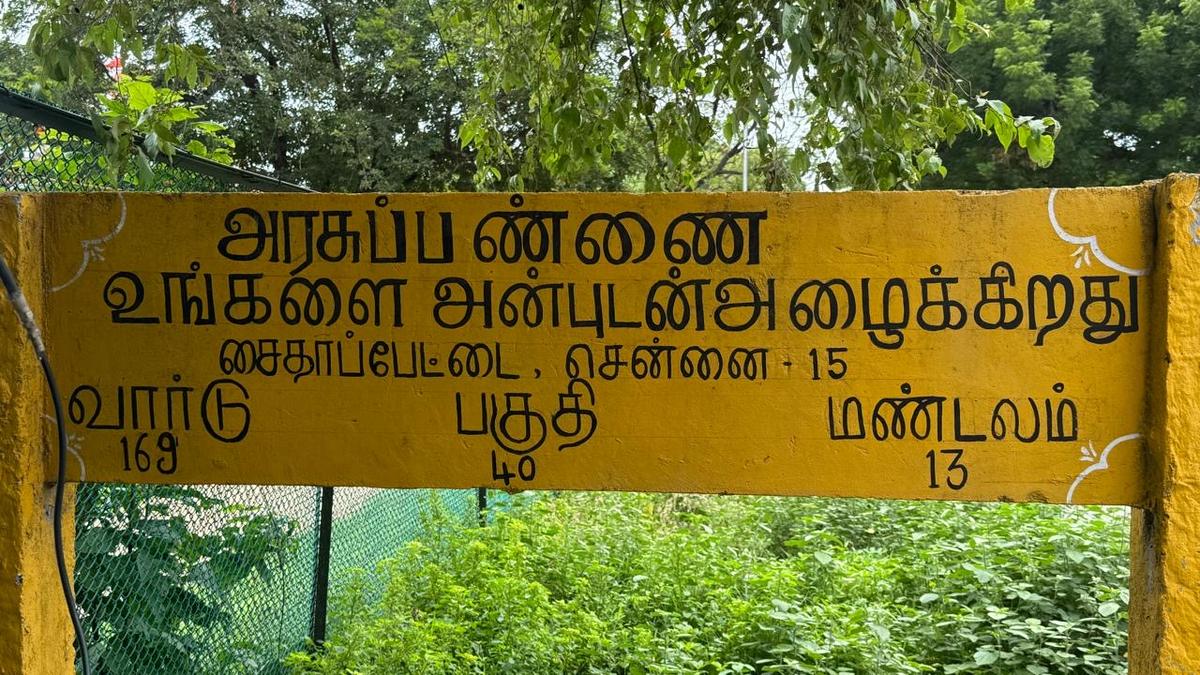


A board signifying ‘Government Farm’ in Chennai
| Photo Credit: Sriram V.
Most accounts of the city, and I include those that were written well into the 1980s, mention with some wonder that the lands to the south of Gemini Circle comprised essentially farms with wet cultivation. They also include the caveat that this was so ‘until recently’ and by that, working backwards, it would appear that farming did take place along much of Mount Road/Anna Salai as it went south, till the early 1970.
The presence of Vellala Teynampet, which was the name for one of its two halves, the other being Vanniyar, shows that agriculture was practised here, and this includes areas such as Raja Annamalaipuram. The Long Tank of Mylapore was certainly a reason for so much of farming and today, as you walk along such areas, you may come across residences named Farmhouse or Field View much to your surprise. But there was sound logic at one time for these.

Of all such anachronisms that have survived, Government Farm Village is perhaps the oldest. It still exists in name, its address given variously as Nandanam, Saidapet, Thatandar (ouch, sorry Sir Charles Todhunter) Nagar, and the Golf Links. All of them happen to be correct. But of Government Farm, there is none. At one time, it spanned 300 acres with a fence all around it. The idea of Governor Sir William Denison, it was set up in 1865. Three years later came William Rowntrie Robertson from the Agricultural College at Cirencester and he superintended the development of the farm for almost two decades. Under him, “139 acres were under crop, and a further 36 under timber, chiefly casuarina.” The latter is significant, for the big public works of Madras city required tonnes of firewood in making bricks and moving loads. The casuarina groves we see as we drive along ECR are the remnants of the time when this wood was in massive demand.
Robertson, after whom it is very likely the eponymous lane in Raja Annamalaipuram is named, suggested several changes in the way cultivation was undertaken in Madras Presidency. At the farm, he demonstrated alternating between dry and wet agriculture, introduced new tools, advised on the importance of proper irrigation, and the usage of manure. He also set up a School of Agriculture here with subordinate branches in the various districts. The sale of implements, seeds, and other products brought in modest revenue but the farm and the school depended on government munificence to keep them going even in the 1880s.

Opposition to Government Farm
The naysayers were in plenty. As late as in 1897, The Madras Mail was railing against the futility of setting up a Government Farm near the city. It declared that the site itself was a mistake – “a hungry tract of land near the sea coast, ploughing the sands of which would yield little about the soils of the interior and get up no new data for the irrigation works.” The Mail also noted that Madras was not alone in this, for the same mistake had been made in Bombay, Bangalore, and other places. Cities were chosen chiefly because students for the school were easier to get. The Mail argued for the setting up of such facilities where two or more distinct geological formations existed to ensure a variety in the soil. It should be noted, however, that of all the Government Farms set up across India, the Madras Farm was the only survivor by 1898. And by then, it was operating on a very small acreage – 20 or so, the balance having been taken up for other purposes, including the Teachers Training College.

In 1898, perhaps acceding to the criticism of The Mail, the government decided to add two more farms, one in Bellary and another in Koilpatti, for cultivating cotton and improving its yield. Both seem to have been short-lived. But even then, the soil of Coimbatore was studied and early in the 20th century, the farm and the school were transferred there, becoming what is today the Tamil Nadu Agricultural University. This move was also widely criticised, the college being branded a white elephant. Agriculture then, as now, seems to have been a complicated subject with no uniformity on what could be done.
The land back in Madras was, however, still designated the Government Farm Village, all 300 acres of it, no matter that the Teachers Training College was occupying some of it. In the early 1920s, when the new colony of Theyagaroya (yes, that was the spelling) Nagar was planned, named at inception as the Mambalam East Town Planning Scheme, the lands of Government Farm village came in very convenient. As the remnants did in the 1950s when Nandanam was laid out. On paper, however, all of this remains Government Farm Village. Memories die out very slowly in Madras.
(Sriram V. is a writer and historian)
Published – September 23, 2026 06:25 am IST