




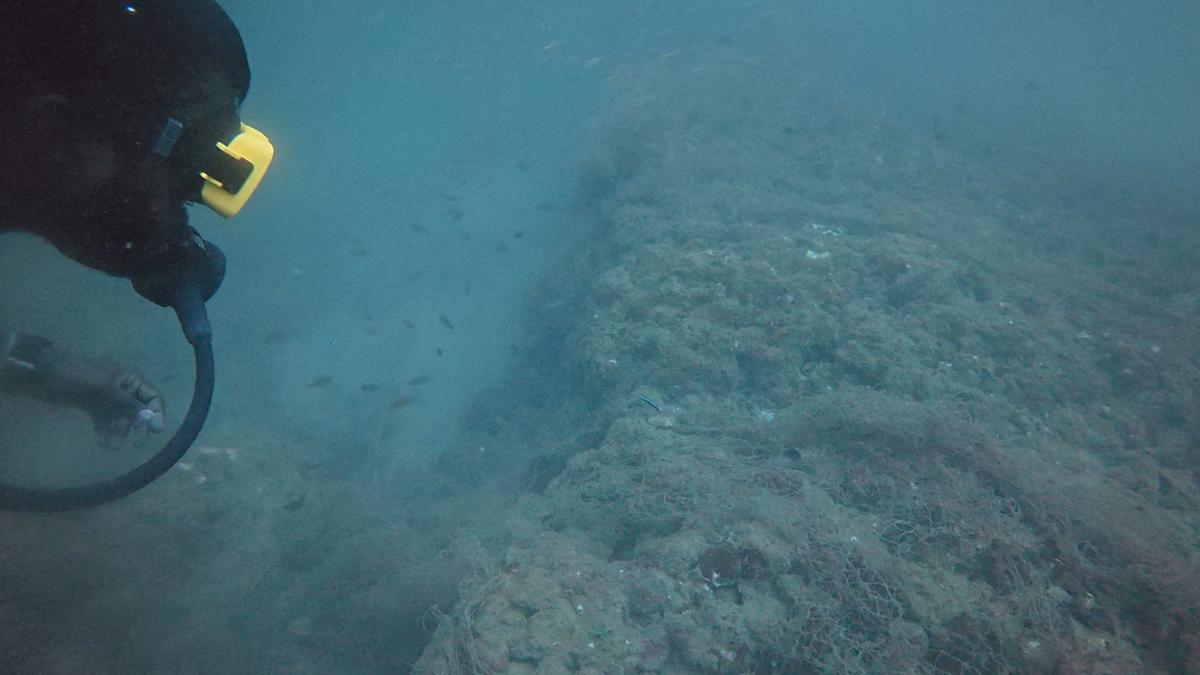


The third phase of underwater archaeological explorations off the coast of Poompuhar in Mayialduthurai district yielded a torpedo jar fragment, ring wells, and ceramics.
| Photo Credit: Special Arrangement
In a first-of-its-kind finding in underwater archaeological exploration in Tamil Nadu, a broken piece of a torpedo jar, believed to have been brought from West Asia during the early historic period, has been found by archaeologists of the Tamil Nadu State Department of Archaeology (TNSDA) during the third phase of the survey off the Poompuhar coast in Mayiladuthurai district.
V.P. Yathees Kumar, Joint Director (in-charge), TNSDA, and three other archaeological experts, found the fragment at a depth of about 10 metres and around two kilometres from the coast, in the sea between Poompuhar, the ancient port city once known as Kaveripoompattinam, and Thirumullaivasal.
Mr. Kumar told The Hindu that this was the first time a piece of a torpedo jar, a tubular vessel with a cylindrical body and a narrow mouth, had been found underwater off Poompuhar. Similar torpedo jars had earlier been found at archaeological sites such as Alagankulam, Korkai, and Porpanaikottai. Torpedo jars were generally used to transport liquid commodities such as wine or oil by ship. Their shape helped prevent the contents from spilling during transport, he said.

The broken piece of a torpedo jar that was found during the exploration off the coast of Poompuhar in Mayiladuthurai district.
| Photo Credit:
Special Arrangement
The fragment is made of a fine variety of ceramic. Based on its shape, the diameter of the complete torpedo jar is estimated to have been 30 cm to 35 cm. It is believed to have come from West Asia. More than 250 ceramic pieces, including glazed ware, have been recovered during the underwater exploration, which covered nearly two square kilometres.
The archaeologists also found four ancient ring wells with diameters ranging from 60 cm to 65 cm. According to Mr. Kumar, the discovery of the ring wells indicates that a palaeochannel might have been present at the location.
The findings have emerged from a preliminary investigation and are significant in the context of the continuing changes to the Poompuhar coast and sea floor owing to erosion. The TNSDA would take up further investigations in greater detail.
The third phase of the underwater exploration was launched on September 6 by Minister for School Education and Archaeology Rajmohan. It continued for 18 days and concluded on Tuesday (September 22, 2026).
Published – September 22, 2026 09:51 pm IST