






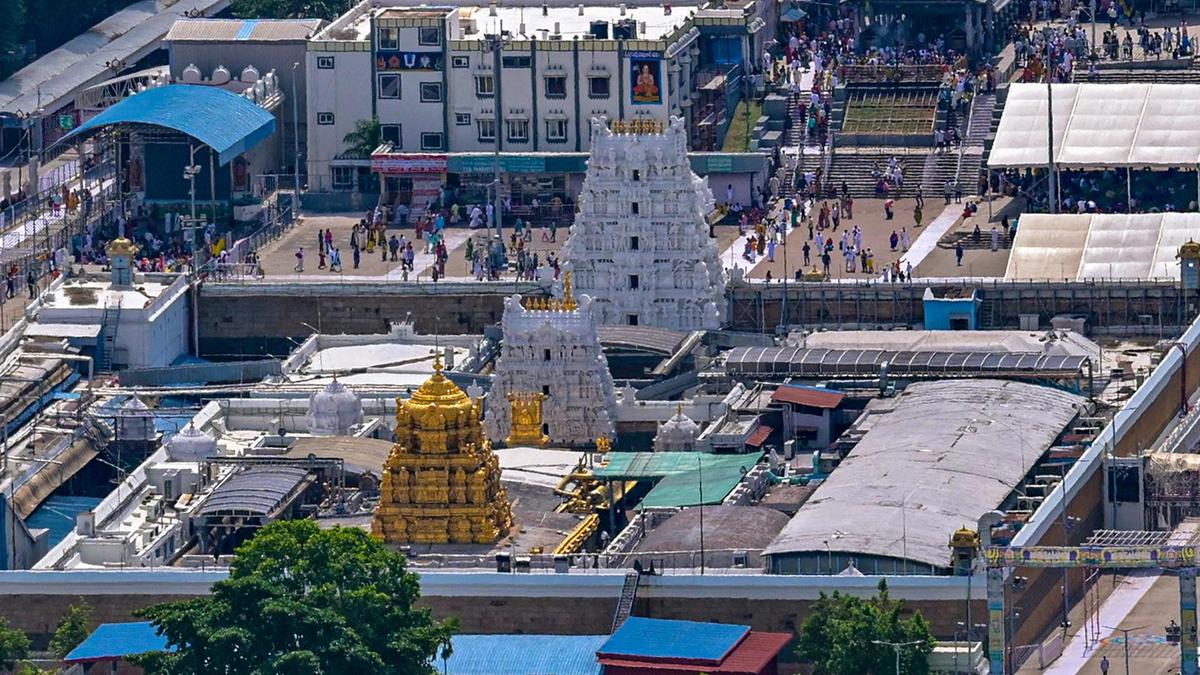

Tirumala, the abode of Lord Venkateswara, witnesses a heavy influx of pilgrims on the auspicious ‘Vaikuntha Ekadasi’ every year. But the darshan system has evolved four times over the last six years, indicating that efforts are on to find the best alternative.
After the unfortunate stampede in Tirupati on January 8 early this year, which led to the death of six devotees and caused injuries to 20 others, the Tirumala Tirupati Devasthanams (TTD) is treading cautiously.
‘Vaikuntha Ekadasi’ is an auspicious day in the holy month of ‘Dhanurmasam’ (December – January). The ‘Uttara Dwaram’ (threshold) is kept open and the devotees are allowed to pass through it, which is considered a symbolic prerequisite to attain ‘moksha’ (liberation).
As this essentiality makes heavy crowds zero in on this day, the shrines keep the threshold open even the following day, ‘Vaikuntha Dwadasi’, to tackle the spillover crowd.
Ever since the TTD’s formation in the 1930s, significance has been attached only to ‘Vaikuntha Ekadasi’ in Tirumala, which, over the last few years, cascaded to the second day. However, the darshan token issue system has evolved over four formats from 2018 to 2025.
Till 2018, it was the regular two-day affair. In a novel experiment from December 25, 2020, the TTD had emulated the Srirangam temple format of keeping the threshold open for 10 days. The switchover led to higher footfalls.
Under the two-day format in January 2015, a total of 1,63,080 devotees had darshan, followed by 1,68,743 (December 2015), 1,77,101 (2017), 1,67,417 (2018), and 1,74,738 (January 2020).
In the 10-day format on December 25, 2020, the number, notwithstanding the COVID-19 pandemic, jumped to 4,25,472, followed by 3,78,928 (2022), 6,09,283 (January 2023), 6,47,452 (December 2023), and 6,83, 304 (January 2025).
The metamorphosis of format was quite complex, in four stages. In 2019, devotees walked in straight into the temple to get darshan on a first-in, first-out basis. From 2020 to 2022, during the 10-day affair, they still walked in straight, waited for longer hours and then had darshan.
After the slotted system was introduced in 2023, the token issue counters were brought down from Tirumala hills to 10 centres across Tirupati city, some of which were not even known to the pilgrims.
E-dip system
Now, the TTD has taken its experiment to a new high by issuing tokens online, in advance, through an ‘e-dip’ system.
Accordingly, tokens have been issued for the first three days — Vaikuntha Ekadasi (December 30), Vaikuntha Dwadasi (December 31), and the New Year (January 1) at the rate of 60,000 a day. Devotees will be allowed normally from the fourth to the 10 days.
Though this system is meant to increase predictability in darshan timing and prioritise those planning their darshan in advance, it still suffers from one predicament.
There is a section of regular visitors that often springs a surprise. Clothed in yellow robes, devotees who have taken the ‘Govindamala’ vow follow abstinence for 42 days and relinquish their vow on this day in Tirumala.
They are sure to reach Tirumala in batches, potentially making the TTD’s plans go astray. The e-dip system has no provision to accommodate this section of “unexpected visitors.”
The current format, which is the fourth in the last six years, is believed to be the best answer to a nagging problem faced every year, but the officials are still unsure if this will work out to be a lasting solution.
While reviewing the January 2025 stampede, Chief Minister N. Chandrababu Naidu had squarely blamed the 10-day format and vowed to do away with it. The system, however, continues even today.
Published – December 27, 2025 08:19 pm IST