








Anne Hathaway in ‘Verity’
| Photo Credit: Amazon MGM Studios
You know how it is with adaptations. You are invited into a world without the stray pleasures of imagination as someone else reads between the lines for you. The personal ambiguity takes shape of a collective uniformity; what you are seeing is how one person read the book. That way, the twisted dynamics of Colleen Hoover’s novel, Verity, seem to be forever at odds with the audio-visual sense of director Michael Showalter in the adaptation. While telling a story that is rooted in the idea of truth and its manipulation, Michael leads with a sensationalist reckoning, leaving little space for nuance in the tone as he infuses flashy visuals, jump-scary edit patterns and a nosy, The Shining meets Final Destination-type background score to the proceedings. As Jack Torrance would say, it’s all no work, no play.

It pains me to resurrect Stanley Kubrick’s inventive re-imagination of Stephen King’s iconic novel here but Verity tries to bring a similar eeriness to the forefront in its opening portions as the generic beats of the score underline the arrival of something terrible. The action point towards this violence too as a struggling writer Lowen Ashleigh (Dakota Johnson) sees an accident happen in front of her and blood splatter all over her body. On way to a meeting with a big publisher, Lowen has no choice but to accept help from a stranger, Jeremy Crawford (Josh Hartnett), who offers his white shirt to her. It is a scene that brings only a momentary unsettling feeling to the front as it leaves little impact on Lowen, who seems rather unfazed by it.

Dakota Johnson in ‘Verity’
| Photo Credit:
Amazon MGM Studios
A sense of superficiality starts crippling early on as Lowen comes to know Jeremy as the husband of bestselling author, Verity Crawford (Anne Hathaway), who wants Lowen to complete her upcoming book after a car accident leaves her comatose. Verity can’t move nor can she speak when Lowen comes to stay at her luxurious house to gather all the material to work on the novel. It’s here that Lowen comes across an autobiographical piece that Verity had started writing, which reveals darker secrets about her obsessive relationship with Jeremy and her hate towards their twin kids.
Verity (English)
Director: Michael Showalter
Runtime: 117 minutes
Cast: Anne Hathaway, Dakota Johnson and Josh Hartnett
Synopsis: A struggling author gets a lucrative opportunity to ghost write a novel for a popular writer after a car accident renders her comatose
Taking on the material from Hoover, Nick Antosca’s screenplay is devoid of subtexts. The psychological density of the story is presented with a direct outcome in scenes that only focus on the action of events while forgetting to shape the inner lives of characters and their relationships. The film seems to be stuck in the minds of Lowen and Verity, with voice overs dryly explaining major plot points. The lackadaisical writing meets with a perennially disjointed taste of Michael, whose dated handling riddles the film with the emotional intelligence of a B-grade movie, where everything that happens before is irrelevant to the steamy action that follows.

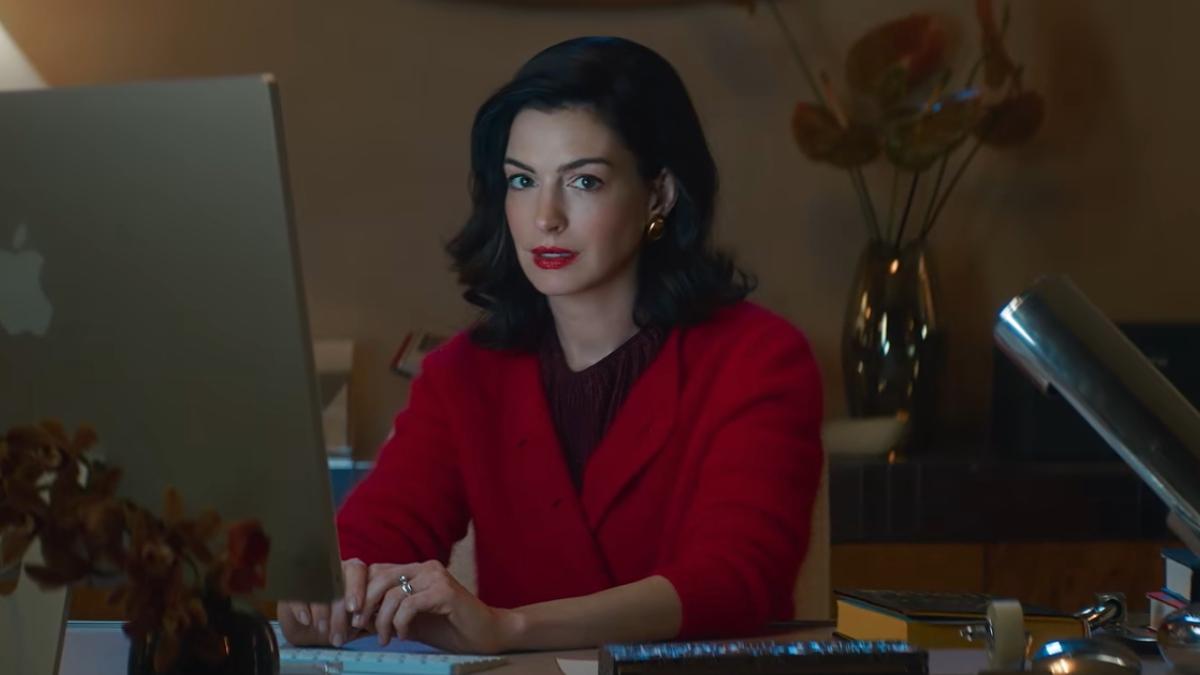
Anne Hathaway in ‘Verity’
| Photo Credit:
Amazon MGM Studios

Forget a dark, twisted, erotic drama, what’s hiding beneath Verity is an unrealised parody. How else can you explain the unintentional humour that it brings with the awkward positioning of Verity on a wheelchair? How does one take seriously the apparent romance blossoming from Jeremy reminding Lowen of pudding remnants on her lips? Its characters belong to a movie and not in real-life and their only tragedy is in not being even minutely self-aware. The seriousness feels compulsive even in the intimate scenes which play over with a caged physicality, whose only motivation to be part of the film is to justify its genre. That’s why repetitive visuals show Lowen taking a shower, changing her clothes or suggestively eating her food. What’s corny becomes cornier; Verity gets very tedious.
I wouldn’t have imagined a review turning shamefully to puns to describe a Dakota Johnson and Anne Hathaway starrer that was promoted widely for the sizzling chemistry between the two. Having watched the film, I now understand the real reason for that scene. It serves purely as an object of male desire, having little significance in the narrative other than acting as yet another sensationalist piece. Other than that, Anne feels surprisingly lost in the film, never quite getting to her enigmatic groove while Dakota struggles to evoke a sense of tension and vulnerability. In the earlier scene, after blood splashes on her face, Jeremy is confused if she is calm or worried. He addresses his inability to understand her facial expressions again in another scene as Lowen reasons, “That’s just my resting face.” Wait, was he asking to Dakota or Lowen?

Not that Hartnett guarantees a defining screen presence either. A film that is going down, destroys everything that it touches, including Hartnett’s sense of rhythm. What is shown is not implied and what is implied is not shown. Maybe a line that Verity writes in her autobiography is actually a hidden cautionary message for us. “There is no light where we are going”. Maybe that’s the truth that the film is ultimately manipulating, which ushers it towards an open ending. The weight of its glory ultimately rests on the climactic twist which leaves you with a truth, a manipulation and a false hope of wishing it had all come together coherently. Maybe a certain Vijay Salgaonkar will give an answer to Hollywood in Drishyam The Conclusion.
Or maybe not. You know how it is with adaptations.
Verity will be released in theatres on October 2
Published – September 30, 2026 06:31 pm IST