


Abhishek Bachchan and Shoojit Sircar were fated to work together. Sircar has, over the years, extracted at least two great performances from Abhishek’s famous father, Amitabh — Bhaskor Banerjee, the high-pitched hypochondriac in Piku (2015), and Mirza, the curmudgeonly landlord in Gulabo Sitabo (2020). Combine shades of both characters and you will arrive at someone close toArjun, the frumpy cancer survivor with a ticking mind, played by Abhishek inI Want to Talk.

The film, currently playing in theatres, is based on a true story: marketing whiz Arjun Sen endured twenty surgeries while single-handedly raising his daughter (or perhaps she raised him, as the title of Sen’s book winks). It is an unglamorous, somewhat familiar work from Sircar, with his yen for difficult filial relationships and the humour of healthcare. “My father died of cancer and my mother passed away due to a stroke,” Sircar says. “I spent a chunk of my younger life around hospitals. You see glimpses of it in my films. I am not worried about death. I celebrate death.”
Excerpts from an interview with Shoojit and Abhishek…
‘I Want to Talk’ is your first film collaboration. What did you guys discover about each other’s working methods?
Shoojit Sircar: I have worked with Abhishek’s dad for more than 17 years now. I have done four feature films with him and hundreds of commercials. They are different personalities, father and son. Mr Bachchan comes from the era of film stock, so he does everything in one take. His first take has to be right and for that, he can rehearse the entire day. With Abhishek, his process is one of quiet acclimatization. He will come to the set, hang around, have his chai or coffee, and gradually ease into the character. I will make eye contact with him and figure out if he is ready or not. I never disturb my actors.
AB: As a performer, I need to be comfortable with the environment I am in. I don’t like stress. I don’t like any confrontation because none of that matters in front of the camera. Never once in this entire film did Shoojit dada ask me to hit my marks. That’s not his thing. Whatever came naturally to me, he captured that. We did one or two rehearsals before a scene. He has this basic sense of where things are moving and then he lets you be.
Why were prosthetics avoided for the various looks?
AB: I’ve tried putting on a fake belly in earlier films and, first of all, it doesn’t move naturally. The silicon doesn’t get the kind of movement that a natural belly does because, at the end of the day, it’s one singular body. Secondly, there is a discomfort with prosthetics that affects performance. By putting on actual weight, I didn’t have to ‘act’ fat. There are a lot of scenes when I’m standing up with effort because it was all natural.
SS: True, we needed that. Arjun’s body language and mannerisms had to look real.
Early in the story, Arjun, separated from his wife, says he is not an ‘absentee father’. Yet, as the film unfolds, we see the gaps in his relationship with his daughter…
SS: Since 2020, I used to have long discussions with the real Arjun Sen over Zoom. I also spoke to his daughter, Raka. There were two emotions that spoke to me. Firstly, as busy parents, we end up stealing crucial time from our children when they are growing up. Secondly, Raka told me that, even after all they have been through, she has yet to have that one heart-to-heart conversation with her father. They are still opening up to each other, and that reconciliation is still waiting to happen. I thought it was another beautiful cinematic emotion to tap into.
AB: My mother (Jaya Bachchan) had stopped acting in films when I was born because she wanted to spend time with the children. But we never felt the void of dad not being around. At the end of the day, he always came home.
SS: But you see, at least one of them was constantly around. It’s a huge sacrifice that your mother made…

AB: That’s right. Even in my household, I’m lucky I get to go out and make the movies, but I know that Aishwarya is at home with Aaradhya and I thank her immensely for that. But I don’t think children think of it that way. They don’t look upon you in the third person.
SS: Generally as men, something stops us from possibly expressing the finer things. We lack the communication skills that mothers have. I have felt that with my two daughters.
AB: Because I think genetically women are wired to be nurturers, we’re not. That’s one of the fundamental differences between men and women. Men are not comfortable being demonstrative with their love.

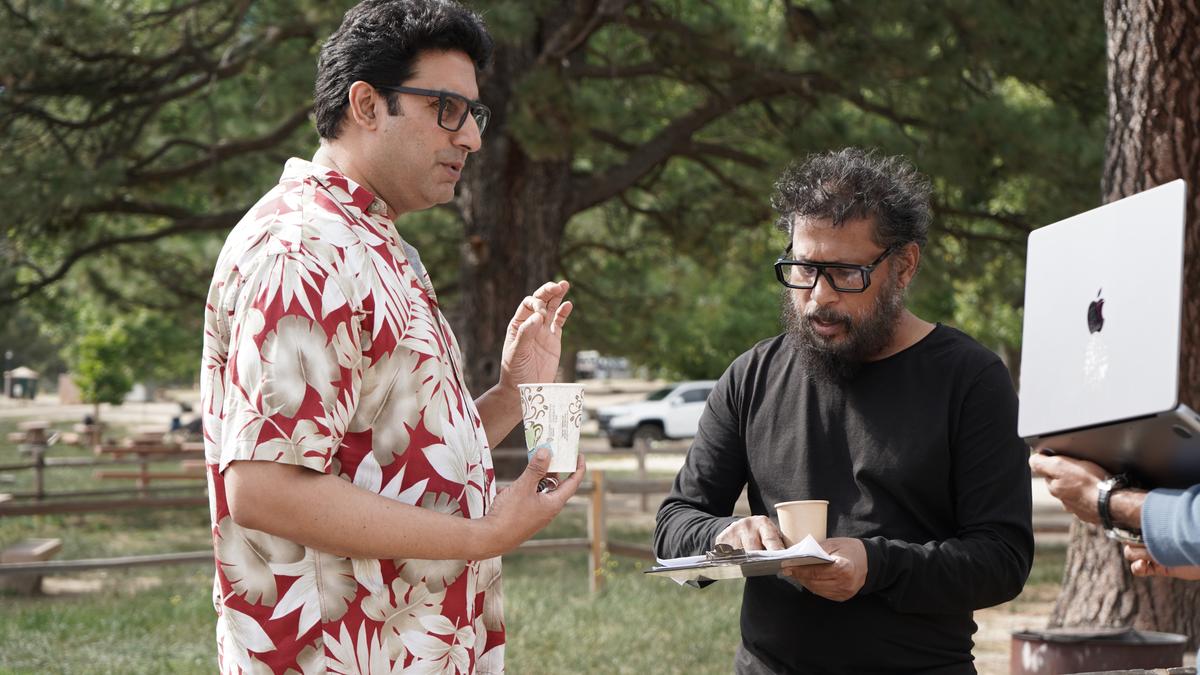
Shoojit and Abhishek with Johnny Lever on the sets of ‘I Want to Talk’
| Photo Credit:
Special Arrangement
I enjoyed the sequence where Arjun’s own parents turn up. It’s a funny cross-section of values in one family…
SS: You see, the problem of the generation gap has existed for ages. From our vantage point, we think that the present generation doesn’t understand what’s best for them. But I have reconciled myself to the fact that the present generation is really intelligent. There’s no doubt about it. So it’s a learning process for me. When I see my two daughters and how they are treating me, I know what I’ve done wrong and I am doing my course correction now. It takes 20, 30 years to course-correct.
AB: There’s something that Arjun da’s daughter used to always say. And then Shoojit would tell me the same thing. It’s that we don’t bring up our children. They bring us up. Parents don’t have all the answers. We’re also learning along the way.
Arjun is called ‘manipulative’ by his doctor. Even at his lowest, we see his marketeers’ mind at work. What went into making Arjun a complex character in his own right?
AB: Arjun has the gift of the gab. He can talk himself in and out of any situation. Marketing is his mojo, and he applies the same philosophy in life. I mean, take for instance how he convinces the doctor for the Bi-Max surgery. He appeals to his sense of duty, the duty to protect a patient’s life. Elsewhere he reassures his daughter by saying he does not feel pain, then lightens the mood by saying the FBI should have employed him.
SS: Between us and Ritesh (Shah screenwriter), we decided that we were not going to underline things. We wanted to play a joke on every adverse situation because the character is like that.