



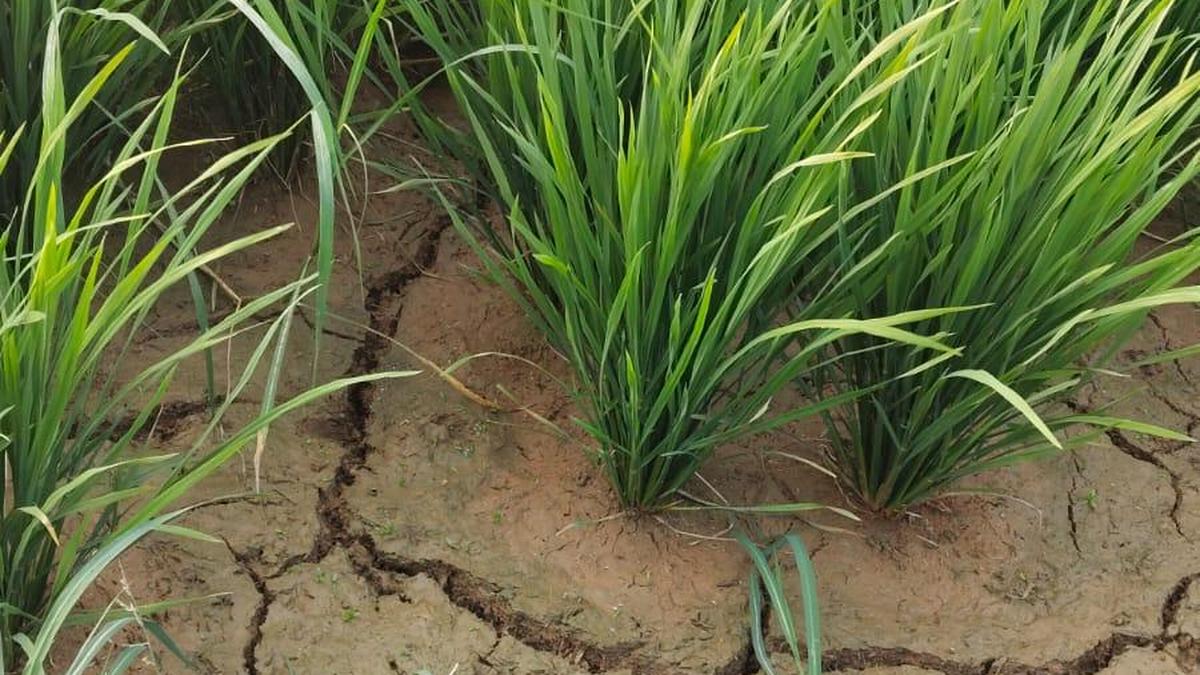


A paddy field in Aloor grama panchayat that is facing acute water shortage.
Farmers in Velookkara, Aloor, Puthenchira and Mala grama panchayats of Thrissur district are facing a severe agricultural crisis as crucial irrigation water has failed to reach the paddy fields and adjoining farmlands. The shortage has put both rice cultivation and other crops under serious threat.
The worst affected are cultivators in the Kannukettichira–Vazhikkilichira polder, where 35 acres of paddy cultivation initiated in December is now facing drought due to an acute water shortage. Farmers say they have received irrigation water for barely five days since the start of cultivation.
The paddy fields and nearby farmlands depend on water from two check-dams—Vazhikkili chira and Venkulam chira. However, these waterbodies have dried up after the flow through the Kottanellur branch canal, which feeds them, was disrupted.
Farmers allege that the crisis was triggered by the failure of the Kerala State Electricity Board (KSEB) to release water from its dams into the irrigation system. They point out that water from the Lower Sholayar and Peringalkuthu dams, released after power generation, is meant to reach the Kottanellur branch canal, which in turn fills Vazhikkili chira and Venkulam chira.
“The KSEB releases water for agriculture and drinking purposes only as residual flow after power generation. Since hydroelectric generation is minimal and the KSEB increasingly relies on power purchases from external grids, water releases have remained negligible, disrupting the entire irrigation balance,” alleged National Green Socialist president Vaxarin Perappadan.
He noted that farmers across Kerala face similar crises almost every year due to delays and disruptions in irrigation supply. “Farmers are repeatedly forced to protest in front of irrigation offices, but these agitations have become ritualistic exercises without lasting solutions,” he said.
He further alleged a structural imbalance in Kerala’s water governance, pointing out that the KSEB controls nearly 75% of the State’s dams and around 85% of total water storage. In contrast, the Irrigation department has direct control over only about 24 % of dams and roughly 10% of stored water, leaving it largely dependent on the KSEB’s decisions.
“Water must be treated as a farmer’s right, not as a favour from the KSEB,” farmers said, demanding urgent corrective measures, including legal amendments to guarantee timely and adequate water supply for agriculture.
Farmers in the area have warned of large-scale protest marches to KSEB offices if immediate remedial action is not taken. They have submitted detailed representations to Chief Minister Pinarayi Vijayan, Power Minister K. Krishnankutty, Agriculture Minister P. Prasad and Water Resources Minister Roshy Augustine, seeking urgent intervention to avert an impending agricultural disaster.
Published – February 04, 2026 09:07 pm IST