






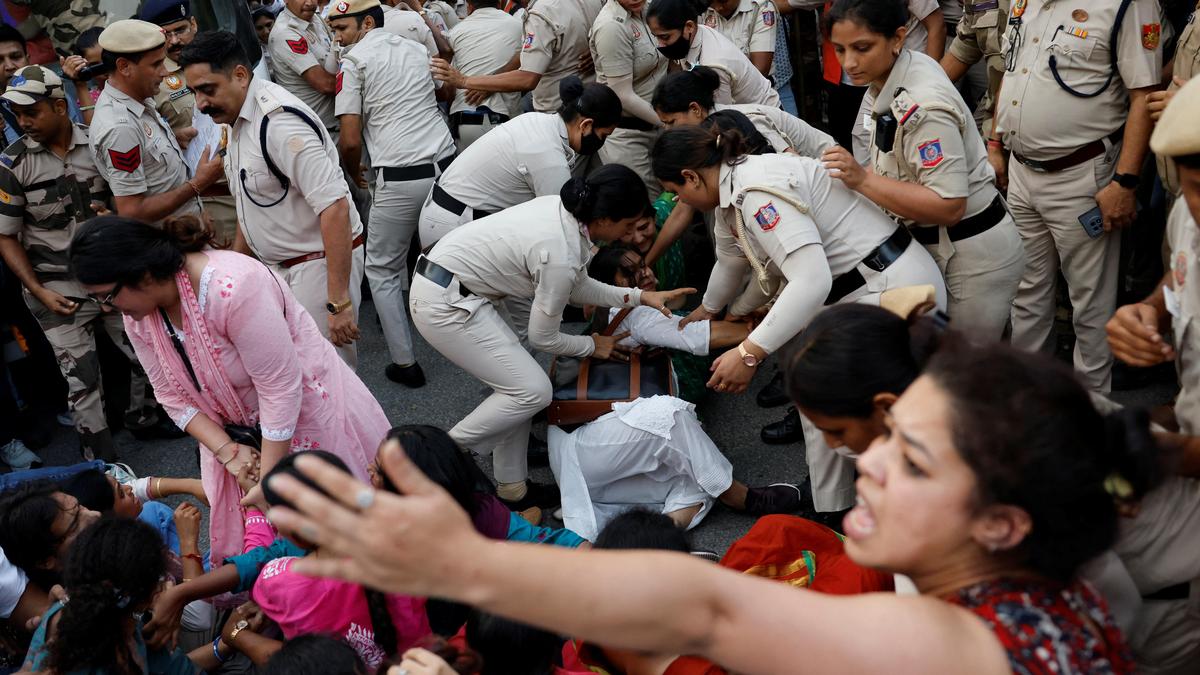


Police detain protesters demanding the resignation of Chief Election Commissioner Gyanesh Kumar in New Delhi on October 7, 2026.
| Photo Credit: Reuters
The Delhi Police has stepped up its social media campaign ahead of the October 10 protest at Jantar Mantar, with its perception management wing working to counter what officials describe as a “cyber warfare” campaign that, according to the force, had projected the police in a negative light during the Cockroach Janta Party’s (CJP) July demonstration.
“Concentrated efforts are being made to show the police’s side of the story. The effort is being made based on the learning from our past experience during the July protest of the CJP, and efforts are being made to draw engagement on social media platforms,” an official close to the matter said.
The police began examining the performance of their social media content and why their version of events did not receive similar traction during the July protest. Another official close to the development said the force was working with Meta, X and other social media platforms to examine why its content was not being amplified by their algorithms.
A series of videos showing personnel allegedly injured during protests, uniforms and badges that were torn, women officers being assisted after collapsing and instances of protesters allegedly pushing or resisting police personnel have been circulated via the official Delhi police handle on X. Videos also include statements and assessments by senior police officials on incidents during the demonstrations.
According to police officials, the July protest generated a large volume of social media content in support of the demonstrators, while comparatively fewer videos presenting the police’s account of events were circulated. The police believe the imbalance in online content helped shape public perception of the protest and put the force on the defensive.
The Delhi police have identified at least 500 individuals who they believe are likely to attend the protest. The list includes members of the CJP’s core team, supporters and people associated with the organisers, including domestic workers, drivers and other staff, according to the document seen by The Hindu.
The police have also identified around 200 WhatsApp and Telegram channels that are being used to “mobilise people for the protest”.
Separately, the force is monitoring at least 100 individuals who describe themselves as “independent journalists”, along with around 20 channels associated with them, officials said. The police said the exercise was aimed at tracking online activity surrounding the protest.
The police’s intensified online outreach marks a shift from its approach during the July protest, when, officials said, the force was largely reacting to a narrative that had already gained traction online.
The force has since sought to increase the volume and reach its own content. Officials said its current strategy includes monitoring material being posted by protesters and others online and then putting out the police’s account of the same incidents.
“We are not posting CCTV footage or any evidence material, but whatever other people are sharing, we are telling our side of the story,” the official said.
The development comes as the Delhi Police prepares for the October 10 protest and steps up surveillance of the online networks being used for mobilisation. The Delhi Police Perception Management and Media Cell division was initiated in October 2021.
At a glance
500 — People identified by the Delhi Police as likely to join the October 10 CJP protest
200 — WhatsApp and Telegram channels identified as being used to mobilise people for the protest
100 — Individuals identifying themselves as “independent journalists” being monitored by the police
20 — Channels associated with such “independent journalists” being tracked by the police
Published – October 08, 2026 07:39 pm IST