



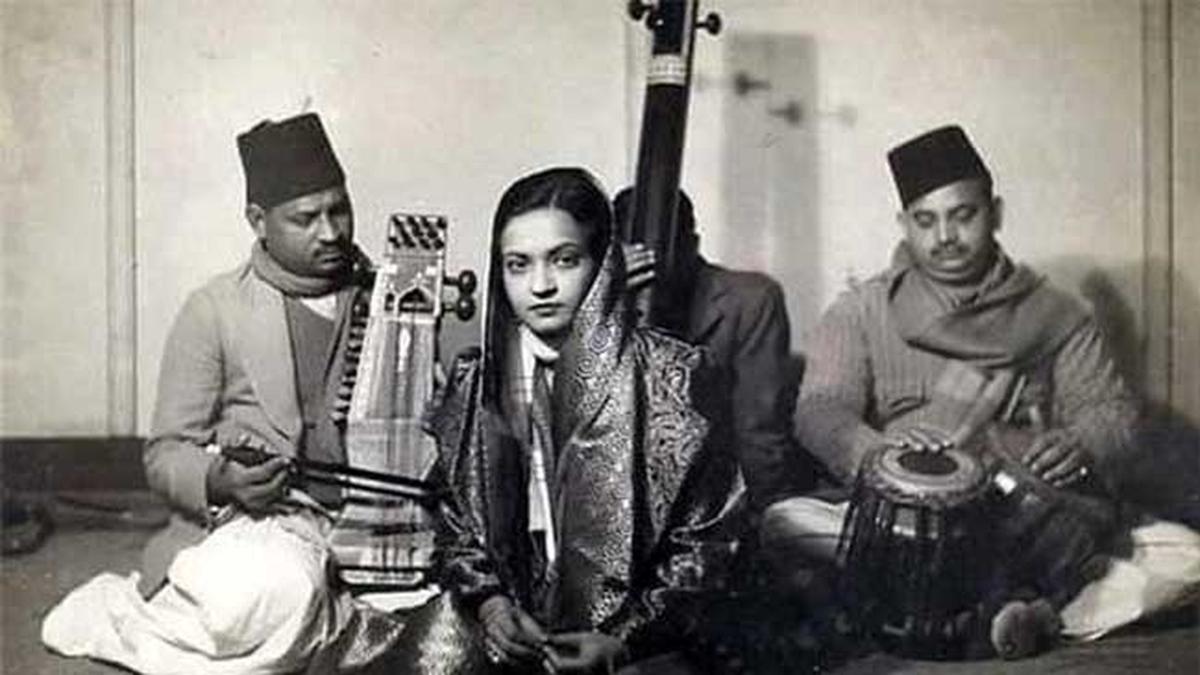


Begum Akhtar, the queen of ghazals.
| Photo Credit: Special Arrangement
In the aesthetic setting of Sabhablr, on a recent evening in Bengaluru, Kafeel Jafri sat down to tell the life story of a woman, whose journey was nothing short of extraordinary. Known as the Mallika-e-Ghazal, Begum Akhtar navigated the path of social marginalisation to become one of the most celebrated voices of the country. Her life was marked by love, heartbreak, fame, friendship, loneliness and rebellion. Amidst all this, music remained her steadfast companion.
Kafeel unfolded the story through the tradition of Dastangoi, a centuries-old art form of storytelling that relies on voice, imagination, and direct interaction between the storyteller and the audience. ‘Dastan’ means story and ‘goi’ means telling.
Dastan-e- Akhtari embodies this tradition. Kafeel’s narration, interspersed with songs sung by Yusra Naqvi, gives Begum Akhtar’s music another dimension. They were accompanied by live tabla, harmonium, and sarangi.

Yusra Naqvi, Gaurav Gadiyar (harmonium) and Kedarnath Havaldar (tabla).
| Photo Credit:
Murali Kumar K.
The story begins with Begum Akhtar’s mother, Mushtari Bai, who was married into a family in Lucknow, but was not accepted by her in-laws, and was eventually disowned by them. Her daughter, Akhtari, was born into a world in which questions of respectability, money and a woman’s place in society were commonplace. Through the piece, Kafeel explores how these experiences shaped the daughter’s life. Rather than presenting Begum Akhtar as a tragic persona, he seeks to understand the choices she made and the circumstances in which they were made. Kafeel says he wanted to look closely at the stories about the musician, especially the question of her agency.
For instance, Begum Akhtar’s decision to stop singing after marriage is often perceived as she was forced into giving up music. Kafeel views it differently. “Social pressure certainly played a role, but she also made an active choice because marriage offered her the respectability that her background had denied her,” he says.
Kafeel grew up listening to Begum Akhtar’s music. There was another personal connection: he was born in Lucknow, 10 years after her passing, and her final place of resting, is close to his parents’ house. He wanted to tell her story partly because so many fascinating aspects of her life remain unknown. So, in his presentation, you meet a Begum Akhtar, who formed friendships with some of the great musicians of her time, such as Pt. Kumar Gandharva, Ustad Bade Ghulam Ali Khan, Ustad Bismillah Khan, Neelam Bai from Bhendi Bazaar and Sayeeda Aapa from the All India Radio, Lucknow.

The story begins with Begum Akhtar’s mother, Mushtari Bai.
| Photo Credit:
K. Murali Kumar
Kafeel weaves in interesting anecdotes such as Begum Akhtar’s fascinating story of her trip to Mecca, which she decided on impulse while in Bombay. Her students managed to arrange the journey in two to three days, even though she had no money. In Mecca, she began singing near the Prophet’s grave. “A Saudi radio officer heard her and invited her to perform a live session. The opportunity enabled her not just manage the trip but to return with some money. I feel she was someone who went with the flow,” believes the dastango.
Yusra’s rendition — of ghazals, thumris and dadras — doesn’t interrupt the story but rather acts like extensions of it. For Begum Akhtar’s first heartbreak, Kafeel chose ‘Muhabbat tere anjaam pe rona aaya’, to reflect on her relationship with the Nawab of Gaya and her pain on discovering that he had been unfaithful. Other familiar songs sit alongside the less-frequently heard pieces such as ‘Koyalia mat pukaar’ or ‘Dil ki baat kahi nahin jaati chupke rahna thana hai’ by Mir Taqi Mir. Yusra has her own long relationship with one of the pieces in the performance. She first learnt ‘Chha rahi kaari ghata, jiya mora lehrae hai’, a dadra, when she was 11.
In Begum Akhtar’s life the classical and the popular, and the personal and the public were clearly divided. She flitted in and out of these worlds, sometimes with ease and at times at a considerable cost. What Dastan-e-Akhtari does, is to allow all those versions of her to come together.
Published – September 25, 2026 11:20 am IST