





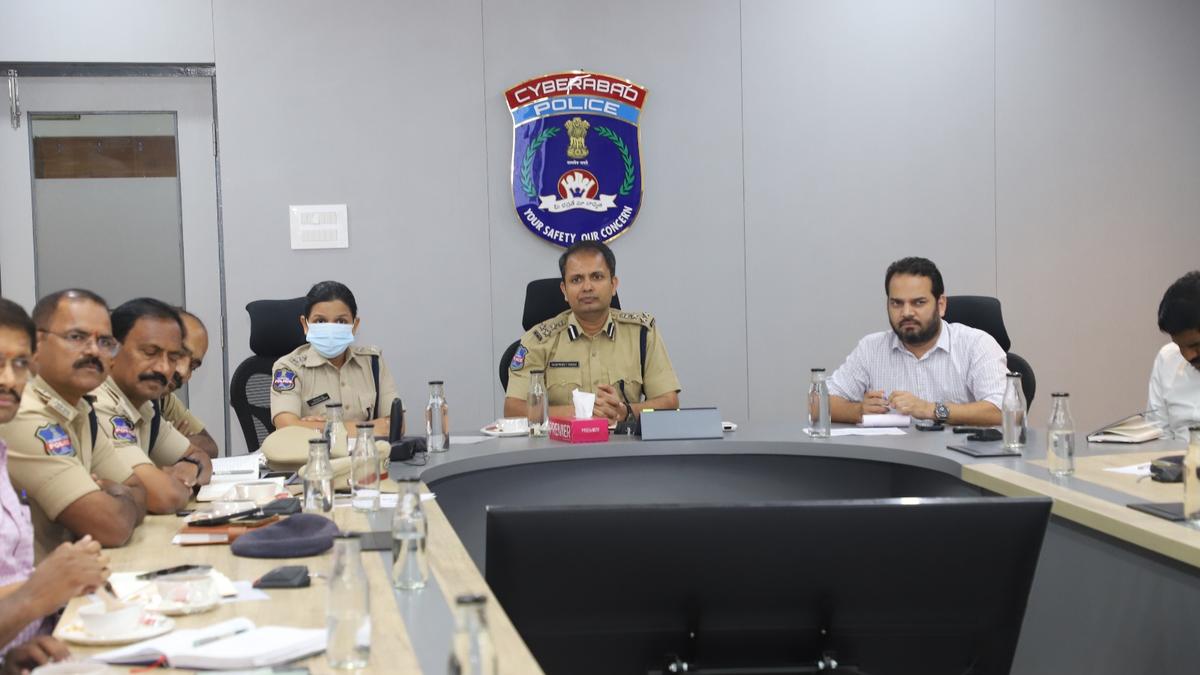


Joint Commissioner of Police (Traffic) Sunpreet Singh discussing the BRT during a meeting with Traffic Police officials, SCSC and FRIP representatives and officials from TGIIC, TGSRTC and other departments.
| Photo Credit: By Arrangement
A seven-kilometre commute between JNTU Junction and Raidurgam that takes about 45 to 50 minutes during peak hours could become shorter by up to 20 minutes under a proposal to introduce a dedicated Counterflow Bus Rapid Transit (BRT) system along one of Cyberabad’s heavily congested corridors.
The proposal, which could also extend connectivity towards Wave Rock, was discussed at a joint coordination meeting convened by the Cyberabad Traffic Police on Thursday following a traffic flow, road safety and traffic management survey conducted by the Foundation for Resources and Innovations Policy (FRIP) in coordination with the Society for Cyberabad Security Council (SCSC).
The survey found that the JNTU-Hitec City-Raidurgam Metro corridor was already operating close to its maximum vehicular capacity. With peak-hour journeys stretching to around 45 minutes, the study identified the need for a mass public transport system capable of moving more commuters without adding private vehicles to the road.
One option now being examined is Counterflow BRT, under which buses would get a dedicated lane designed to allow them to bypass much of the congestion faced by general traffic.
Under the proposal discussed on Thursday, the Counterflow BRT lane could run either through the central portion of the opposite carriageway or on the left side of the road in the same direction, accompanied by traffic management measures. Traffic Police and Telangana Industrial Infrastructure Corporation (TGIIC) officials suggested examining the left side of the road for the dedicated lane, subject to technical feasibility.
Bus stations have been proposed along the road median, with their locations and spacing to be decided based on passenger demand, connectivity to major activity hubs and operational feasibility.
The proposal is expected to bring travel time down by as much as 20 minutes from the present 45 to 50 minutes, while increasing the number of passengers that can be moved through the corridor. Significantly, the proposal envisages doing so without major land acquisition.
Rather than creating an entirely separate fleet operating in isolation, buses could run on optimally designed circular routes. Existing services operating along the JNTU-Raidurgam-Wave Rock stretch could also use the dedicated Counterflow BRT lane wherever feasible.
TGSRTC officials told the meeting that a considerable number of buses were already operating up to Wave Rock and suggested integrating these services with the proposed system to improve passenger movement and make better use of the dedicated lane.
The survey preceding the proposal involved a detailed road inventory of the corridor. The Foundation for Resources and Innovations Policy (FRIP) team studied carriageway widths, availability of footpaths, bus bays and stops, U-turns, junction designs, parking arrangements and encroachments, apart from existing traffic flow.
The plan, however, is still at the study stage and several practical questions remain.
Joint Commissioner of Police (Traffic) Sunpreet Singh asked FRIP to conduct a more detailed assessment of the operational difficulties involved, including a basic but potentially disruptive problem: what happens when a bus or another vehicle breaks down and blocks the dedicated lane.
The proposed system would also require supporting infrastructure, including bus bays, shelters and pedestrian facilities. Its implementation could consequently require considerable time and resources, besides additional manpower and expenditure, the Joint Commissioner observed.
Officials from the civic authorities assured support for developing and improving footpaths, bus bays, bus shelters and other infrastructure identified during the survey.
The team has been directed to reassess the proposal and study feasible and cost-effective measures that could provide short-term relief to commuters, even as the longer-term feasibility of Counterflow BRT continues to be examined.
The meeting at the Cyberabad Police Commissionerate was attended by Traffic Police officials, SCSC and FRIP representatives and officials from TGIIC, TGSRTC and other departments.
Published – September 24, 2026 09:00 pm IST