







During the enumeration phase, electors could establish a link, or “mapping”, with their own or a relative’s details in the previous SIR rolls. Those who established such a link were not required to prove their eligibility separately through documents.
| Photo Credit: SHASHI SHEKHAR KASHYAP
Confusion persists among Electoral Registration Officers (EROs) and Assistant Electoral Registration Officers (AEROs) over the documents required from the 13.7 lakh electors served “no mapping” notices under Delhi’s special intensive revision (SIR) of electoral rolls, with some officials asking them to produce documents issued before 2002, even though officials at the Chief Electoral Officer’s (CEO) office said no such requirement exists.
The notice also lists the prescribed documents for verification and does not specify that they must have been issued before 2002.
The notice exercise covers 33 lakh electors, including 13.7 lakh served notices for “no mapping” and 19.3 lakh for “logical discrepancies”. The hearings, along with the disposal of all notices, claims and objections, have to be completed by October 29, before the final electoral roll is published on November 4. So far, around 70,000 hearings have been conducted across the 70 Assembly constituencies.
During the enumeration phase, electors could establish a link, or “mapping”, with their own or a relative’s details in the previous SIR rolls. Those who established such a link were not required to prove their eligibility separately through documents.
Electors who did not establish this link, including those who were not eligible to vote in 2002 or could not recall the earlier roll details but submitted their enumeration forms, still found their names in the draft electoral roll published on August 31.
These electors have now been served “no mapping” notices, requiring them to produce documents to verify their eligibility before the final electoral roll is published.
‘Not required’
An official at the CEO’s office said the notices only require electors to submit any of the documents prescribed by the Election Commission (EC) of India for verification and do not require them to produce documents issued before 2002 or prove their presence in the earlier SIR rolls.
The prescribed documents include passports, birth certificates, educational certificates, permanent residence certificates and government employee identity cards, among others.
If an elector does not possess any of the 11 prescribed documents on the list, the ERO may consider other available documents on a case-by-case basis. Aadhaar is the 12th document, but it cannot be submitted as the sole proof of eligibility, the official said.
The official acknowledged the confusion and said a meeting would be held with EROs and AEROs to clarify the procedure.
“There is confusion and we will clarify it with the EROs and AEROs so that wrong instructions are not given and people do not face unnecessary inconvenience,” the official said, adding that it has been over two weeks since hearings began.
Digital verification
Another official said electors need not necessarily visit a hearing centre for verification. In cases involving system-generated “logical discrepancies”, Booth Level Officers (BLOs) can verify documents at an elector’s residence and record photographic attendance. Electors can also upload documents by scanning the QR code in the notice, after which the BLO can verify them.
“The logical discrepancies are system-generated. Even BLO verification will be enough and they can upload the documents,” the official said.
Lack of explanation
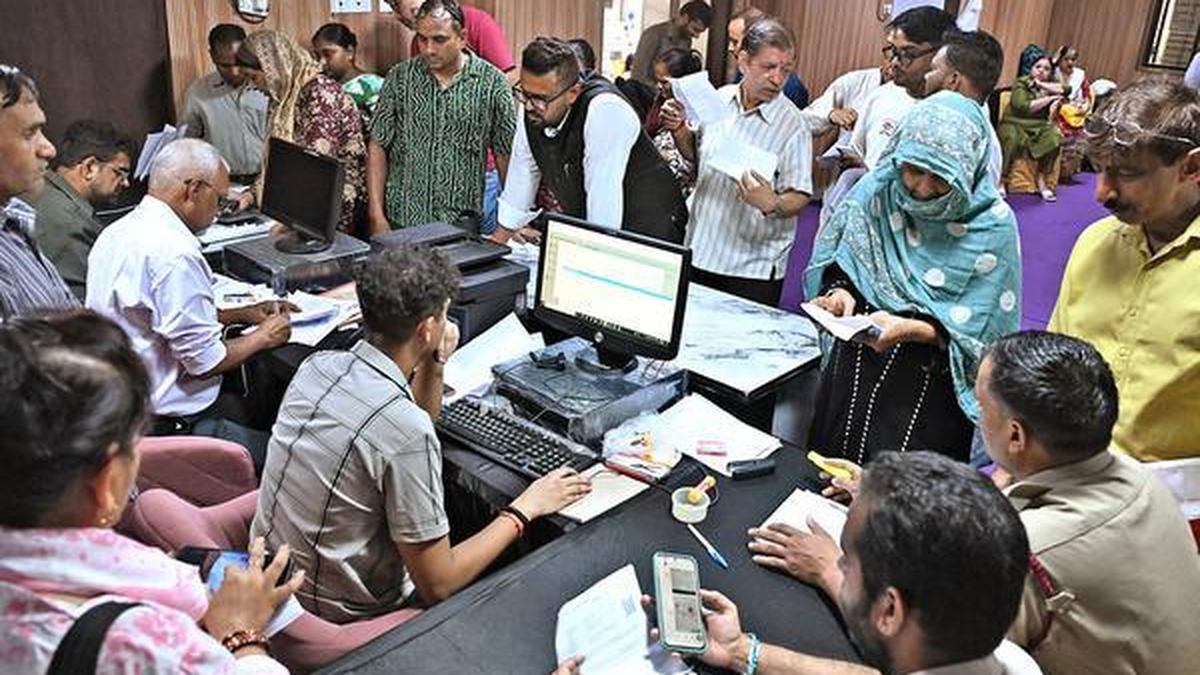
Several electors, however, said they had not been informed about the home-verification option, leading to long queues at hearing centres due to confusion over the documents required.
In a JJ cluster in Pul Mithai in the Chandni Chowk constituency, most of the 285 electors in the draft roll received notices. Around 40 notices were handed to cluster head Subodh Bind by the BLO for distribution, without explaining the documents required.
“I am myself not able to understand what documents are needed. All notices are in English. How will I explain them to others?” Mr. Bind said. “Our voter ID addresses say we are homeless. We have been living in Delhi since birth and have voted in every election. The EC should clarify what documents we are expected to provide.”
Another 679 electors from the polling area were left out of the draft roll and will have to submit Form 6 for inclusion.
Published – September 23, 2026 06:14 pm IST