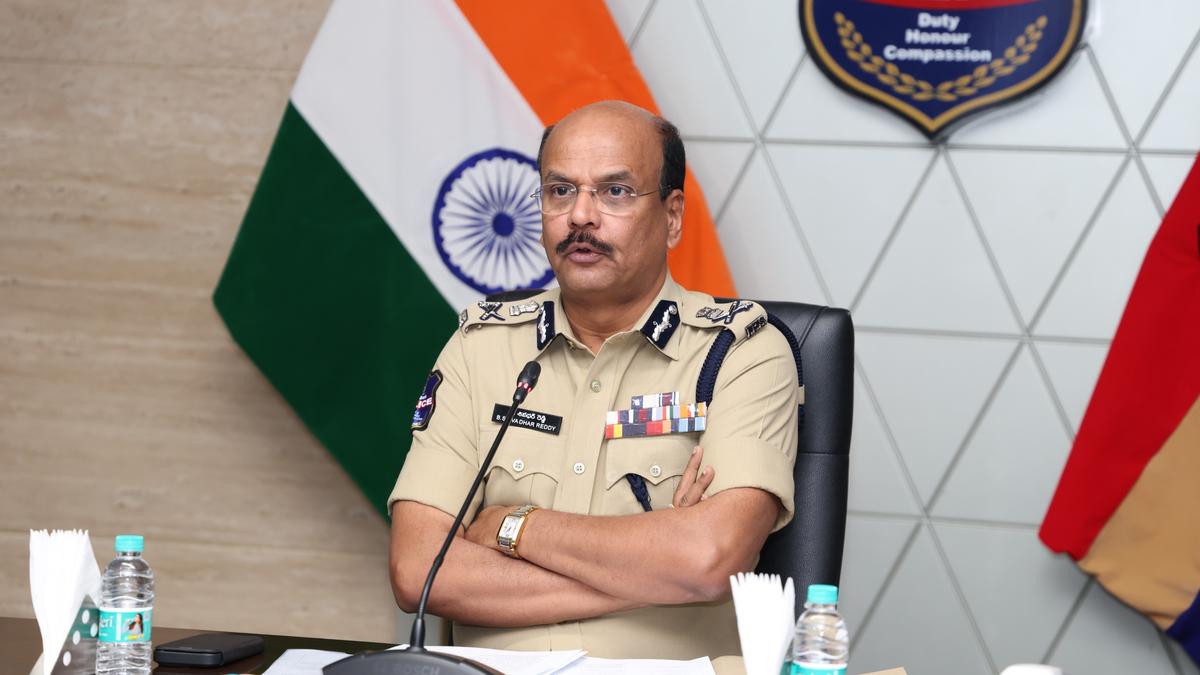

Director General of Police B Shivadhar Reddy
Director General of Police B. Shivadhar Reddy on Tuesday directed police officers to ensure that the upcoming municipal elections are conducted in accordance with the law, warning against any lapses that could lead to complaints or untoward incidents.
Addressing Police Commissioners, District Superintendents of Police and Station House Officers through a video conference, the DGP said municipal elections are scheduled in seven municipal corporations and 116 municipalities in the State. These include elections in 414 wards under the limits of Kothagudem, Karimnagar, Mahbubnagar, Mancherial, Nizamabad, Nalgonda and Ramagundam municipal corporations, in addition to 2,582 wards across the 116 municipalities.
With polling scheduled for February 11 and counting on February 13, the DGP emphasised the responsibility of the police in ensuring a free and fair electoral process. He instructed officers to take all necessary preventive measures to avoid complaints, disturbances or untoward incidents, and to act strictly within the framework of the law to uphold the credibility of the state police and the government.
During the meeting, Hyderabad Police Legal Adviser Ramulu explained the legal provisions governing the conduct of elections. He said strict penalties would be imposed on anyone attempting to influence voters, force them to vote for a particular candidate, or obstruct the filing of nominations. He added that the law would be enforced firmly in cases involving social or economic boycotts of voters.
The official also warned against the distribution of liquor during the election period, stating that violations of the Excise Act could result in imprisonment ranging from six months to two years. He reminded officers that under the Arms Act, holders of licensed weapons are required to deposit them at police stations as per rules, failing which they could face imprisonment of one to three years.
Police officials were instructed to strictly enforce election campaign regulations applicable to political parties and candidates. The DGP said unauthorised posters, wall writings and obscene advertisements should be removed under the Public Places Disfigurement Act, 1997, and criminal cases may be registered against violators. He also stressed the need to control noise pollution under the Town Nuisance Act, pointing out that using loudspeakers in public places without prior police permission is a punishable offence.
He further highlighted restrictions under the Motor Vehicles Act, 1988, stating that vehicles used for election campaigning require prior permission from the Returning Officer, and that the original permission document must be prominently displayed on the vehicle. Misuse of religious institutions or places of worship for political campaigning was described as a serious offence under the Religious Institutions (Prevention of Misuse) Act, 1988, while hate speech and attempts to incite caste or communal tensions could attract imprisonment of up to five years.
The DGP also noted that public meetings and processions require prior licences under the District Police Act and warned that strict action would be taken against those who violate police instructions or disrupt public life. He added that offences such as obstructing election duties or engaging in illegal activities like rigging are punishable under the Telangana Municipalities Act, 2019.
Published – February 03, 2026 07:34 pm IST