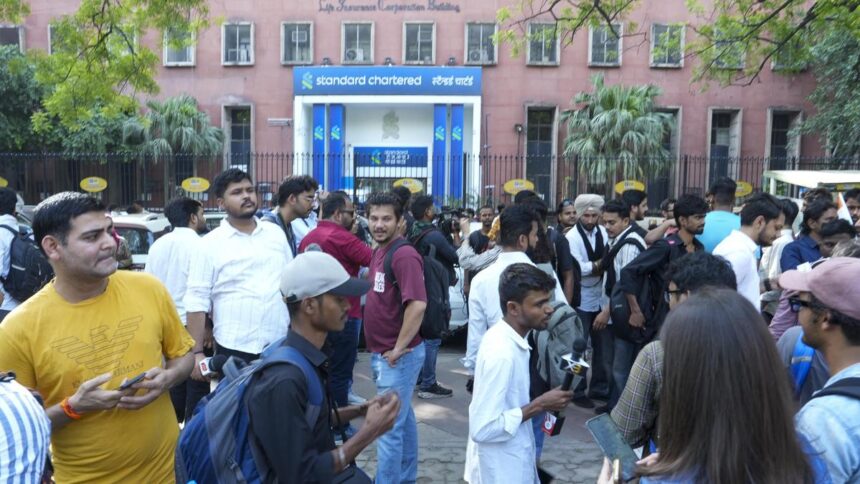





Demanding an end to alleged illegal and unscientific laterite mining, the Kannur District Environmental Coordination Committee, a collective of environmental organisations, staged a march to the Mining and Geology office in Kannur, warning that the destruction of midland laterite hill could threaten drinking water resources and biodiversity.
Raising the alarm against indiscriminate mining by illegal laterite quarries in the district, the committee claimed that such activities were causing a huge environmental impact. It also alleged that they were happening with the knowledge of Revenue and Geology department officials. The march, which began from the old bus stand, culminated in a protest meeting outside the Mining and Geology office.
Inaugurating the protest, Society for Environmental Education in Kerala (SEEK) director T.P. Padmanabhan called for strict regulation of laterite stone and soil mining. He demanded that the Revenue, Geology and Police departments take action against the alleged exploitation of natural resources.
Committee president V.C. Balakrishnan said that over 400 laterite quarries were operating in the revenue district of Kannur, but the Geology department had granted mining permits to only 32 of them. Only 11 have reportedly obtained e-passes for transporting laterite.
He said as many as 22 laterite quarries were allegedly operating without any permission in Alapadamba village alone in Payyannur. Though officials of the Geology department are aware of the situation, no effective action is being taken, he alleged.
According to the committee, several abandoned quarries had turned into large pits, and some are being used for dumping waste. Residents reported that wells near abandoned quarries had begun drying up at the beginning of summer, and that streams originating from the laterite formations were also drying up rapidly. Agricultural fields are being left fallow because of water scarcity.
Mr. Balakrishnan said several rivers in the Kannur-Kasaragod region, including the Perumba, Kavvayi and Ramapuram rivers, originate from midland laterite hills.
“Laterite hills are a major source of groundwater recharge for rivers that continue to flow even during summer. The laterite plateaus and hills are therefore among the most important water reservoirs of the region,” he said.
The formations also support microclimatic conditions through different seasons and provide habitats for rich biodiversity, he said. Their destruction could result in the loss of opportunities to identify and document new plant and animal species, he added.
The committee rejected the argument that laterite mining was primarily intended to meet local construction requirements, claiming that more than 600 loads of laterite were being transported daily to distant district. If the trend continued, the laterite habitat itself could disappear, it warned.
Committee convener K.E. Karunakaran demanded comprehensive drone and satellite-based surveys to assess the remaining laterite rock formations and hills in the district. He also called for a time-bound environmental and social impact assessment of the destruction caused by mining in the midland laterite hills and plateaus.
Meanwhile, District Geologist K.R. Jagadeesan said illegal quarrying was being detected, and action was being taken. According to him, enforcement involves the Mining and Geology department, Revenue department, and the police, while a taluk-level Vigilance Committee headed by the Sub-Collector also includes representatives of the Pollution Control Board, local bodies, and the Geology department. He said inspections were being conducted twice a week.
The department has registered cases against illegal quarrying and is pursuing proceedings for recovery of penalties, he said.
The official put the number of cases involving illegal quarries at around 430 this financial year. He said action against illegal quarrying could not always result in an immediate closure because a prescribed procedure had to be followed.
“When an illegal operation is detected, a stop memo is issued first, followed by a show-cause notice. The operator is given an opportunity to respond. If the explanation is not satisfactory, a demand notice is issued, followed by adjudication and revenue recovery proceedings. There is also provision for appeal,” he said.
Mr. Jagadeesan said that there were no major technical hurdles in taking action, but the procedure was time-consuming. He also pointed to manpower constraints, saying the mineral squad presently had only two personnel to cover the district.
Published – September 25, 2026 09:04 pm IST