





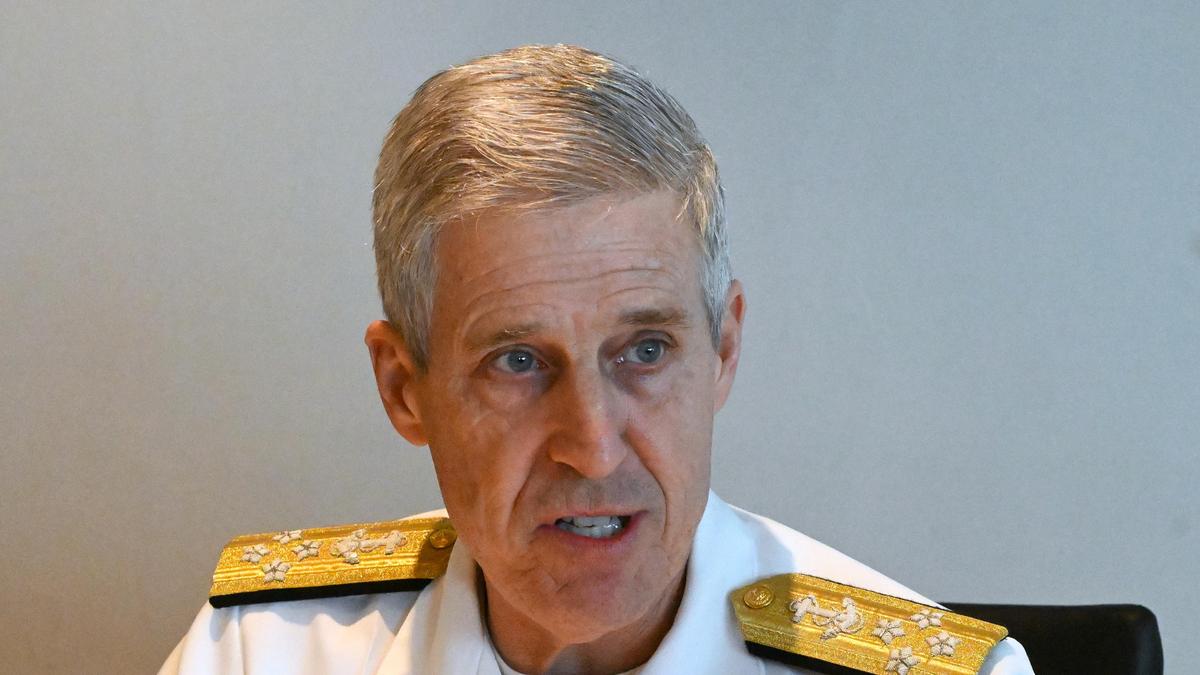


India has a strong navy and the capacity to play a central role in the IOR and, most importantly, it is a highly professional force, observes Admiral Stephen T. Koehler, Commander, U.S. Pacific Fleet.
| Photo Credit: V. RAJU
Both India and the United States have a critical role to play in the Indian Ocean Region (IOR) and the Indo-Pacific, given their strong naval capabilities, says Admiral Stephen T. Koehler, Commander of the U.S. Pacific Fleet.
Speaking to The Hindu on the sidelines of the recently held International Fleet Review (IFR) and MILAN-2026 in Visakhapatnam, Admiral Koehler said the IOR and the Indo-Pacific were vast oceanic regions where it was important to safeguard sovereignty and ensure stability.
“It is a major trade route that underpins the economies of many nations. It is vital for like-minded countries such as India and the U.S. to maintain freedom of navigation in this region. Both nations share common values and possess strong naval forces. When they work together with other like-minded partners, their combined strength can help protect the region from various challenges, safeguard sovereignty, maintain peace, respond swiftly to disasters, and, if necessary, act as a deterrent,” he said.
Highlighting the growing operational cooperation between the two countries, Admiral Koehler said India was a strong partner and that both nations regularly undertake joint operations and complex exercises such as Malabar, MILAN, and RIMPAC to enhance interoperability.
“Both navies operate P-8I aircraft and MH-60R helicopters, which are capable of anti-submarine warfare. We are working to strengthen our capabilities in areas such as quicker response to Humanitarian Assistance and Disaster Relief (HADR) operations and anti-submarine warfare by deploying our assets, as we value a free and open Indo-Pacific,” he said.
Responding to allegations from China that the Quadrilateral Security Dialogue (Quad) was formed to contain Chinese naval expansion, Admiral Koehler said the grouping — comprising the United States, Japan, India, and Australia — consisted of like-minded nations committed to a free and open IOR and Indo-Pacific, and was not created to contain any particular country.
On the rapid expansion of the Chinese navy, he said, “We welcome any country expanding its naval forces. However, we will not accept any breach of peace or challenge to sovereignty. That position applies universally.”
Praising India’s naval capabilities, Admiral Koehler said, “India has a strong navy and the capacity to play a central role in the IOR. Most importantly, it is a highly professional force. In the coming years, we expect to scale up the complexity of our joint exercises.”
He also noted that Visakhapatnam-based Eastern Naval Command (ENC) was strategically positioned and likely to play a leading role in the years ahead.
Published – February 21, 2026 06:47 pm IST