





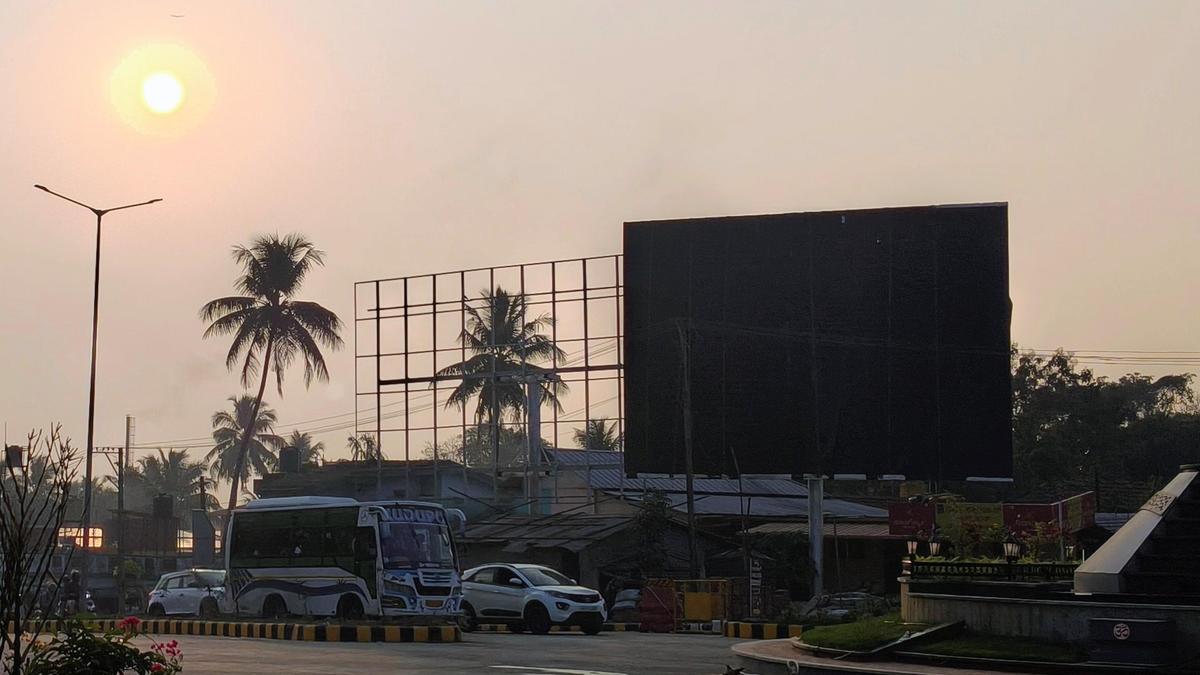

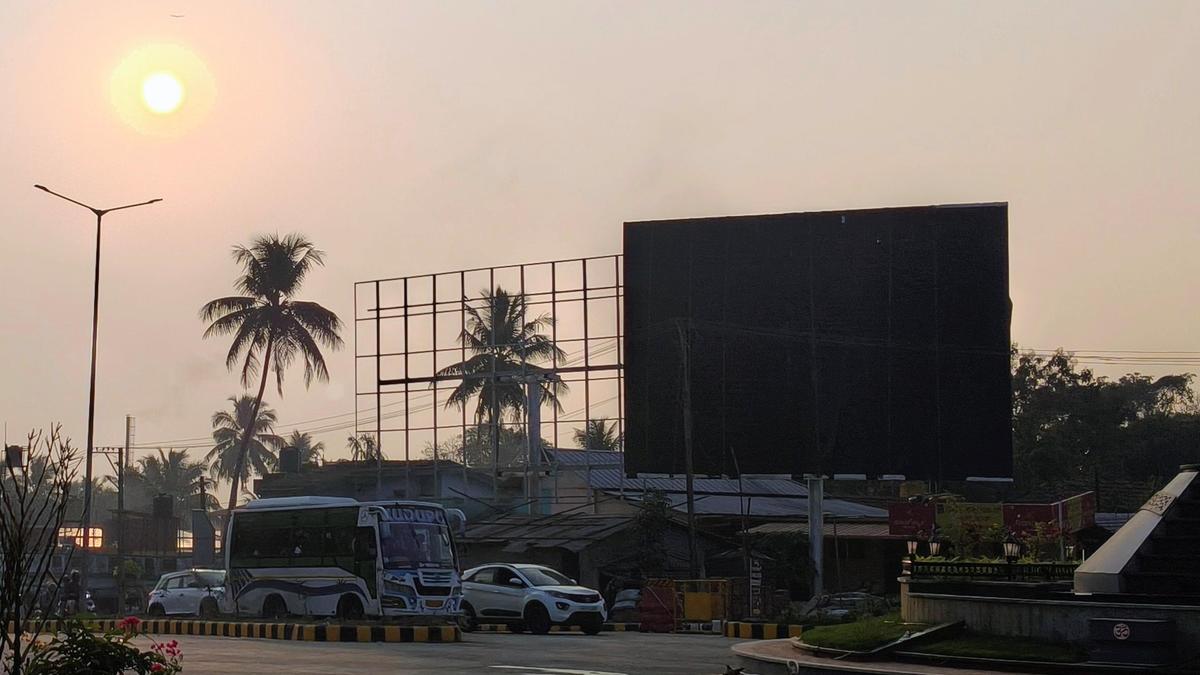
The Kanara Chamber of Commerce and Industry petitioned Mangaluru City Corporation administrator and Deputy Commissioner H.V. Darshan to pause the tender and ensure that Mangaluru’s urban and environmental character is protected.
| Photo Credit: ANIL KUMAR SASTRY
Raising concerns over Mangaluru City Corporation (MCC) floating a tender for the development of bus shelters, directional signage structures (gantries and cantilevers) with advertisement rights in the absence of an elected council, the Kanara Chamber of Commerce and Industry (KCCI) has urged the civic body to put it on hold or reconsider.
In a February 9 letter to H.V. Darshan, the administrator of MCC and Deputy Commissioner of Dakshina Kannada, P.B. Ahmed Mudassar, president, KCCI, said, “Initiating a large, long-term project that will shape public spaces, advertising rights and the city’s streetscape for years without deliberation by elected representatives raises important concerns. Decisions of this scale ideally require democratic oversight and policy direction, not merely administrative approval.”
Mr. Mudassar added, “We respectfully urge that the tender be paused and reconsidered; that elected representatives be involved once the council is constituted; that public opinion be sought; that eligibility and evaluation criteria be revisited; that monopolisation be prevented by unbundling the project; that pending allotments be honoured; and that Mangaluru’s urban and environmental character be protected.”
Lack of public involvement
The KCCI said bus shelters, gantries and advertising structures directly affect commuters, pedestrians, shopkeepers, residents and road users. Moving ahead with a city-wide advertising infrastructure project without seeking public opinion weakens participatory governance and risks eroding public trust. Urban infrastructure should be shaped with citizens, not imposed upon them.
“The requirement of a minimum ₹18-crore standalone turnover from the advertisement business effectively excludes all local Mangaluru-based vendors. Local firms have successfully designed, erected and maintained civic infrastructure for decades. Public procurement should encourage MSMEs and local enterprises, not eliminate them through disproportionate eligibility criteria,” he said.
Previously, the Corporation followed a package-based model that divided advertising media into smaller lots, enabling participation by MSMEs and vendors with modest turnover. This inclusive approach has been bypassed without explanation, raising legitimate concerns, the KCCI said.
150 public assets bundled
It said the tender bundles 150 major public assets under a single concessionaire, effectively granting exclusive control over Mangaluru’s outdoor advertising ecosystem. This risks monopolisation of public visual space, reduces competition and creates long-term dependency on a single private operator. “There is a growing perception that the tender structure may favour a large out-of-city vendor,” the letter said.
Reminding the MCC of how the civic body faced risks by going for a single-vendor model for solid waste management, the letter said, “This reinforces the importance of avoiding similar monopolistic structures in this project.”
Mr. Mudassar said, “Bidders are required to secure a minimum of 75 marks in the technical evaluation, with significant weight given to development plans, designs and methodology. These parameters are inherently subjective, and the tender does not specify clear, measurable benchmarks for evaluation. Such discretion creates scope for bias or preferential treatment and undermines confidence in a fair and transparent process.”
Tree protection
The tender also lacks a robust framework for tree protection and environmental safeguards, raising concerns about tree cutting, canopy trimming and long-term ecological impact, the KCCI said.
Local vendors possess deep knowledge of coastal weather conditions, monsoons, soil behaviour and traffic patterns. They provide faster response times, generate local employment and remain directly accountable to the community. Marginalising them in favour of distant monopolies risks turning civic infrastructure into a purely extractive commercial exercise, the letter said.
Published – February 10, 2026 07:39 pm IST