






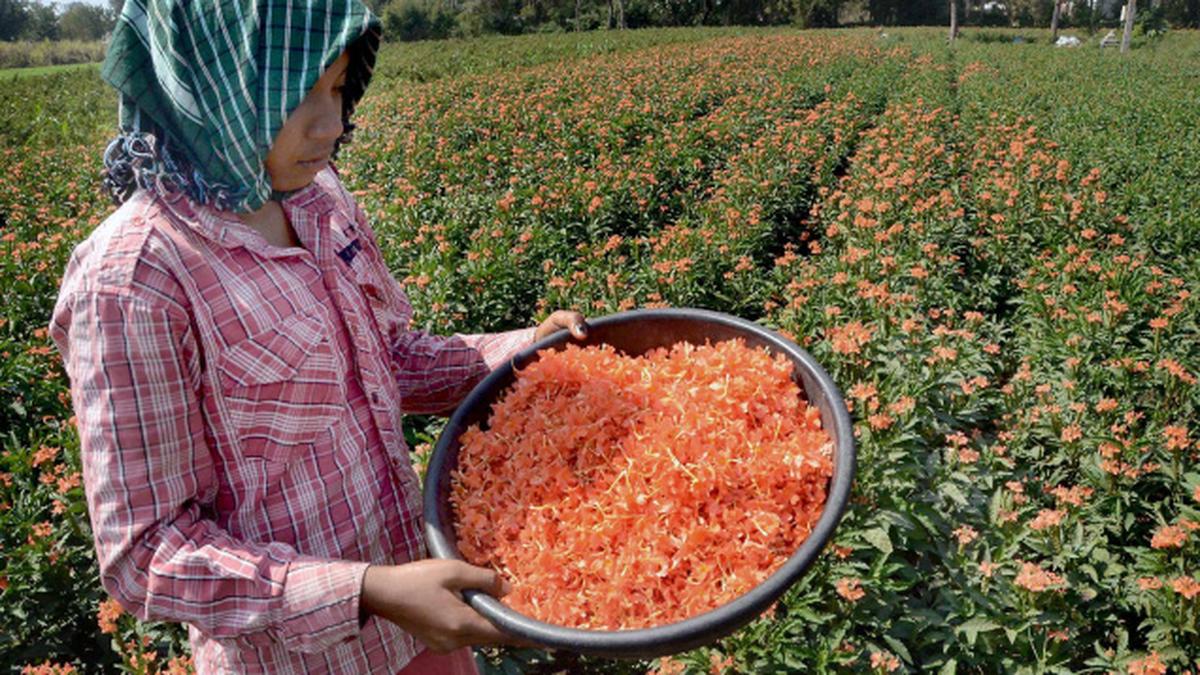

For 30 years, Munemma’s day began at 4 a.m., among the kanakambara (Crossandra infundibuliformis) plants on her acre at Rallabaduguru village. This March, she woke to a heat that had already settled over the field, and to flowers that had given up before the day had begun.
“The delicate flowers wilted on the plants themselves, unable to bear the intense heat,” says Munemma, 56, a small farmer in Shantipuram mandal, in Andhra Pradesh’s flower basket at the tri-junction with Karnataka and Tamil Nadu. “Usually, kanakambara, delicate as it is, holds its freshness on the plant till 11 a.m. But this year, since March, the flowers started wilting by 8 a.m.,” she says.
Kuppam, at the southern tip of Andhra Pradesh, sends flowers to four cities in three States every day of the year. This year, traders say, the tonnage is down by at least 40%, the blooms are smaller and lighter, and growers are being paid less for them.
Munemma is one of 3,000 small and marginal farmers spread across 2,000 acres in the core flower belt of Kuppam revenue division. The belt covers several village clusters: Mallanur, Nadimur and Chinnagandlapalle in Kuppam mandal; Shantipuram, Syamarajupuram, Dandikuppam and Thummanapalle in Shantipuram mandal; Gudupalle and Amudagondi in Gudupalle mandal; forested hamlets in Ramakuppam mandal; V. Kota, Kadiriobandlapalle and Pothur in V. Kota mandal; and Pathikonda on the Palamaner fringe.
Kuppam mandal got 100.8 mm of rain between June 1 and September 18, against a normal of 400.1 mm, a shortfall of 75%, according to the State’s water resources portal, Andhra Pradesh Water Resources Information and Management System (APWRIMS). Gudupalle was 74% short and V. Kota 68%. Every district in the State is short of rain this monsoon.
Monsoon rain fell short across the flower belt
| Mandal / area | Rain, June 1 to Sept. 18 (mm) | Normal (mm) | Shortfall (%) |
| Kuppam | 100.8 | 400.1 | 75 |
| Gudupalle | 104.4 | 397.4 | 74 |
| V. Kota | 124.2 | 384.7 | 68 |
| Ramakuppam | 199.1 | 314.3 | 37 |
| Shantipuram | 241.4 | 378.0 | 36 |
| Chittoor district | 179.9 | 392.4 | 54 |
| Andhra Pradesh | 252.4 | 504.4 | 50 |
Source: APWRIMS
Chittoor is among 315 districts mapped by the Centre as vulnerable to El Niño, with four Rayalaseema districts flagged as high-risk. The heat has stayed high in Kuppam since March. March highs averaged 32.8 to 33.6 degrees Celsius and lows 19.3 to 20.1 degrees. April and May sustained highs of 34.8 to 35.5 degrees, with lows of 23.9 degrees, and a heat index of 40 to 45 degrees. June highs were 30 to 32.6 degrees; July and August, 29 to 31.1 degrees. With humidity holding at 63% to 68% through the heat, fungal rot has spread across the region.
March and April together brought 3.7 mm against a normal of 37.6 mm. May was wet, 113.7 mm against a normal of 90.6 mm, but July brought 5.8 mm against 82.5 mm.

Horticulture scientists at Dr. Y.S.R. Horticultural University say a flower crop needs a diurnal range of 15 to 18 degrees, the gap between day and night temperatures, in December and January for flower bud initiation. In Kuppam division, the gap came late in January, and the March heat set in early. Flowering was delayed by four weeks, and the blooms lost weight, fragrance and shelf life.
Normally, Kuppam farmers send out over six tonnes a day, in varieties such as jasmine, kanakambara, marigold, chrysanthemum and polyhouse rose, to Bengaluru, Chennai, Coimbatore and Vijayawada by the express trains that halt at Kuppam, with larger consignments going by road from Kolar.
“The figure is about 180 tonnes a month, with the Dasara outflow crossing 800 tonnes. This year, the tonnage is down by at least 40%,” says Krupa, 38, a flower merchant from Ambur in neighbouring Tamil Nadu, who buys from several growers in Kuppam.
The dry monsoon has followed a falling water table. In Chittoor district, groundwater stood 16.64 metres below ground on September 18, 4.2 metres deeper than a year earlier, the APWRIMS portal shows. It is deeper than a year ago in every Rayalaseema district.
The water table has fallen across Rayalaseema
| District | Depth on Sept. 18, 2026 (m) | Deeper than a year earlier (m) |
| Sri Sathya Sai | 21.65 | 10.85 |
| Annamayya | 18.97 | 8.49 |
| Ananthapuramu | 16.26 | 5.88 |
| Nandyal | 10.61 | 5.40 |
| Chittoor | 16.64 | 4.20 |
| Kurnool | 9.27 | 3.55 |
| YSR Kadapa | 13.92 | 3.42 |
| Tirupati | 10.12 | 1.94 |
| Rayalaseema average | 14.68 | 5.47 |
| Andhra Pradesh | 11.27 | 3.26 |
Source: APWRIMS
Business at the Kuppam flower market yard averages ₹9 crore a month. Prices rise by 60% to 200% during festival seasons, as they did in August 2025.

This year, under the shadow of El Niño, marigold fetched ₹120 a kg wholesale at Kuppam and sold at ₹400 retail in Bengaluru; kanakambara ₹3,000 against ₹6,000 in Chennai; jasmine ₹800 to ₹1,200 against double that in the metros; and polyhouse rose ₹8 a flower locally against ₹40 in the metros.
Gudupalle mandal recorded 4 mm of rain this August, against a normal of 106.5 mm and 161.8 mm last August, the APWRIMS data shows.
Rajesh, a farmer from Gudupalle, says he sold his half-acre yield of several flower varieties for ₹23,000 in August. “The same month last year, the yield fetched me ₹58,000. The buyer says the flowers are small, so the rate is low. What can we do if the sun itself burns them?” he asks.
Published – September 18, 2026 03:48 pm IST