






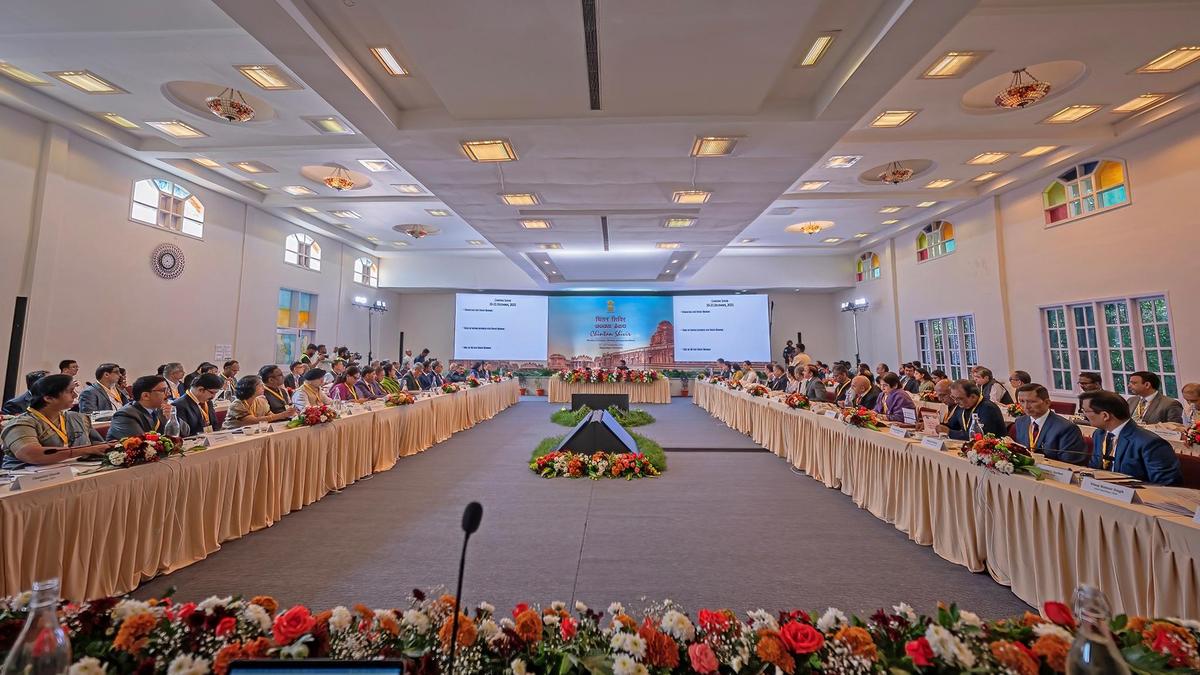
The Chintan Shivir of the Ministry of Finance and the Ministry of Corporate Affairs chaired by Union Minister for Finance and Corporate Affairs Nirmala Sitharaman under way at the UNESCO World Heritage Site of Hampi in Vijayanagara district on Saturday.
| Photo Credit: SPECIAL ARRANGEMENT
Union Minister for Finance and Corporate Affairs Nirmala Sitharaman on Saturday set a strategic roadmap for India’s economic future, emphasising the integration of Artificial Intelligence (AI) and the establishment of regulatory predictability to achieve the vision of a Viksit Bharat.
She, along with Union Minister of State for Corporate Affairs Harsh Malhotra, was chairing a high-level Chintan Shivir (brainstorming session) of the Ministry of Finance and the Ministry of Corporate Affairs that commenced at the UNESCO World Heritage Site of Hampi in Vijayanagara district.
The session brought together the top brass of India’s financial policy-makers, including all Secretaries of the two Ministries, the Chairmen of the Central Board of Direct Taxes (CBDT) and the Central Board of Indirect Taxes and Customs (CBIC), and the Chief Economic Adviser to the Central government.
The primary deliberations centered on the theme of “AI, Ease of Doing Business, and Financing for Viksit Bharat”, where officials engaged in intensive discussions on strengthening institutional capacity and policy-making through technology-enabled systems.
The Union Finance Minister underscored the importance of process reforms to improve the ease of doing business, highlighting that the simplification of procedures and coordinated inter-departmental functioning are essential for a robust economy.
The sessions also covered critical areas such as ensuring efficient fund flows, establishing a future-ready tax administration and identifying financing pathways for sustained growth, all while leveraging digital tools to enhance transparency, efficiency and accountability in governance.
Reflecting on the choice of venue, Ms. Sitharaman spoke on the profound historical significance of the Vijayanagara region.
She noted that the erstwhile empire represents the peak of Indian imperial power from barely 500 years ago, with its cultural and administrative imprint still visible across large parts of the subcontinent.
She, however, balanced this historical pride with a call for pragmatism, drawing the attention of senior officials to the stark contrasts within the Vijayanagara district.
The Union Finance Minister pointed out that while the region is home to magnificent world-heritage monuments, it also encompasses drought-prone areas struggling with low agricultural productivity and persistent human-animal conflict.
She emphasised that the vision for a developed India must remain grounded in these present-day development realities to ensure that economic policies effectively address the challenges faced by such regions.
Published – December 21, 2025 06:54 pm IST