






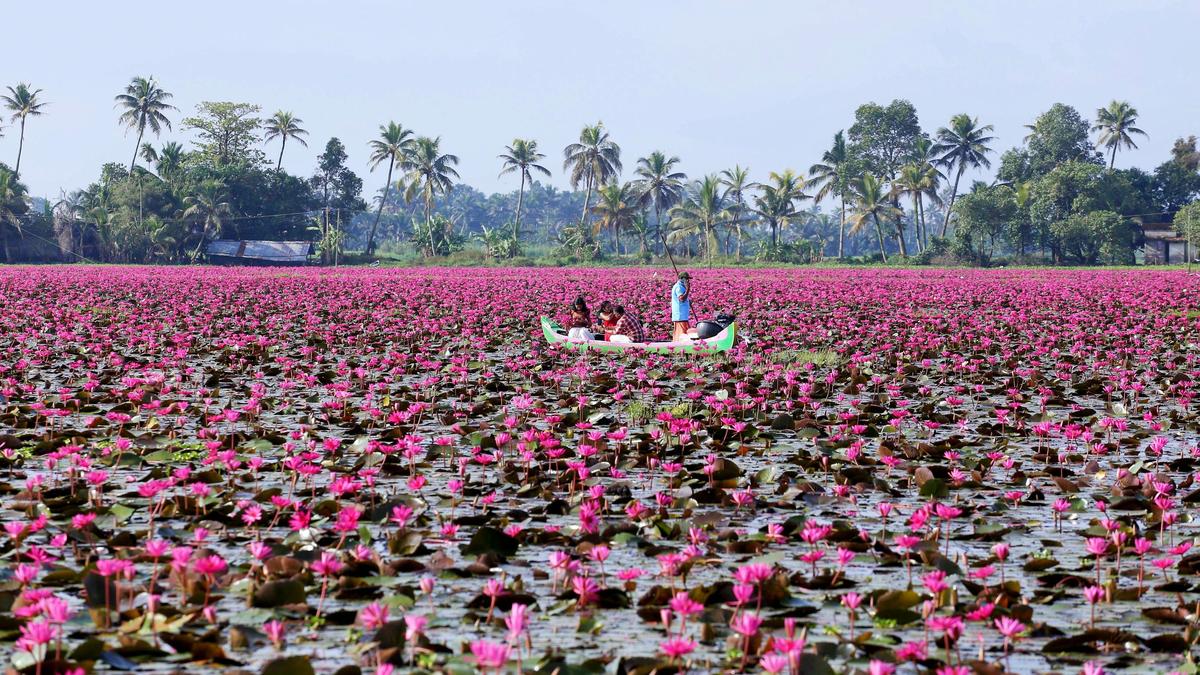

The profuse blooming of pink water lilies in Malarikkal may have brought joy to hundreds of visitors and local tour operators, but not to biodiversity experts.
The three-month-long floral economy, which begins in July and ensures a flurry of activity and generates revenue, is having an adverse impact on the local ecology, ecologists fear.
A two-year-long study carried out for the Kerala State Biodiversity Board (KSBB) has revealed that the lily, an aquatic plant, has shown unprecedented and uncontrolled growth, adversely affecting the ecology.
Rameshkumar K.B., senior principal scientist at the Jawaharlal Nehru Tropical Botanic Garden and Research Institute, who has been carrying out the study, said the water lily appeared in the region after the 2018 floods and showed prolific growth.
“The plant did not exist previously in the region, and research is ongoing to confirm whether the species could have escaped from nurseries or is a variant of an existing species. Studies are being carried out at the genetic and molecular levels to ascertain the species,” he said.
N. Anil Kumar, Chairperson of the Board, said the uncontrolled growth of the plant was alarming and needed to be prevented so that it did not spread to other water bodies.
“The ecological impact on the species in the water body needs to be studied further. We need strict control measures to prevent such species from deeply infiltrating into our ecology, and eventually decimating the local flora,” said Mr. Anil Kumar.
According to the study, the water lily has led to an increase in the rodent population and the disappearance of local varieties of water lilies and other aquatic plants. The release of greenhouse gases such as methane from decaying plant material is a major concern, said Mr. Rameshkumar.
“With millions of water lilies blooming, they are attracting pollinators significantly, and this may affect the pollination pattern of land crops in the future. It has affected the natural rate of water flow. The sedimentation of sludge as well as decayed plant biomass has led to the water bodies getting polluted. Traditional water transportation has also been affected,” said Mr. Rameshkumar.
Another concern is the vast coverage of the water surface by the large leaves, which affects the penetration of sunlight into the water body. He noted that this could be negatively impacting the habitats of algae and other micro- and macro-organisms inside the water body.
As the species emerges as a threat to the ecology and threatens to spread to more regions, locals are, however, rejoicing at the unexpected revenue they have received.
The water lily blooms every year from July, after paddy cultivation in the region. Ever since the pink bloom appeared, the tourism economy has exploded.
The water lily blooms across two main paddy parcels in Malarikkal in Kuttanad. One of the land parcels, J Block, is spread across 1,800 acres and is held by 600 farmers, while Thiruvaikkari Padam, which spans about 850 acres, is held by 300 farmers.
“Majority of the owners have country boats, which they use during the season to take tourists across the water body. Around 250 country boats are in use during this time,” said Shajimon Vattappallil, secretary, Malarikkal Tourism Society.
He added that he regularly gets calls from nearby farmers asking how they can replicate this.
“I tell them they cannot imitate this, but they can try collecting some of the water lily roots and try planting them,” said Mr. Vattappallil.
Residents of the area say the bloom has benefited people in the region, including women who make bouquets, as well as farmers who rely on the tourist footfall for additional income.
K. Anilkumar, coordinator of the Meenachil-Meenanthayar-Kodoor river rejoining project, said a revenue of about ₹5 crore was generated last year.
“It brings additional income for the farmers and the locals,” said Mr. Anilkumar.
Published – October 06, 2026 07:30 am IST