



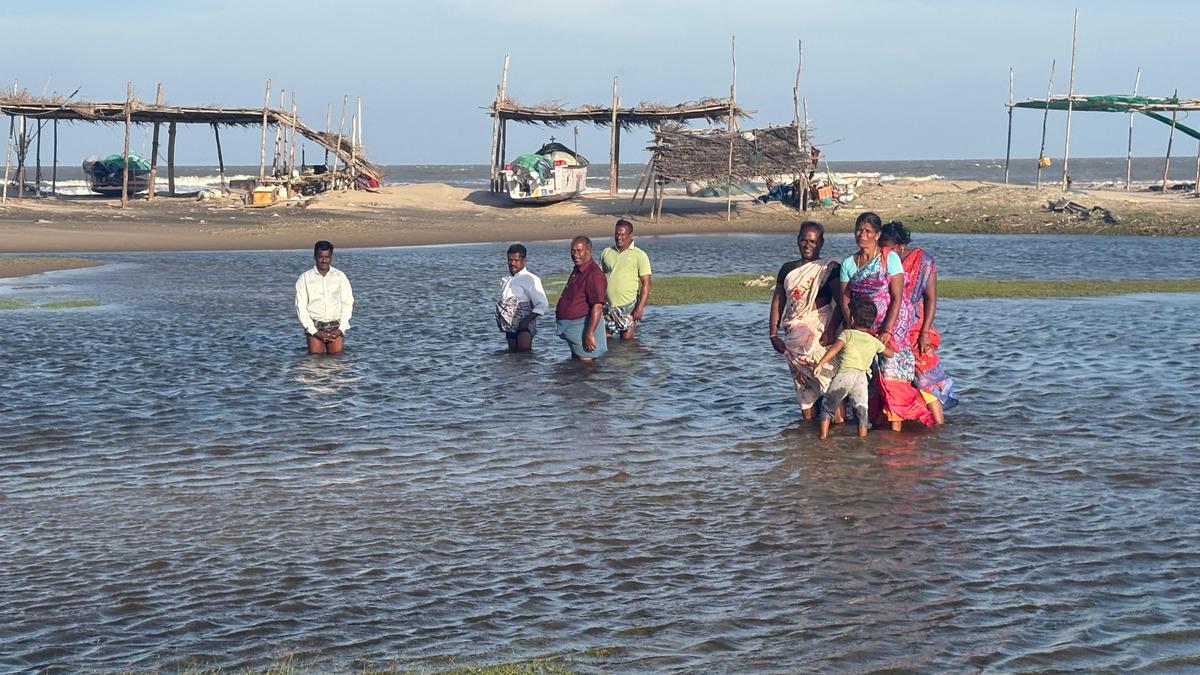


Fisherfolk from North Vizhunthamavadi village wade through knee-deep to hip-level water in the drain that separates their hamlet from the sea, after the bridge connecting the settlement to the fishing shore collapsed years ago and remains unrepaired.
| Photo Credit: Special arrangement
At three in the morning, when most of the coast is asleep, the men of North Vizhunthamavadi wade into darkness and cold water to reach the sea. There are no streetlights to guide them, no bridge to carry them across. Instead, there is a hip-deep drain that slices between their homes and the shore — a daily obstacle they have been forced to endure for seven years.
North Vizhunthamavadi is a small, isolated fishing hamlet with around 30 families, all dependent on small-scale fishing from Vizhunthamavadi panchayat in Kizhvelur taluk. Fibre boats are their only assets; the sea, their only livelihood. Yet the very path to the sea has remained broken since a bridge collapsed in the 2004 tsunami. A temporary crossing later put together by the villagers themselves was washed away again during Cyclone Gaja in 2018. Nothing has replaced it since.
“We have submitted petitions again and again. Officials come, inspect the place, and assure us that the issue will be resolved in a week. Seven years have passed,” said S. Andiyappan, a senior fisherman from the village.
The drain — known locally as a vadikal — begins in the neighbouring Kameshwaram fishing village, cuts through North Vizhunthamavadi, and empties into the sea. The missing stretch of the bridge spans barely 100 metres, but its absence has turned everyday life into a test of endurance.
Before dawn, fishermen carry ice boxes on their shoulders and step down into the cold, murky water to cross. During the monsoon, what is usually hip-deep can quickly rise to neck level. “If it rains, we are constantly afraid,” Mr. Andiyappan said. “Even after we return with fish, bringing the catch back safely is a struggle.”
For the women, the crossing is often impossible. “We carry fish on our heads and sell them in neighbouring villages,” said Vimala R., one of several fisherwomen who spoke to The Hindu. “Getting down into that drain and crossing is not possible for us.” Priya S. and M. Ilamathi echoed the concern, saying the lack of a bridge has cut them off from their work and made them dependent on others. “We are a small hamlet. No one listens to us,” one of them said quietly.
The sense of neglect runs deeper than the broken bridge. The approach road to the fishing point is damaged, and there are no streetlights at night. Welfare measures, villagers say, rarely reach this corner of the coast. “Because we are isolated, we are forgotten,” a resident said.
What hurts most, they say, is not the scale of the demand but the indifference to it. “We are not asking for a big concrete structure,” said a fisherman. “Even a temporary bridge — steel, wood, anything — would help us cross safely.”
When contacted, Fisheries Department officials said they were aware of the problem but cited shortage of funds. A senior official in the district administration said the issue would be looked into.
Published – December 24, 2025 07:33 pm IST