




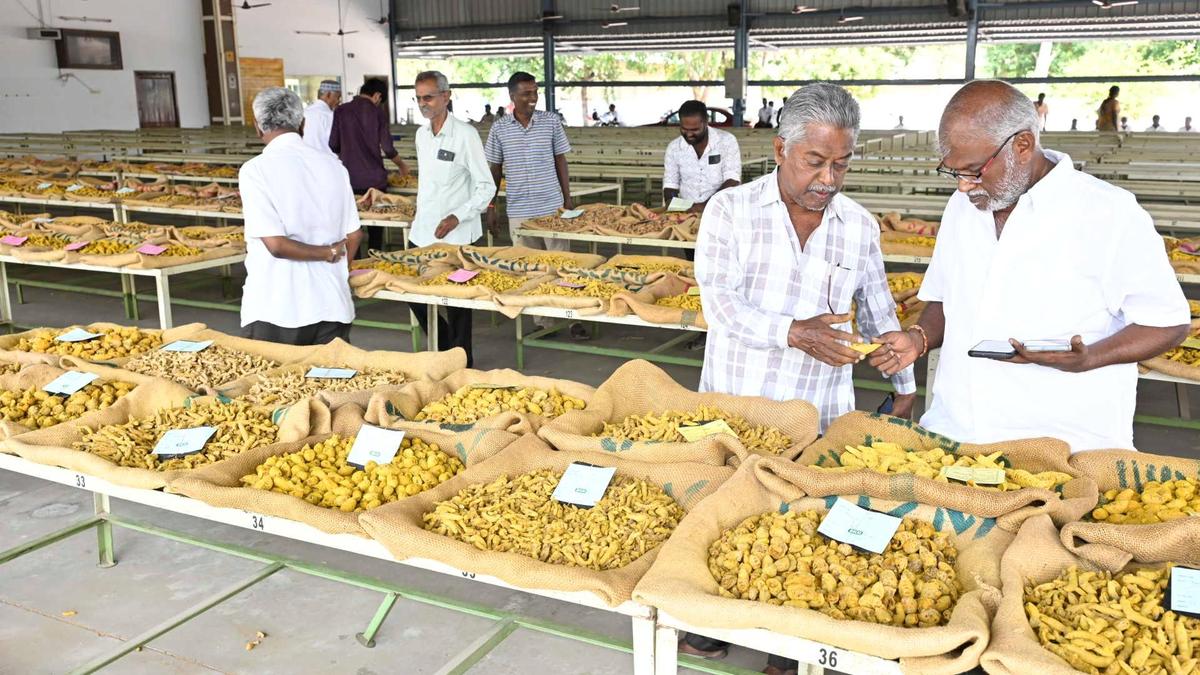


Turmeric samples kept on display at the turmeric complex in Erode in Tamil Nadu on Wednesday. The price of turmeric is on the rise due to increased demand and shortfall in supply
| Photo Credit: M. Govarthan
Turmeric prices crossed ₹23,000 a quintal at the Perundurai Regulated Market on Wednesday (October 14, 2026), touching their highest level in recent years. Lower arrivals, drought conditions in major growing regions, and uncertainty over the next crop are expected to influence prices in the coming weeks.
Turmeric is widely cultivated in Erode and Dharmapuri districts and parts of Karnataka. The commodity is traded at regulated markets in Erode and Perundurai and at the Agricultural Producers’ Cooperative Marketing Societies in Karungalpalayam and Gobichettipalayam.
At the Perundurai Regulated Market on Wednesday, finger turmeric fetched between ₹15,336 and ₹23,099 a quintal, while bulb turmeric was priced between ₹15,099 and ₹19,626. At the Erode Regulated Market on October 7, finger turmeric fetched between ₹13,509 and ₹19,244 a quintal, while bulb turmeric was priced between ₹7,599 and ₹17,729. The maximum prices of finger and bulb turmeric rose by ₹3,855 and ₹1,897, respectively, over the week.
Drought conditions
M. Sathyamurthy, secretary of the Erode Turmeric Merchants and Godown Owners’ Association, told The Hindu that drought conditions in major turmeric-growing regions, including Marathwada in Maharashtra, Nizamabad in Telangana, and parts of Tamil Nadu, were pushing up prices.
He said the area already planted with turmeric had declined by 20% to 30% in some regions owing to water scarcity, with a further reduction in cultivation expected in the coming months. “The drought impact is expected to be significant, leading to a substantial decline in production next year,” he said.
Turmeric futures on the National Commodity and Derivatives Exchange (NCDEX) for April 2027 were trading between ₹24,000 and ₹25,000 a quintal, reflecting bullish market sentiment, Mr. Sathyamurthy said. The crop situation in November and the impact of El Niño would influence prices in the coming months, he added.
Water is currently not being released from the Bhavanisagar dam for irrigation through the Lower Bhavani Project (LBP) and Kalingarayan canals, whose command areas are major turmeric-growing regions. Rainfall from the northeast monsoon, expected to set in this week, could help ease the water shortage.
With prices trending upwards, some farmers who have stocked their produce are reluctant to sell, anticipating further increases.
Published – October 14, 2026 05:18 pm IST