
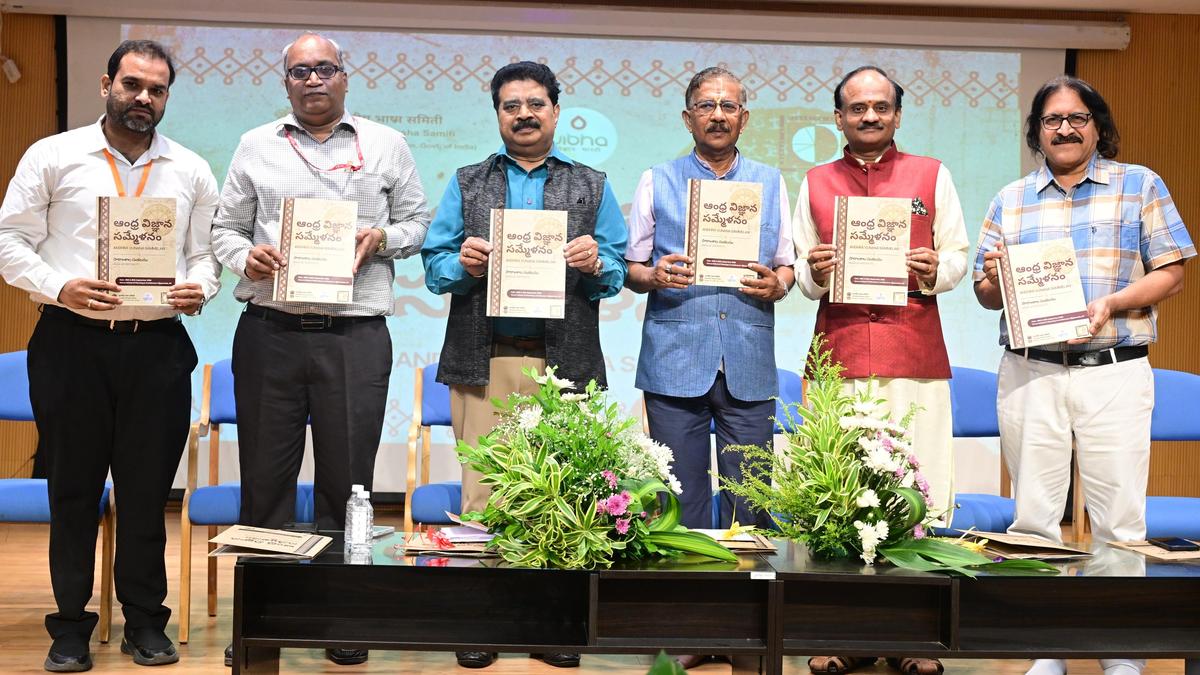


Dignitaries releasing a poster during the inaugural session of the two-day Andhra Vignana Sammelanam-2026, at the SPA campus in Vijayawada on Monday.
| Photo Credit: G.N. RAO
Subjects such as environmental protection and biodiversity, Telugu literature, the role of nuclear energy in sustainable development, traditional Indian architecture, water conservation and Ayurveda dominated the discussions on the first day of the Andhra Vignana Sammelanam-2026, held at School of Planning and Architecture (SPA), Vijayawada, on Monday (September 28, 2026).
The two-day programme aimed to promote scientific and technological knowledge through Telugu and to connect traditional Indian knowledge systems with contemporary scientific thought. It brought together scientists, academicians, researchers, and students.
Professor and architect Amogh Kumar Gupta, chairperson of the Board of Governors, SPA Vijayawada, was the chief guest, while former JNTU-Kakinada Vice-Chancellor K.V.S.G. Murali Krishna and Indira Gandhi Centre for Atomic Research (IGCAR), Kalpakkam, Chemical Sciences Division Dean C.V.S. Brahmanandam Rao attended as guests of honour.
The organisers said one of the principal objectives of the Sammelanam was to make scientific knowledge accessible to a wider section of society through Telugu. The event also sought to encourage scientific temper among students and young people and create greater awareness of India’s knowledge traditions.
The discussions attempted to bring together contemporary scientific approaches and traditional knowledge systems, while providing a platform for experts to discuss their relevance in areas such as health, environment, architecture, mathematics, and sustainable development.
Students, researchers, and science enthusiasts took part in the interactive discussions held during the day. SPA Vijayawada Director Ramesh Srikonda presided over the proceedings.
The second day of the Sammelanam, to be held on Tuesday (September 29), will feature expert sessions and discussions on yoga, Ayurveda, mathematics, astronomy, Indian knowledge traditions, artificial intelligence, and ethics. Research papers will also be presented as part of the second-day proceedings, followed by the valedictory programme.
Published – September 28, 2026 08:13 pm IST