


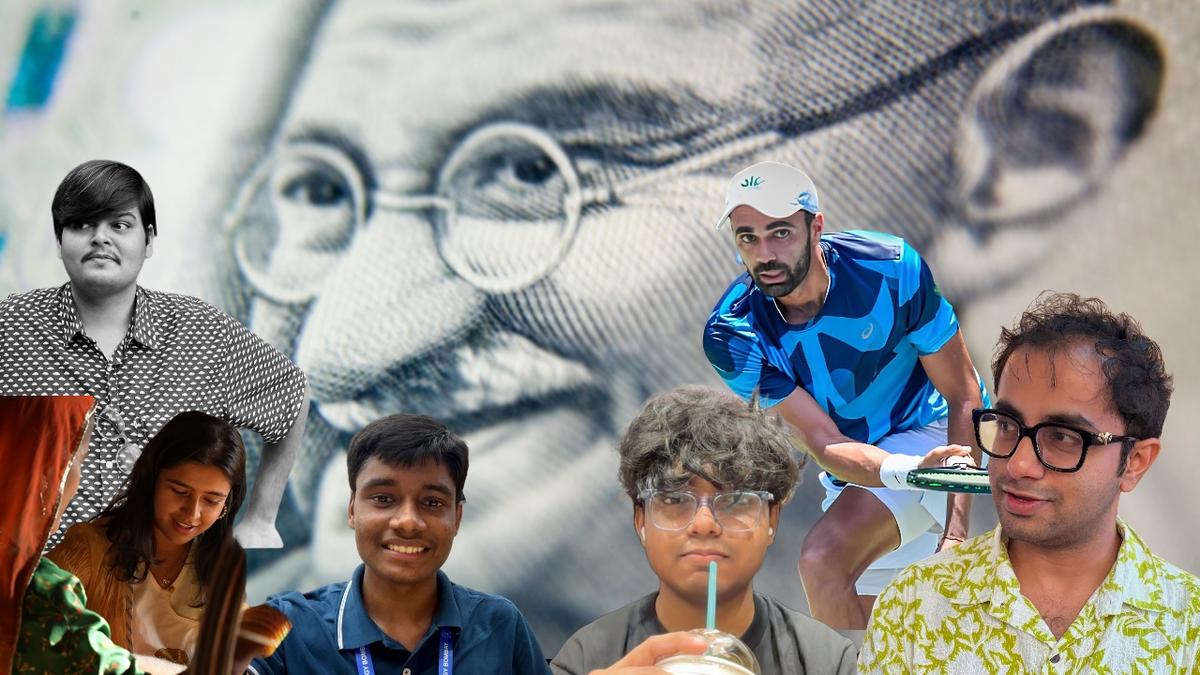


“If alive today, Gandhi would have been uncomfortable with our obsession with instant results. In his time, things took patience and a lot of work before they came to life. He would want us to understand that the slow journey is what makes doing something great worthwhile. I think simplicity and choosing to live with less is radical today. Gandhi gives you the idea that restraint can be strength. He would have probably used social media platforms to spread his ideas of non-violence and civil disobedience. We don’t need to make Gandhi ‘cool’, we need to make him relevant. Rap is a great way to get his message across to
Gen Z.”Adil Kalyanpur, or A-KAL, 26Professional tennis player and rapper

“What comes to me is the person, not the Mahatma. The image of his personality and resilience was handed down by our grandparents who were there during the freedom struggle. It’s an extension of nostalgia. But, also, of my own readings of Gandhi over these years as a history student, reading his autobiography and Ramachandra Guha’s books. While non-violence, simplicity, truth and civil disobedience are radical ideas, there are complex ideas of Gandhi [on gender, sexuality, and caste] which must be contested, debated, and criticised. People have to read and engage with Gandhi in order to criticise him. Gandhi, Ambedkar, Bhagat Singh, Periyar were all fighting in different ways for the same goal. One thing that reading Gandhi doesn’t give you is the space for despair. The CJP protest showed that non-violent satyagraha can still be a useful tool. He remains our leader in spirit. At Karwaan, since 2019, we have tried to start dialogues of compassion, love and communal harmony.”Eshan Sharma, 26Documentary filmmaker and founder of Karwaan Heritage, a student-led
history collective

“We have new colonisers in the country who look like us. So, [if Gandhi were a young Indian today] he would be opposing the same things he was opposing a century or so ago. He would be opposing extreme power, corruption, the condition of women. I live in Delhi, where all the protests are happening, and I believe Gandhi would be on the streets again now. But this time, though his message of non-violence worked very well at Jantar Mantar, I feel he would be a little louder, a little more rebellious.”Kaanchi Chopra, 27Artist and designer

“When I say no to “father of the nation” or “Mahatma,” I’m not rejecting Gandhi as much as those very categories. The paternalism of one and the infallibility of the other are harmful. Gandhi had himself rebuffed at least one of them [the metaphorical fatherhood]. It’s challenging to consider Gandhi’s practice in an increasingly indifferent and broken world. That Gandhi was constantly inquisitive and uncertain about his own [famous and infamous] practices is lost on us, I think, and we might do well to read him more than only focus on his actions. Scholar and translator Rita Kothari once taught me in a class on Gandhi the importance of the question-answer form of his book Hind Swaraj; even in correspondence with others, he is posing and answering questions. That room for disagreement and questioning, for disagreement because one has carefully listened to someone, is rare and significant.”Vighnesh Hampapura, 27Translator, writer, and Ph.D student

“I think of Gandhi as someone who turned moral courage into political power. But the saint-like image is mostly something we inherit. He would probably dislike how India often mistakes growth for progress. Gen Z’s speed, irony and online politics would confuse him. Truth and civil disobedience still feel radical because they require real courage. Simplicity feels less relevant today. Gandhi gives us restraint and mass mobilisation without hatred. But Ambedkar explains inequality and structural power much better.”Nisarga Adhikary, 19Cybersecurity engineer, IIT-Kanpur

“If Gandhi were a young Indian today, he might be deeply uncomfortable with the deteriorating civic sense and an apparently aimless education system. His ideas of simplicity and truth feel radical now, as we are losing these virtues rapidly. Ideas of non-violence and civil disobedience, though not outdated, aren’t so radical, but the working population today can’t afford a civil disobedience en masse. Gandhi gives this generation the concept of ‘simplicity in sophistication’ in a way few others have, but falls short in offering the kind of radical revolt figures like Bhagat Singh, Ambedkar, Periyar articulated to turn stones and crack nuts.”Shubham Kumar, 18Student, IIT-Bombay
Enjoyed reading this article? Share feedback to [email protected]
Published – October 01, 2026 03:15 pm IST