







As Delhi sleeps on a Friday night, women come together to walk through streets lined with streetlamps that do not work, streets bereft of footpaths, streets where cars and occasional stares zoom past, and streets that belong to them, despite the circumstances trying to tell them otherwise.
In Vasant Kunj, Disha Barwal, 21, a Delhi University (DU) student, is on her first midnight walk in the city. She says, “For those who do this often, I wonder if walking during a time like this feels heavier, politically,” referring to the recent incident where a minor was gang-raped by a group of men in Delhi’s Astha Kunj park.
As she disassociates and stares at the ground while walking, she says she is scared herself, but the walk is important to her; “I’m here so that they see us doing this more and are not surprised to see women out at night.”

She is part of a walk organised by Women Walk at Midnight a campaign designed to normalise walking during ‘forbidden hours’. It is open to all those assigned female at birth or anyone who identifies as a woman. Both before and after the walk, the women coordinate about their travel from and back home on WhatsApp groups, and many carpool together.
The walk comprises mostly women in their 20s and 30s, and some of their mothers too.
Inter-generational solidarity
Sheena Shah, a working woman in Delhi is a volunteer at the walk. For the first time, her mother, Shama Shah, who resides in Sahranpur in Uttar Pradesh, and is in Delhi to visit her daughter, has joined her. Sheena jokes that this time, her mother, who is constantly worried about her safety, will find out how late she actually gets back home on such nights.

But instead of being encumbered by worry for her daughter, Shama decides to own the night too. “Freedom jaisa lag raha hai” (It feels like freedom). She says that she never imagined that women could claim the streets in such a way, and decides to start a similar walk in her hometown.
Similarly, Keerat Kaur, is joined by her mother Gurveer Kaur. The women say that they come from a conservative family, where the curfew for women is usually 8pm. “I wanted her to join because she is always worried about my safety,” says Keerat, but as the hands on the clock approach midnight, she adds, “I think it means something to her too.”
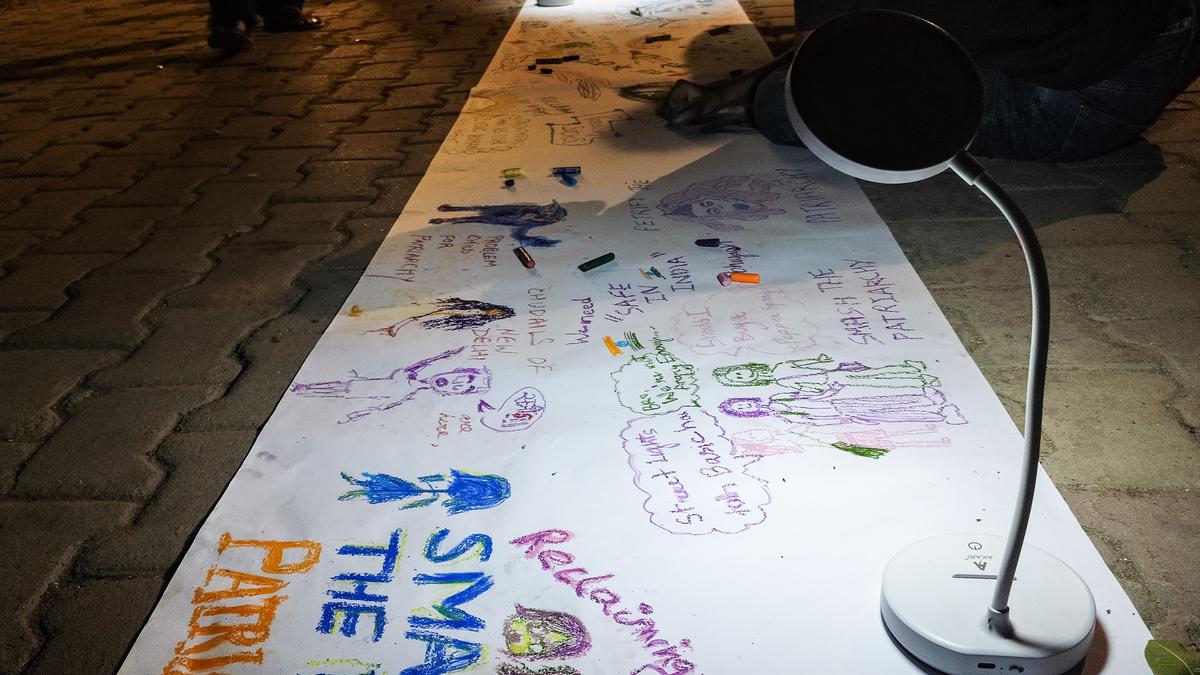
The walk culminates in the women sitting down in a market area as the organisers roll out chart paper. The women sitting on the ground, bring out their sketch pens, paints, and crayons. Soon, the empty paper is brimming with drawings of what safe spaces look like to them, slogans such as ‘Smash the patriarchy’ and ‘Petrify the patriarchy’, and speech bubbles with conversations about safety.
The anger
On Saturday night, another campaign WhyLoiter which is rooted in a seminal book by the same name, takes over the streets, starting from Delhi’s Greater Kailash, only minutes away from the Astha Kunj park.
The walk ends in a public park in Chittaranjan Park where the women chant slogans such as ‘Aurat kyu hai pardon mein, sharam nahi hai mardon mein (why are women behind curtains and men without shame)’ and ‘Ek chai do samosa, in mardon ka kya bharosa’ which has become emblematic of the women’s movement for safety.
Many such similar campaigns have sprouted over the last few weeks, all organically, with the help of volunteers. The calls for such walks are circulated online. This particular campaign extends beyond Delhi. Similar walks have been organised across the country, from Goa, Kolkata, Jaipur to Delhi. In the Delhi chapter, the organisers say that they expected around 100 people, but at least 200 showed up.

KOCHI, Kerala, 04/12/2019: Street lights at exit point of Vyttila Hub is dysfunctional, a man walks into darkness at night on Wednesday. Ill-lit public spaces pose many terrors to Kochiites. Photo : Thulasi Kakkat/The Hindu
| Photo Credit:
THULASI KAKKAT
Another woman, who works as a researcher and does not wish to be named, says that this movement extends beyond just reclaiming the night. It questions why reclamation is necessary to begin with.
“Why are we the ones who have to fight, when we are not the transgressors here? Women-only spaces feel much safer, and these walks remind us that they can exist,” she says as she is seated in a dark park, surrounded with other women, before she joins her friends who speak about the need to be out at night more often, with it being ‘normal’ and not necessarily a political statement.
Published – October 07, 2026 04:59 pm IST