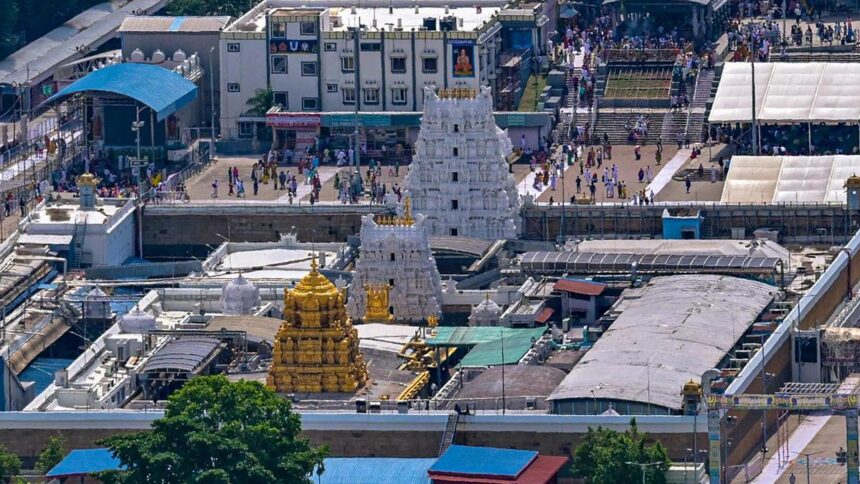






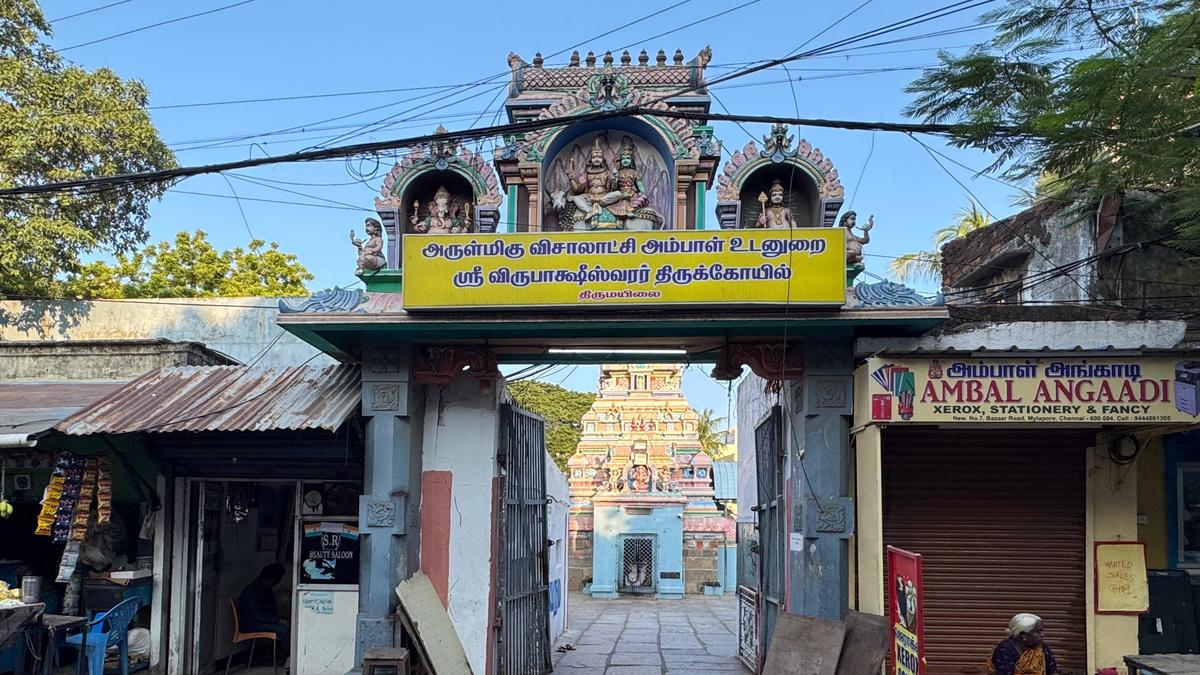


A view of Virupakshiswarar temple at Mylpore in Chennai
| Photo Credit: Sriram V.
Of late, cult of the Sapta Sthana circuit is growing in Mylapore. It involves seven Shiva temples in the area. If social media is to be believed, the tradition is a 1000 years old! And yet until the early 2000s, none of us Mylaporeans had even heard of it, familiar as we were with the temples.
Also Read: Sketching Meenakshi: Learn to draw temple sculptures and architecture
Before we get on with Sapta Sthanam in Mylapore, we need to know that such a tradition exists elsewhere and for centuries. In the Thanjavur region is a group of seven Shiva temples, all of them of great antiquity, adored in the Tevaram. These are Thiruvaiyyaru, Thirpazhanam, Thiruchotruthurai, Thiruneithanam, Thiruvedikudi, Thirupoonthuruthi and Thirkandiyur. In the month of April/May (Chithirai), the Lord at Thiruvaiyyaru sets out in a palanquin and visits each of the other six temples. At each, the deity of that temple joins in a palanquin and this way, there are seven palanquins by the end of the festival. The temples are all by the Cauvery, on whose dry bed the procession progresses.

In sharp contrast, the seven temples of Mylapore are not linked by a common legend, and they are also not shrines of the same antiquity. Among these, the Kapaliswarar temple is certainly the oldest. Though its inscriptional records are weak, its history is well established by way of Tamil poetic works – the Tevaram (7th century CE), the Periya Puranam (12th) and the Tirupugazh (15th). The lack of inscriptions is attributed to the destruction of the older shrine by the sea. This is most likely to have been by the Portuguese – though we don’t have any written evidence of this, their record at Shiva temples in Sri Lanka supports the theory. The present temple is said to be “around three hundred years old,” and as we have been saying this for around a hundred years, let us add a century to it. The relocated precinct today owes a lot to the dubashes of the East India Company.
Of perhaps equal antiquity is the Virupakshiswarar temple of Mylapore, with its vast tank. Inscriptions from the 11th century have surfaced here. It is believed that Sivanesan Chettiar, the father of Poompavai, at whose invitation Sambandar came to Mayilai in the 7th century, was associated with this temple. But it is significant that Sambandar in his Tevaram hymns sings only of Kapaliswarar. The Periya Puranam of the 12th century does not mention Sivanesan’s connect with this temple either.
Madras is, as we all know, an agglomeration of villages, populated by migrants. Apart from the truly ancient temples of the city that predate the founding of the colonial metropolis, most shrines here were constructed by the well-to-do, wanting some symbols of their places of origin in the city in which they had settled. That accounts for practically all the remaining five Shiva temples of Mylapore. Government records however add to the confusion. The Karaniswarar temple was 300 years old as per the government census of 1961. It is likely that when migrants moved to Mylapore from Saidapet, a weaver’s colony, where there is an older temple to Shiva by the same name, they built a shrine here. But we also have a claim that inscriptions from the 12th century have been found here! The Valeeswarar temple, as per the HR&CE is 1300 years old but as per the 1961 census dated back 400 years. It is very likely inspired by the temple of the same name in Kanchipuram, with which it shares a legend. The Teerthapaleeswarar temple according to the 1961 census again is of Pallava origin but the same record says that the present shrine dated to 500 years prior.
The two most recent ones have of late begun to claim the greatest antiquity. The Velleeswarar temple began life dedicted to Ganesa by the weavers of Mylapore around 300 years ago. The shrines to Velleeswarar and Kamakshi came up in the 1850s, inspired no doubt by Mangadu and funded by the Sengunthar community. A tale now circulates that it predates the Kapali temple! The Malliswarar temple was constructed in the 1850s by a Chidambara Mudaliar and now claims to date back a thousand years!
When challenged on their historicity, most shrines have a common answer – they were so thoroughly destroyed “by invaders” that there was nothing left. What is inexplicable is the silence of Tamil sacred poetry. Beyond a point, like the legend of St. Thomas, it is best to respect faith and keep facts to ourselves.
Lastly, on the Sapta Sthanam circuit – it is my hunch that it was the slim booklet Siva Temples of Mylapore, published in 2002 by Kalamkriya, the publication wing of the Sanmar Group, that first gave the devout such an idea. From there, it has travelled back a 1000 years.
(Sriram V. is a writer and historian)
Published – October 07, 2026 07:32 am IST