





The story so far: Groundwater contamination in villages around the SIPCOT Industrial Growth Centre at Perundurai in Erode district of Tamil Nadu has come under renewed scrutiny after the Tamil Nadu Water Supply and Drainage (TWAD) Board found water from 37 sources in 25 villages unfit for drinking last year. A ₹136.76-crore Common Effluent Treatment Plant (CETP) is under construction to treat the contaminated seepage water and resupply the water to industries. However, a sustainable and long-term solution is yet to be framed.
What is the scale of industrial activity at the SIPCOT?
The SIPCOT Industrial Growth Centre that was established at Perundurai in 1991 over 2,700 acres has grown into a major industrial cluster with more than 250 industries, including 52 textile dyeing and processing units. Of the 52 textile units, 43 have individual Effluent Treatment Plants (ETPs) and nine are connected to a CEPT. The estate also has a history of tannery operations. In 2001, 23 tannery units operating along the Cauvery and Kalingarayan Canal in Erode were shifted to SIPCOT.
Subsequently, 14 units were established and were again linked to a common effluent treatment arrangement. The tannery units and the CETP were closed in 2021 following complaints of pollution of waterbodies.
Why the contamination became a concern?
Farmers and residents have for years alleged that polluted seepage from textile-processing units entered the adjoining Nallaa Odai and subsequently reached the Odaikattur tank, spread over 13 acres, and the Punjai Palatholuvu tank, spread over nearly 400 acres. The Perundurai SIPCOT Affected People’s Welfare Association that was formed in 2018 started raising the issue at multiple forums. Its coordinator, S. Chinnasamy, says farmers used water from local waterbodies for cultivation until around 2005 after which they began noticing changes in colour and foul odour.

The Nallaa Odai carrying seepage from textile processing units located at the SIPCOT Industrial Growth Centre in Perundurai of Erode district in Tamil Nadu
| Photo Credit:
M. Govarthan
The association alleges that untreated tannery effluents were discharged into oxidation ponds, unused borewells, and waterbodies. Further, leakage from effluent storage and treatment facilities contributed to groundwater contamination, it charged. The association claimed that total dissolved solids (TDS) in groundwater crossed 15,000 mg/l in 2018 and fell to around 8,000 mg/l in 2025 after the discharge was stopped.
What do the tests show?
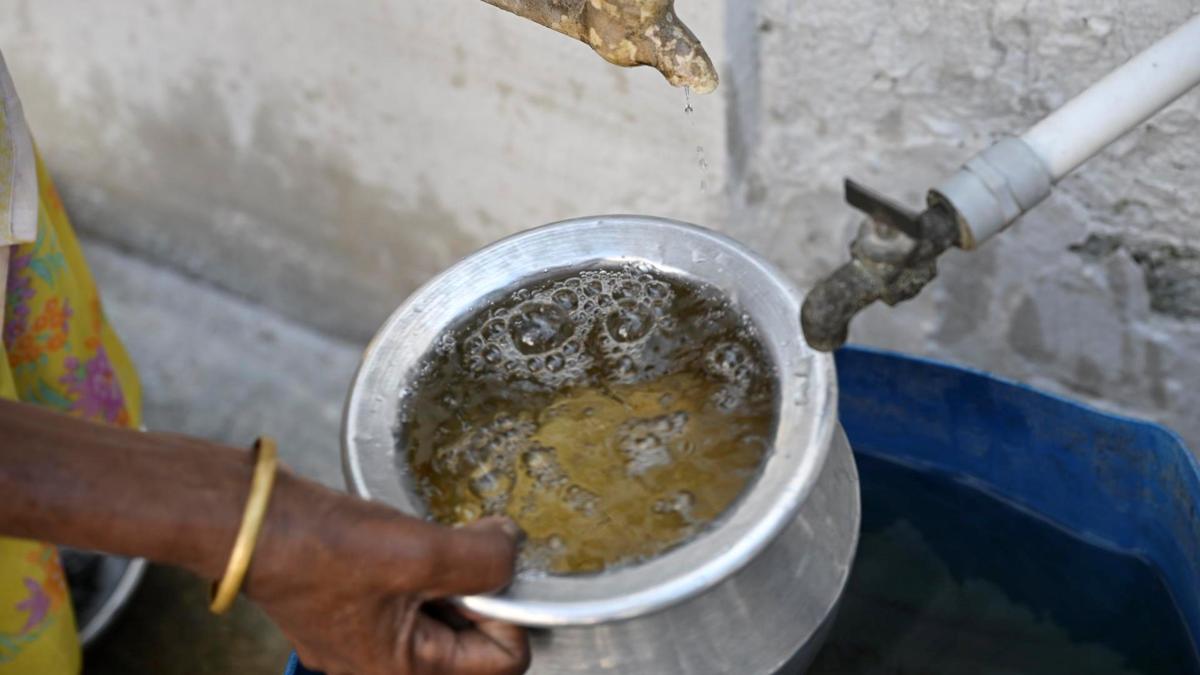
The latest official indication of the severity of the issue came from the TWAD Board. In a letter dated March 7, 2025, the Board informed the Chennimalai Block Development Officer that groundwater from 37 sources in 25 villages was unfit for drinking. The samples were collected from the Mukasi Pidariyur, Vaipadi, Varapalayam and Ingur village panchayats, from electric motor pumps, hand pumps, open wells and overhead tanks.

Tests found excessive levels of TDS, nitrate, iron and total hardness. TWAD directed the authorities to put up warning boards at the affected sources, prevent operation of electric motors, and ensure that residents used drinking water supplied through the Combined Water Supply Scheme.

A board declaring that well water is unfit for drinking was installed at a village located at the SIPCOT Industrial Growth Centre premises in Perundurai in Erode district in Tamil Nadu.
| Photo Credit:
M. Govarthan
The affected residents’ association says contamination has spread to groundwater within a radius of about 10 km from the industrial estate, affecting drinking water sources, livestock, and agriculture.
What is being done to provide safe drinking water?
Affected residents are supplied safe drinking water by pipelines and groundwater is used mainly for other domestic purposes. Following requests for increased supply, the district Collector S. Kandasamy directed TWAD officials to increase the duration of water supply to the affected villages. While this provides an immediate alternative, the larger challenge is to determine whether the affected groundwater and waterbodies can be restored.

What is the new CETP expected to do?
The State government sanctioned, through an order dated November 20, 2023, a 2,000-KLD Common Seepage Water Treatment Plant based on Zero Liquid Discharge (ZLD), with a hardness-removal facility, at an initial estimated cost of ₹40 crore. The proposal was subsequently modified into a Design, Build and Operate ZLD-based CETP with five years of operation and maintenance. A work order was issued in 2025 for ₹136.76 crore, and work commenced in February 2026.
The facility is intended to collect and treat contaminated seepage water on the estate premises and maximise recovery and reuse, reducing the possibility of polluted water entering drains and nearby waterbodies. Its effectiveness, however, will depend on proper collection of seepage, compliance by industries with treatment requirements and prevention of illegal discharge or bypassing of treatment systems.
What did the NGRI study examine?
The CSIR-National Geophysical Research Institute (NGRI), Hyderabad, conducted hydrogeological and geophysical investigations in 2019 to understand groundwater conditions in the industrial estate, including groundwater movement and areas affected by pollution.
According to the affected people’s association, NGRI drilled seven large borewells and 30 smaller borewells and used 14 existing open wells to collect groundwater samples. The association says an interim report was submitted, but the report was not made public. Mr. Chinnasamy says the findings could help establish groundwater-flow patterns, the extent of contamination and the remedial measures required. Making the complete scientific assessment available would provide a baseline against which future groundwater quality can be measured.
What is the way forward?
Commissioning the CETP is the immediate priority. But, its operation will require sustained monitoring. Industries must continue to operate the individual ETPs and route wastewater through approved treatment systems. The Tamil Nadu Pollution Control Board must regularly monitor compliance and take action against illegal discharge or bypassing of treatment systems.

The 37 groundwater sources identified by TWAD should also be tested periodically, with the results made public. The Association has suggested that 26 waterbodies around SIPCOT that were left out of the Athikadavu–Avinashi scheme are included in the scheme’s second phase. It believes an alternative water source could reduce dependence on groundwater and help the affected waterbodies recover. Mr. Chinnasamy has also suggested that SIPCOT could, in the long term, consider pumping groundwater from affected villages to a treatment facility and reuse it.
Published – September 22, 2026 03:51 pm IST