




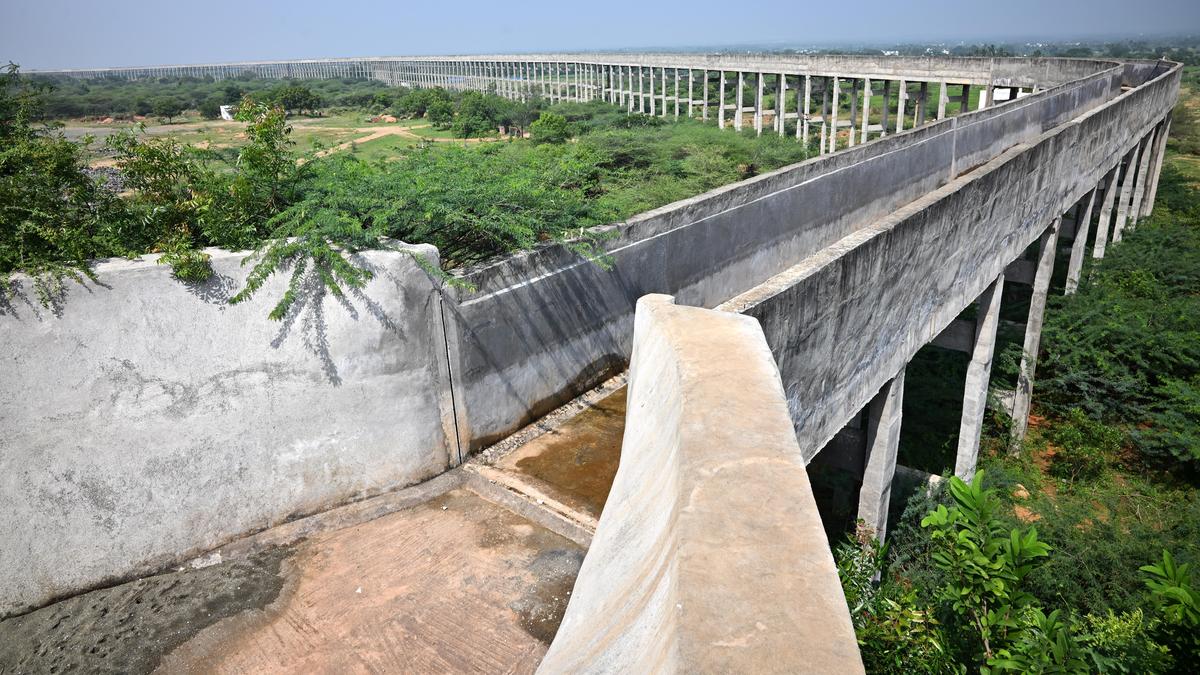


The zero point at Uthappanaickanur in Usilampatti where the 58-canal scheme branches off and supplies water to 58 villages remaining dry.
| Photo Credit:
R. ASHOK
After several years, water has been released into 58-canal scheme, a vital irrigation network benefitting 58 villages in the Usilampatti region, bringing short-term relief to farmers.
Yet, despite the long-awaited flow and repeated promises by politicians from AIADMK, DMK and other parties during every Assembly election, agricultural lands in Usilampatti remain dry.
The 58-canal scheme comprises three canals, including aqueducts, which stretches for 28 km. At the zero point in Uthappanaickanur, Usilampatti taluk, the main canal branches into two, distributing water to all 35 chain-linked tanks. However, despite the recent release from the Vaigai dam, most of these waterbodies remain dry, leaving farmers without much-needed irrigation.
The 58-canal scheme was envisaged to benefit around 2,500 acres of agricultural land with surplus water released from Vaigai dam.
According to officials of the Agriculture Department, villages located under Usilampatti block along the canal—such as Uthappanaickanur, Nadupatti, Kalluthu, Keeripatti and Thimmanatham—primarily cultivate paddy. In addition, farmers in the Usilampatti region raise horticultural crops, particularly vegetables, which are largely dependent on water from the 58-canal scheme.
Constructed in 1996 at a cost of ₹33 crore, 58-canal scheme was intended to provide irrigation to the Usilampatti region and adjoining villages by transfering water from Vaigai river basin to Gundar river basin.. However, Tamil Selvan, Vice-President of the Usilampatti Taluk 58 Villages Irrigation Farmers’ Association, says the canal has received water only a few times in nearly three decades.
According to Mr. Tamil Selvan, thousands of cultivators in the region have migrated to other States in search of work because of the uncertainty in irrigation. He added that several farmers in Usilampatti, who traditionally depended on river flows and expected regular water supply from 58-canal scheme, have now shifted to drip-irrigation systems and well irrigation.
“Though water was released in October this year, most tanks remain bone dry because only 150 cusecs was discharged from Vaigai dam. Therefore, flow reduces gradually and fails to reach the final stretches,” he said.
He further emphasises, “If we do not receive a consistent and adequate supply of water to the 58-canal scheme, we will have no choice but to refrain from participating in the upcoming Assembly election in 2026.”
O. Sivaprakasam, secretary of the Usilampatti Taluk 58 Villages Irrigation Farmers’ Association, said the existing Government Order of 58-canal scheme is ‘impractical,’ as it mandates that water be released only when the Vaigai dam reaches 68 feet and the traditional ayacuts are served by Periyar and Vaigai dams.
“Such levels are rarely achieved. Expecting the canal to benefit farmers under this condition is unrealistic,” he said.
He added that the canal receives only surplus floodwater, after allocations are made to all other irrigation systems, leaving the 58 villages dependent on an uncertain and irregular supply.
“This approach defeats the purpose for which the canal was built,” Mr. Sivaprakasam said.
He noted that while the 58-canal scheme project is officially recorded as having been constructed at a cost of ₹33 crore, the actual expenses were likely much higher. “What is the purpose of building a canal at such a high cost if it remains underutilised and provides no real benefit to the Usilampatti region?” he questioned.
Mr. Sivaprakasam stated that before each Assembly election, farmers consistently demand the regularisation of water supply through 58-canal scheme, and candidates often campaign with promises to address this issue. “However, despite these promises, no government has provided a long-term solution,” he says.
He also said that during a roadshow held by AIADMK general secretary Edappadi K. Palaniswami in Usilampatti in September, farmers had pressed their long-pending demands regarding 58-canal scheme, and Mr. Palaniswami assured that it would be resolved.
To improve water flow to the Usilampatti region, Mr. Tamil Selvan urged the government to lower the water release level for the canal from 68 feet to 60 feet. “Only then will the canal receive water regularly. Otherwise, agricultural conditions will continue to worsen, and residents may be forced to leave the area,” he stated.
P. Manikandan, president of the Madurai District Wet and Dry Land Farmers’ Association, said nearly 25,000 acres of agricultural land in and around Madurai have been converted into residential plots over the years.
“Given these changes, officials must undertake a fresh resurvey of the region, reassess the condition of existing waterbodies, and release water based on the present ground condition. Only then can the surplus water diverted to 58-canal scheme effectively reach the intended areas and truly benefit farmers,” he said.
When asked about the reduced discharge of 150 cusecs from the Vaigai dam into 58-canal scheme, an official from the Water Resources Department (WRD) said the canal’s alignment posed challenges.
“This 28-km-long canal largely runs along the foothills, and hence, periodic maintenance is difficult. Several bunds have been damaged, and because of this, we are unable to release the required 316 cusecs,” the official said.
He added that repair works of the bunds are currently under way but involve multiple procedures and clearances. “Once the damaged bunds are restored, we expect to release the required water. From next year, we hope to discharge 316 cusecs, ensuring that all 35 tanks in the Usilampatti region receive water,” he said.
When asked about the demand to lower the sluice located at 67 feet in Vaigai dam through which water is released to the 58-canal scheme to 60 feet, the official said, “Usilampatti is a high terrain region, and the 67-feet level was fixed based on this topography to ensure adequate flow into 58-canal scheme. Lowering the level is complicated as the scheme has been designed only as a flood-carrier through which only surplus floodwater could be diverted.”
When asked about the need for a new land survey, the official explained that the process would be extensive. “This survey would need to cover five districts: Madurai, Dindigul, Sivaganga, Ramanathapuram, and Theni. Additionally, this procedure comes under the jurisdiction of the Revenue Department and requires significant policy decisions. It is a complex and tedious process,” the official stated.
He added that the recent spell of rainfall, coupled with the latest release into 58-canal scheme, has helped improve groundwater levels in parts of the region.
Farmers are hopeful that continuous attention to the 58-canal scheme will restore the region’s irrigation system.
With election to the Tamil Nadu Assembly fast approaching, the farmers in this region are likely to make it a poll issue and get promises from the contesting parties and their candidates. Whether the promise would be kept or broken would be known soon, farmers added.