






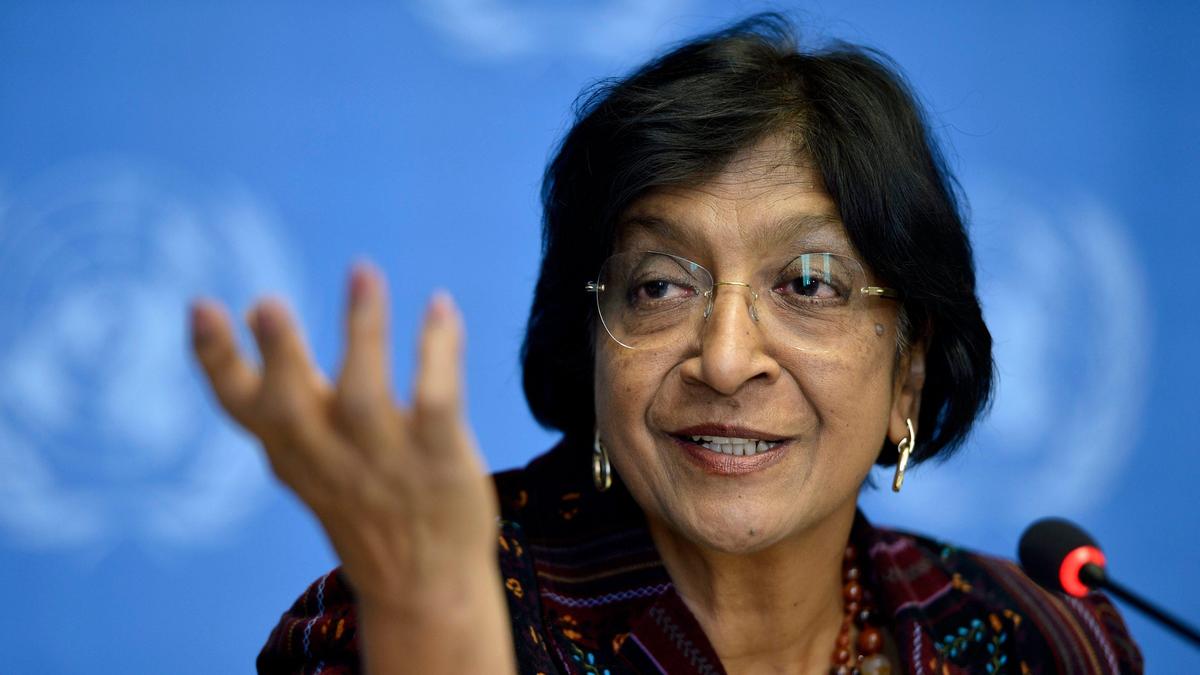


Navanethem ‘Navi’ Pillay. File
| Photo Credit: AP
Navanethem ‘Navi’ Pillay, a South African jurist of Indian origin and a former ICC judge, won the Nobel Peace Prize on Friday (October 9, 2026) “for her efforts to promote peace and international law”.
The Norwegian Nobel Committee praised the 85-year-old Justice Pillay’s commitment to universal legal principles and said she had held states and national leaders accountable while bringing hope to victims of violence and conflict. The Committee described her as one of the most respected international jurists of her time.
Here are five facts about the 2026 Nobel peace prize winner Navanethem ‘Navi’ Pillay
1. Navanethem ‘Navi’ Pillay: South African jurist of Tamil descent
Navanethem ‘Navi’ Pillay was born on September 23, 1941, in apartheid-era South Africa to Indian parents of Tamil descent. Justice Pillay grew up under apartheid and went on to build a career challenging racial discrimination, defending anti-apartheid activists and advancing human rights and equality.

As per a PTI report, which cited a biographical profile published by the Institute for African Women in Law, Justice Pillay’s father was a bus driver who worked multiple jobs to support the family, while her mother looked after their eight children. Despite financial hardship, her parents placed a strong emphasis on education and ensured that their daughters, like their sons, should be educated.
2. First non-white woman judge of South Africa’s High Court
Justice Pillay received her BA and LLB degrees from the University of Natal. In later years, she also earned a Master of Law and a doctorate from Harvard University. In 1967, Justice Pillay became the first woman to start a law practice in Natal, her home province. She is also the first non-white woman to serve on South Africa’s High Court.
Her early years saw her defending anti-apartheid activists and advocating for prisoners’ rights. In 1973, she helped secure the right of political prisoners to access legal counsel and basic amenities, for prisoners on Robben Island in 1973.
3. ICC judge, UN High Commissioner for Human Rights
Her career later took her to the International Criminal Tribunal for Rwanda. In 2003, Justice Pillay was appointed as a judge on the International Criminal Court (ICC) in Hague, where she served until August 2008. She became the UN High Commissioner for Human Rights and served a six-year term, from 2008 until 2014.
Justice Pillay is a judge on the International Court of Justice in the case where Myanmar stands accused of genocide.

4. Led UN Commission of Inquiry on Palestine
Justice Pillay also chaired the the Independent International Commission of Inquiry on the Occupied Palestinian Territory, which was established by the UN Human Rights Council in 2021. In September 2025, the Commission concluded that Israel has committed genocide in Gaza. Israel dismissed the report as “scandalous”.
5. Stood up for women’s rights
Justice Pillay has worked for the rights of women and children, and victims of domestic violence. As a member of the Women’s National Coalition, she contributed to the cause of gender equality in South Africa. She pushed for the inclusion of the clause prohibiting discrimination on the grounds of race, religious, sex or sexual orientation in the country’s constitution.
Alongside Jessica Neuwirth and Feryal Gharahi, she also co-founded Equality Now in 1992, which works to advance women’s legal rights and challenge discriminatory laws and practices.
The Nobel Peace Prize, worth about $1.2 million, is due to be presented in Oslo on December 10.
Published – October 09, 2026 07:57 pm IST