




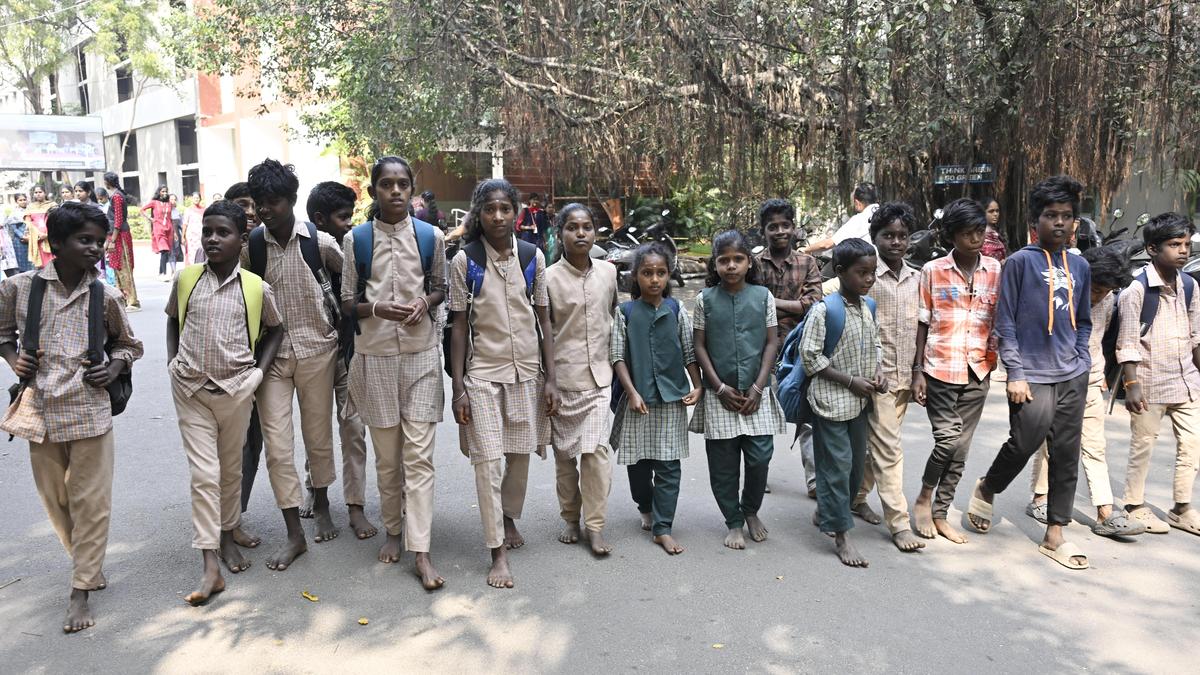

In an effort to address the persistent problem of school dropouts in the hill areas of the district, 18 tribal children from Bargur hills, who had remained out of school for several months, began a two-day residential catch-up camp here on Tuesday (February 10, 2026).
The initiative aims to sensitise the children on the importance of education and facilitate their reintegration into mainstream schooling. The programme, titled “My Dream, My Education”, is being organised by the Tribal Welfare Centre (TWC) of Vellalar College for Women and the NGO Management Club of VET Institute of Arts and Science, in association with SUDAR, a non-governmental organisation.
The participating boys and girls were brought to the college campus. On the first day, they were taken on a tour of the campus, engaged in games and storytelling sessions, and interacted with faculty members and students.
Addressing the children, S.D. Chandrasekar, Secretary, Vellalar College for Women; E. Manvizhi, Chief Educaitonal Officer, K. Maheswari, District Officer, Adi Dravidar and Tribal Welfare Department; Principals R. Parvathi and V.P. Nallaswamy; A. Vanitha, Coordinator, TWC; and SUDAR Director S.C. Nataraj emphasised the role of education in shaping their future.
On Wednesday (February 11, 2026), under the theme “Around the City: To Learn and Lead”, the children will visit the STEM Park, a railway station, and the Vellode Bird Sanctuary, besides interacting with the District Collector. Organisers said the visit was designed to broaden the children’s understanding of the world beyond their villages. Except for a few, most of the children are stepping out of their hamlets for the first time.
Mr. Nataraj told The Hindu that more than 60 children had dropped out of school in the West Bargur Hills, including hamlets such as Kongadai, Oosur, Onnakarai, Kovilnatham, Agnipavi, Periya Sengulam, and Chinna Sengulam. However, the NGO was able to trace and bring only 18 children, who had been studying in Classes III to XI before discontinuing their education.
He said many children accompany their parents who migrate seasonally to the plains for sugarcane cutting. Others stay back to tend cattle when their parents camp for months at Boli hillock, located deep inside the forest, to collect korai grass. Prolonged absence from school often leads to permanent discontinuation of education.
Mr. Nataraj said the rate of school dropouts in the hill areas was rising alarmingly, turning into a major social issue despite the implementation of government welfare schemes. “According to the 2011 Census, the literacy rate among Scheduled Tribes stands at only 54%,” he said. Of the 14 blocks in the district, Sathyamangalam, Thalavadi, Nambiyur, Anthiyur, and Ammapettai remain educationally backward, despite the implementation of schemes such as the Right to Education Act, Sarva Shiksha Abhiyan, Pudhumai Penn Scheme, and Tamil Pudhalvan Scheme.
“In hill villages across Anthiyur and Sathyamangalam blocks, more than a hundred school-age children have dropped out midway, directly contributing to an increase in child labour and child marriages,” he said.
Mr. Nataraj also noted that the National Child Labour Project (NCLP), under which special schools for child labourers functioned for over two decades, was discontinued by the Central Government in 2022, while Karnataka introduced a State Child Labour Project (SCLP) in 2023. The Right of Children to Free and Compulsory Education Act, 2009, declares education a fundamental right, he said, adding that the situation underscored the need for focused monitoring, region-specific interventions, and sustained government support in hill regions.
Published – February 10, 2026 06:48 pm IST